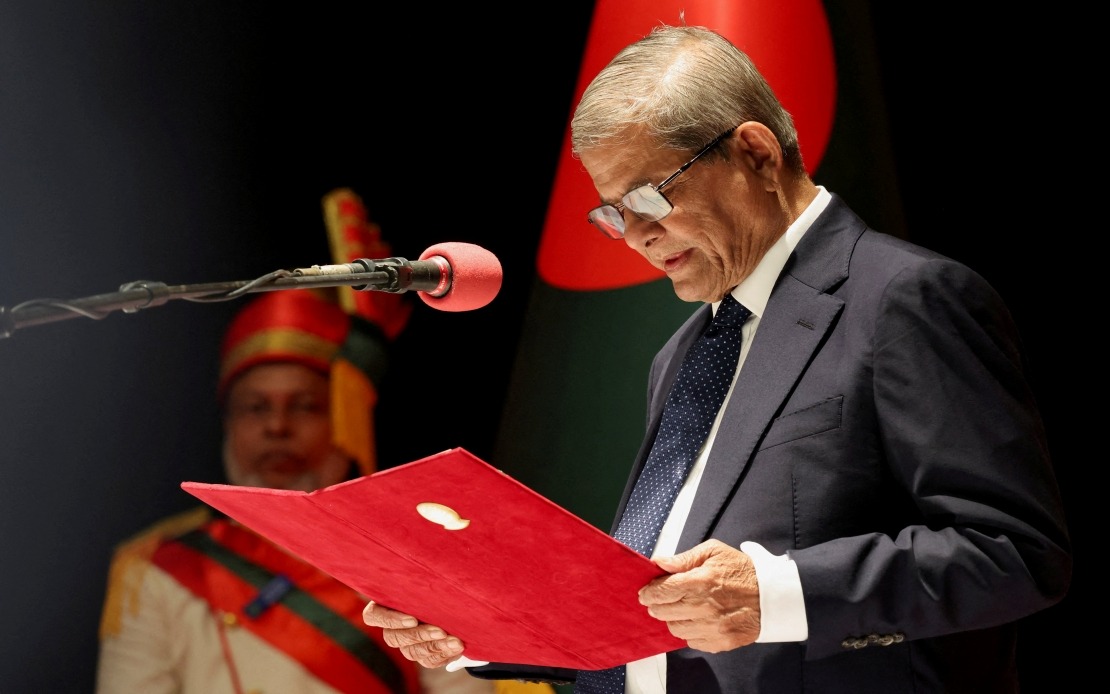
Mirza Fakhrul Islam Alamgir formally assumed office as Bangladesh's 23rd President on Friday evening, taking the oath at an official ceremony held in Bangabhaban's Darbar Hall. The swearing-in represents a pivotal moment for the nation as it transitions leadership following recent political developments that have reshaped the country's governing structure.
The ceremony, which took place at 7.30 pm local time, featured Acting Speaker Barrister Kayser Kamal administering the constitutional oath. The proceedings followed established protocols with Fakhrul receiving a formal welcome from senior government officials upon his arrival at the presidential residence, followed by acknowledgment from outgoing Acting President Hafiz Uddin Ahmad Bir Bikram. The exchange symbolised the orderly transfer of executive authority in accordance with Bangladesh's constitutional framework.
The inauguration drew attendance from the nation's highest-ranking officials and representatives, underscoring the ceremony's constitutional significance. Prime Minister Tarique Rahman, the chief justice, cabinet members, members of parliament, and senior civil and military officials were all present. The presence of foreign diplomats also highlighted Bangladesh's international standing and the global dimension of the leadership transition. The breadth of attendance demonstrated broad institutional acknowledgment of the new presidency across government, judiciary, and diplomatic circles.
Fakhrul's election to the presidency by members of parliament represents recognition of his extensive experience within Bangladesh's political landscape. He previously served as secretary-general of the Bangladesh Nationalist Party (BNP), one of the country's two major political formations, positioning him as a figure with deep roots in the nation's political establishment. His ascension to the ceremonial head of state office comes at a time when Bangladesh is navigating significant constitutional and governance questions following recent political upheaval.
The formal transfer of office unfolded through symbolic gestures embedded in Bangladesh's constitutional traditions. Following the oath administration, Fakhrul and the outgoing acting president exchanged their official seats, a gesture that carries constitutional weight in signifying the completion of the transition. He subsequently signed both the oath of office and the oath of secrecy, documents that bind the president to constitutional duties and confidentiality requirements inherent to the position.
The ceremony concluded with the playing of the national anthem, providing ceremonial closure to the proceedings. This formal conclusion underscored the presidency's role as a constitutionally-grounded institution rather than merely a political appointment. For regional observers, including those in Malaysia and other Southeast Asian nations, the orderly nature of the transition demonstrates institutional continuity despite the turbulent political circumstances that preceded it.
Fakhrul's appointment occurs within the context of Bangladesh's broader constitutional architecture, where the presidency operates within a parliamentary system. While the position carries ceremonial and constitutional significance, executive authority rests with the Prime Minister and cabinet. This distinction is important for understanding how presidential transitions fit within Bangladesh's overall governance structure and how Fakhrul's election shapes the nation's political dynamics without fundamentally altering executive power structures.
The timing of this transition carries implications for regional stability in South Asia and Southeast Asia's extended strategic environment. Bangladesh's political stability has long been central to regional prosperity and security, given the nation's geographic position, significant population, and economic importance. Leadership continuity at the highest constitutional level provides reassurance to both domestic stakeholders and international partners about institutional resilience and governance predictability.
For Malaysian observers and policymakers, Bangladesh's successful navigation of this presidential transition offers insights into how major regional democracies manage constitutional processes during periods of political flux. The inclusion of diverse institutional representatives—from the military to the judiciary to parliament—reflects how institutions can collectively sustain constitutional governance even during challenging political circumstances. This becomes particularly relevant as Malaysia itself periodically navigates leadership transitions and constitutional processes.
The election of Fakhrul specifically reflects Bangladesh's political landscape, where the BNP represents one pole of the nation's bipolar political system anchored by competition with the Awami League. His ascension to the presidency, despite the ceremonial nature of the office, carries symbolic weight regarding which political forces currently command institutional authority. The composition of those attending his swearing-in ceremony—particularly Prime Minister Tarique Rahman's presence—illuminates the current distribution of political power within Bangladesh's governing structure.
Looking forward, Fakhrul's tenure as president will likely focus on fulfilling the ceremonial and constitutional duties inherent to the office while navigating the symbolic dimensions of Bangladesh's current political moment. As head of state, he becomes the living embodiment of constitutional continuity and national unity, responsibilities that extend beyond partisan political considerations. His experience within the BNP provides him with political wisdom and institutional knowledge that may inform his approach to the presidency's ceremonial dimensions.
The successful completion of this presidential transition suggests that despite significant recent political turbulence, Bangladesh's constitutional institutions retain capacity to function according to established procedures and legal frameworks. For a nation of over 170 million people with considerable geopolitical importance, such institutional functionality carries implications extending well beyond Bangladesh's borders. The transition also underscores how parliamentary democracies can manage leadership changes through constitutional means even when broader political circumstances remain contested.

