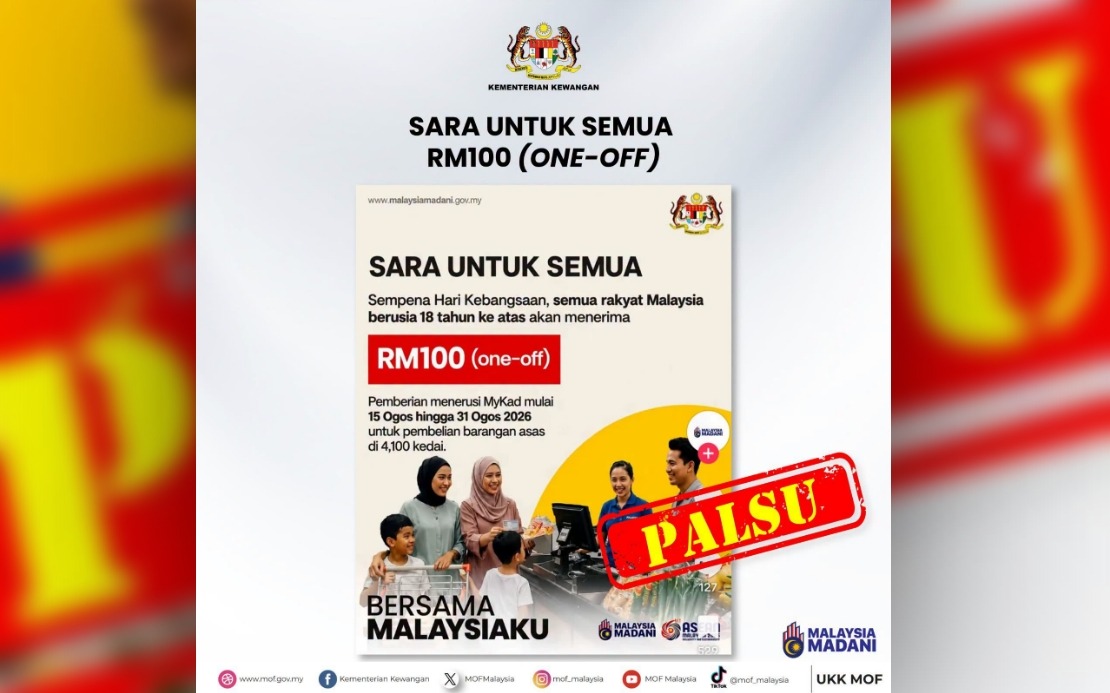
Authorities in Malaysia moved swiftly to counter misinformation spreading across social media platforms when the Ministry of Finance issued a categorical denial on August 5 regarding an alleged RM100 Sumbangan Asas Rahmah (SARA) payment purportedly tied to the nation's National Day celebrations. The ministry's intervention underscores the persistent challenge Malaysian officials face in combating false claims that gain rapid traction online, particularly when promises of direct cash transfers are involved.
The circulating poster falsely suggested that all citizens aged 18 years and above would receive a one-time RM100 grant as part of National Day festivities. Such claims have proven especially potent in Malaysia's digital information ecosystem, where promises of government assistance frequently achieve viral status despite lacking any basis in official policy announcements. The ministry's social media statement made clear that no such initiative had been authorised or announced through legitimate government channels, and categorically rejected the narrative presented in the misleading material.
The timing of this misinformation episode reflects a broader pattern in Malaysia's political communication landscape. The period surrounding major national occasions often witnesses surges in rumour-mongering about special payments, relief measures, or announcements. This latest incident demonstrates how rapidly unverified claims can propagate through messaging applications and social platforms, potentially reaching millions of citizens before fact-checking mechanisms engage.
Official guidance issued by the Finance Ministry emphasised that citizens should exclusively rely on verified information distributed through the ministry's authorised communication channels. This advisory reflects genuine concern about the societal impact of false financial promises, which can distract public attention from legitimate government initiatives and erode institutional credibility over time. The ministry's statement represented an unusually direct public intervention, suggesting officials recognised the need for immediate clarification to prevent further spread of the misleading narrative.
For Malaysian households, particularly lower-income groups who might be most vulnerable to such claims, distinguishing genuine assistance programmes from fabricated ones has become increasingly challenging. The existence of legitimate schemes like SARA itself—a real assistance initiative providing targeted support to specific populations—creates fertile ground for fraudulent claims that exploit public familiarity with genuine government programmes. Scammers and bad-faith actors understand that fabricating extensions or variations of real programmes increases the likelihood of their false claims gaining credence.
The phenomenon of viral false payment claims extends beyond Malaysia but has particular resonance within the Southeast Asian context. Across the region, governments struggle with rapid dissemination of misinformation through encrypted messaging platforms and social networks, where official channels struggle to match the reach and speed of rumour networks. The decentralised nature of these digital ecosystems makes comprehensive counter-messaging difficult, even for well-resourced government communications apparatus.
From a policy perspective, this incident highlights the necessity for Malaysian authorities to develop more sophisticated strategies for rapid fact-checking and public communication. Waiting for false claims to achieve maximum spread before responding, as appeared to happen in this case, means the misinformation has already reached significant portions of the population. Proactive communication about scheduled announcements or deliberate clarifications issued before rumours begin might prove more effective than reactive denials.
The incident also raises questions about how such fabricated posters originate and circulate. Whether motivated by political gain, financial scams targeting gullible recipients, or simple malicious intent, the sources of coordinated misinformation campaigns warrant closer examination. Understanding who benefits from confusion about government assistance programmes could help authorities target interventions more precisely and identify recurring patterns in disinformation tactics.
Citizens seeking information about legitimate government assistance should verify details through official ministry websites, press releases issued through Bernama (the national news agency), or communications from relevant federal and state agencies. The Finance Ministry explicitly recommended this approach as the only reliable method for distinguishing genuine policy announcements from fraudulent claims. In an era of sophisticated digital manipulation, including convincing-looking fake government graphics and fabricated announcements, institutional verification represents the most dependable safeguard against deception.
The broader implication for Malaysian society involves the ongoing challenge of maintaining information integrity across digital platforms where misinformation spreads exponentially faster than factual correction. Building public media literacy—teaching citizens to question extraordinary claims, verify sources, and consult official channels—represents a long-term solution complementing government fact-checking efforts. This latest episode serves as a timely reminder that digital sophistication and critical thinking remain essential skills for navigating Malaysia's complex contemporary information landscape.

