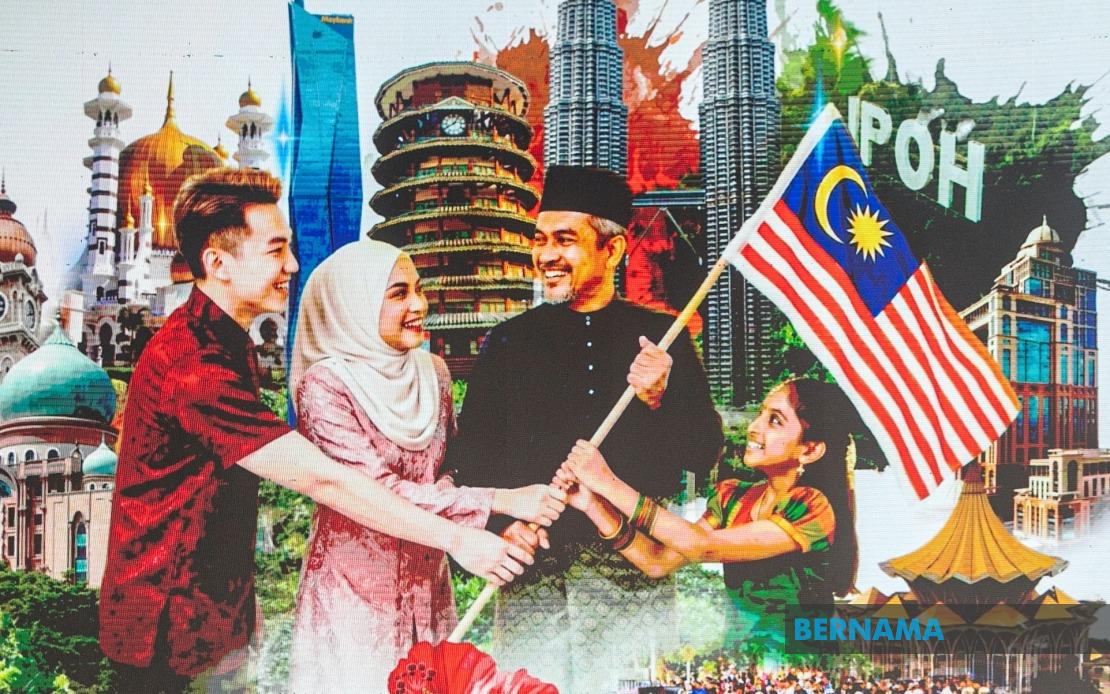
Communications Minister Datuk Seri Fahmi Fadzil has issued a timely advisory regarding the use of artificial intelligence in creating content centred on the Jalur Gemilang, emphasising the importance of maintaining the flag's integrity and accurate representation as Malaysia prepares for its 2026 National Month and Malaysia Day celebrations. The caution comes at the official launch of the 2026 National Month and Fly the Jalur Gemilang campaign held in Ipoh, where Prime Minister Datuk Seri Anwar Ibrahim officiated the event at the Sultan Azlan Shah Ministry of Health Training Institute.
The core concern raised by Fahmi centres on the technical limitations of current AI systems when tasked with reproducing the national flag's distinctive visual elements. The Jalur Gemilang's 14 stripes represent a defining characteristic that carries significant national symbolism, and the minister stressed that content creators must remain vigilant to ensure these fundamental design features are not compromised when utilising generative AI tools. This concern reflects a broader emerging challenge across Southeast Asia, where rapid AI adoption has outpaced regulatory frameworks and public awareness of potential accuracy issues in culturally sensitive applications.
The minister's warning acknowledges a paradox of modern content creation: while AI technology can dramatically accelerate production and democratise creative output, it simultaneously introduces new vulnerabilities where errors may propagate at scale before detection. The specificity of Fahmi's emphasis on the 14 stripes suggests that instances of inaccurate AI-generated flag representations may already have surfaced, prompting the ministry to take preventive action. This proactive approach differs markedly from purely reactive enforcement and reflects lessons learned from similar issues across other nations grappling with AI-generated cultural and national symbols.
Fahmi articulated a collaborative strategy involving key media stakeholders to address this challenge throughout National Month. The Communications Ministry plans to work closely with the Malaysian Press Institute and the Malaysian Media Council to engage media organisations and ensure that all Jalur Gemilang representations, particularly those produced through AI systems, maintain strict accuracy standards. This partnership model extends responsibility beyond the government to industry bodies, distributing the burden of quality assurance across the media ecosystem and potentially establishing self-regulatory mechanisms within newsrooms and content agencies.
When asked about enforcement mechanisms, Fahmi outlined a graduated response framework that prioritises education and correction over immediate punitive measures. The ministry's initial approach will involve advisory communications to individuals or organisations who have generated or displayed incorrect flag imagery, requesting voluntary rectification. This soft-touch methodology recognises that most errors likely stem from technological limitation rather than malicious intent, and that correcting them quickly and collaboratively serves the national interest better than adversarial legal proceedings. The minister indicated that specific legislation exists governing flag representation, but the government wishes to avoid triggering those statutory provisions unless advisory approaches prove ineffective.
The 2026 celebrations mark a significant moment for Malaysia's patriotic expression, with National Day to be held in Putrajaya and Malaysia Day celebrations taking place in Sarawak, locations chosen to emphasise national unity and regional representation. The Fly the Jalur Gemilang campaign itself represents an ambitious initiative to encourage citizens to display the national flag from July through at least September 16, transforming residential areas, villages, and government premises into visual expressions of national pride. However, the proliferation of AI-generated flag imagery during this period could inadvertently undermine these patriotic aims if technical errors go unchecked.
The emergence of this issue highlights a subtle but consequential gap between technological capability and cultural appropriateness in Malaysia's digital landscape. While AI content generation tools have become increasingly accessible to ordinary Malaysians, their training datasets and algorithmic approaches were developed primarily in Western contexts with limited exposure to non-Western national symbols and their cultural significance. The Jalur Gemilang, with its specific geometric proportions and stripe count, presents exactly the type of detailed visual specification that generative AI systems sometimes struggle to reproduce consistently, particularly when these elements lack prominence in the training data.
For Malaysian media organisations and content creators, Fahmi's guidance establishes a new baseline of responsibility regarding AI-generated national imagery. Rather than treating AI tools as black boxes that automatically produce acceptable output, media outlets must implement verification procedures and potentially establish internal review processes before publishing flag-related content. This has practical implications for news agencies, government communications departments, and the broader social media ecosystem, where AI image generators are increasingly deployed for rapid content creation. The advisory essentially asks stakeholders to treat the Jalur Gemilang with the same care they would apply to other constitutionally protected symbols.
The minister's statement also reflects broader concerns about AI governance in Malaysia, a nation that has positioned itself as a regional technology hub yet faces questions about how to manage emerging AI risks. The flag issue, while specific, exemplifies wider challenges: how can Malaysia harness AI's productivity benefits while protecting cultural, constitutional, and national interests? The Communications Ministry's collaborative approach with press institutes and media councils suggests that Malaysia may be gravitating toward industry partnership models rather than heavy-handed regulation, at least in this initial phase of AI integration into mainstream content production.
Looking beyond 2026, this initiative may establish precedent for how Malaysia addresses AI-related cultural and symbolic issues. The successful coordination between government ministries and media bodies could serve as a template for addressing similar concerns in other domains, from the proper representation of state emblems to the handling of culturally sensitive historical narratives. As AI tools become further embedded in Malaysian newsrooms, marketing agencies, and citizen journalism, establishing clear expectations about accuracy and cultural sensitivity early may prevent more serious misrepresentations later.
The practical challenge for ordinary users and content creators lies in verifying AI output before publication or sharing. While the minister has not prescribed specific verification methodologies, the implicit recommendation is that human review should remain an essential step in any content pipeline involving national symbols. This reassertion of human responsibility in an age of automated content generation carries broader implications for media literacy and professional standards across Malaysia's increasingly digital creative sector.

