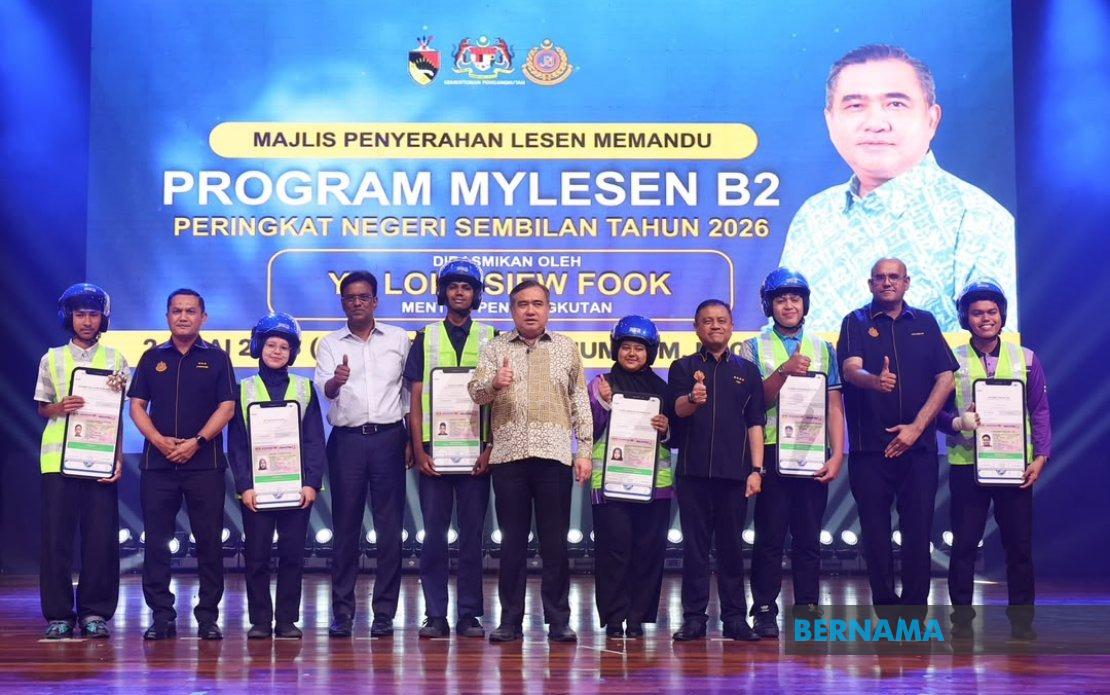
Transport Minister Anthony Loke delivered a stern message to young Malaysians receiving motorcycle licences under the MyLesen B2 Programme, cautioning them that the credential they obtain is fundamentally a mark of responsibility rather than a licence for reckless behaviour. Speaking at the programme's Negeri Sembilan presentation ceremony in Seremban on July 2, Loke stressed that recipients must understand the gravity of operating a motorcycle on public roads and the legal obligations that accompany their new riding privileges.
The minister grounded his appeal in sobering statistics about motorcycle safety in Malaysia. Approximately 60 per cent of all recorded road fatalities annually involve motorcyclists and pillion riders, with the demographic skew proving particularly troubling—the majority of victims fall below 30 years of age. This concentration of deaths among younger road users underscores why Loke's intervention carries such weight, addressing a cohort that statistically faces the highest risk on Malaysian highways and urban streets.
Loke framed the MyLesen B2 initiative as a government gesture of trust and opportunity, not privilege without constraint. The licences are distributed at no cost to qualified participants, removing financial barriers to legal motorcycle operation and enabling young Malaysians to commute safely to educational institutions and workplaces. However, this accessibility comes paired with an unambiguous expectation: recipients must demonstrate maturity by rejecting the temptation to misuse their mobility for thrill-seeking or illegal street racing activities, particularly during weekend periods when enforcement pressures are historically lower.
The Negeri Sembilan contingent represents significant growth in the programme's reach. The state's allocation has nearly tripled from 1,000 to 2,300 participants this year, reflecting accelerating national interest. As of the ceremony date, 1,979 individuals had secured their Learner's Driving Licence, with 1,879 advancing to pass competency assessments and obtain their Probationary Driving Licence. These figures demonstrate the programme's substantial penetration into Malaysia's youth mobility landscape.
Since its inception in 2023, the MyLesen B2 scheme has distributed licences to more than 100,000 Malaysians, establishing itself as a cornerstone government initiative for expanding lawful road access. Beyond the immediate benefit of permitting motorcycle operation, the programme addresses deeper socioeconomic objectives. Reliable personal mobility opens pathways to employment opportunities previously inaccessible to unlicensed riders, facilitates participation in tertiary education across different geographic regions, and contributes to individuals' capacity to improve their overall socioeconomic circumstances through legal and regulated means.
Loke's warnings about illegal racing took on added legislative weight following recent parliamentary action. The Dewan Rakyat has now passed the Road Transport (Amendment) Bill 2026, which substantially tightens penalties for illegal racing and speed testing across all vehicle categories. The legislative response escalates consequences beyond traditional financial penalties—offenders now face potential imprisonment for participation in street racing activities. This hardened legal stance signals government determination to dismantle the informal racing culture that has periodically emerged among young motorcyclists in urban areas, particularly around Klang Valley and other metropolitan zones.
The Transport Ministry and Road Transport Department jointly pledged ongoing commitment to strengthening the MyLesen B2 framework as a cornerstone of Malaysia's road safety strategy. Rather than viewing the programme as a one-time initiative, both organisations characterise it as an evolving component of a broader ecosystem designed to enhance mobility access while systematically improving road safety outcomes. This dual commitment reflects recognition that expanding licences without simultaneously advancing safety culture would prove counterproductive.
Equally critical to Loke's message was emphasis on protective equipment standards. New licence holders received explicit instruction to wear only SIRIM-certified helmets when operating motorcycles or travelling as pillion passengers. This specification matters considerably—substandard or counterfeit helmets proliferate in Malaysian markets, offering false security while providing minimal actual protection during collisions. Enforcement of helmet certification standards remains inconsistent across enforcement agencies, making ministerial reinforcement of this requirement particularly valuable for audience members who may otherwise assume any helmet provides adequate protection.
The ceremony itself drew participation from significant government figures including Transport Ministry Secretary-General Datuk Seri Jana Santhiran Muniyan, Road Transport Department Director-General Datuk Aedy Fadly Ramli, and other senior transport officials. This high-level attendance underscored the programme's priority status within Malaysia's transport policy architecture and signalled that government takes motorcycle safety seriously beyond rhetoric.
For Malaysian readers and policymakers, Loke's intervention highlights the evolving tension between expanding mobility access and containing safety risks. The MyLesen B2 scheme represents genuine commitment to removing licensing barriers for young Malaysians, yet this democratisation of motorcycle access creates corresponding obligations for recipients to demonstrate responsibility. As the programme scales nationally with quotas expanding across all states, the cultural messaging around safe riding becomes increasingly consequential. Young riders receiving licences today will establish behavioural norms influencing peers and younger cohorts entering the road system over subsequent years, meaning the safety culture embedded in early licence-holding experiences carries implications extending well beyond individual recipients.
The legislative response embodied in the Road Transport (Amendment) Bill 2026 suggests recognition that exhortation alone proves insufficient—legal consequences must accompany messaging to achieve meaningful behaviour modification. Street racing, particularly among young motorcyclists, has evolved into a multifaceted social phenomenon in Malaysian urban contexts, intertwined with identity formation and peer group dynamics that simple warnings cannot fully counter. The combination of expanded access through MyLesen B2, enhanced penalties through updated legislation, and emphasised safety protocols represents a more comprehensive policy response than any single intervention could achieve.

