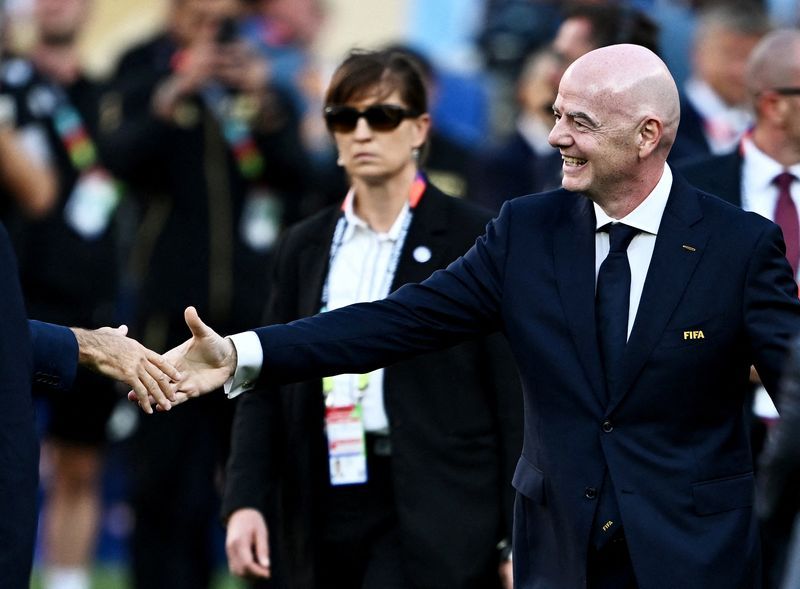
Gianni Infantino's grip on the FIFA presidency faces its most serious challenge yet as global football fractures into competing camps over a controversial proposal to monetise World Cup commercial rights. Despite the mounting pressure, Mexico and Argentina have moved to shore up the Swiss administrator's position, creating a patchwork of support and opposition that exposes fundamental tensions within international football governance.
The Mexican Football Federation (FMF), which co-hosted the 2022 World Cup alongside the United States and Canada, has broken ranks with its continental governing body CONCACAF by publicly endorsing Infantino. This decision represents a significant split within North American football politics, as CONCACAF itself has demanded a comprehensive reassessment of Infantino's leadership. Mexico's federation issued a forceful statement declaring it would not recognise any process to remove Infantino that bypassed formal institutional procedures involving all 211 FIFA member associations. The declaration signals that Mexico views threats to FIFA's constitutional order as potentially more destabilising than the missteps that prompted the current crisis.
Argentina, the defending World Cup champion and one of football's traditional powerhouses, has similarly rallied behind Infantino through a letter from its football association (AFA) to the FIFA president. While Argentina's statement acknowledged that the ill-fated commercial proposal generated more uncertainty than confidence and that procedural errors had occurred, the AFA framed continued support for FIFA's leadership as essential to institutional stability. The letter praised a decade of development work and highlighted governance reforms implemented more than ten years ago designed to promote transparency and institutional strength. This endorsement carries particular weight given Argentina's influence within South American football and its status as a recent World Cup victor.
The regional confederations have, however, adopted markedly different stances. South America's CONMEBOL issued a statement Thursday rejecting any attempt to unseat Infantino without a full membership vote, effectively supporting the procedural protections that favour the incumbent. Africa's confederation (CAF) unanimously backed Infantino's leadership the same day, providing the FIFA president with substantial support from the continent with the most member nations. These developments suggest that the Global South, a crucial voting bloc within FIFA, remains largely supportive of Infantino despite the governance failures that triggered the crisis.
Europe, by contrast, has adopted a confrontational posture. UEFA has committed to boycotting FIFA competitions if Infantino remains in power, an extraordinary move that threatens to splinter world football along continental lines. Asia's confederation stated it stands in solidarity with UEFA and CONCACAF, further isolating Infantino among the wealthy, developed football economies. This geographic division reveals a critical faultline in FIFA's structure: poorer nations dependent on FIFA development funding and World Cup opportunities appear more willing to forgive governance lapses, while richer confederations with greater institutional autonomy demand accountability.
The immediate trigger for this leadership crisis was Infantino's now-abandoned proposal to sell portions of World Cup commercial broadcasting rights to private investors. FIFA issued an apology at a meeting in Rabat this week, acknowledging mistakes in how the proposal was developed and communicated to members. The federation pledged to undertake a comprehensive review of the processes that produced the failed initiative, an implicit admission that unilateral decision-making bypassed established consultation mechanisms. Yet even this mea culpa has not satisfied all critics. FIFPRO, the global players' union, characterised Infantino's actions as a profound abuse of presidential power that transcended mere procedural bungling.
The timing of this crisis could not be more consequential for Infantino's political future. His reelection as FIFA president is scheduled for the FIFA Congress in Morocco in March, a vote that appeared inevitable just two months ago. The collapse of the commercial rights proposal and the subsequent backlash have transformed that race into a genuinely contested election for the first time in Infantino's tenure. Yet despite the ferocity of the criticism and the breadth of opposition ranged against him, no credible candidate has emerged to challenge Infantino's reelection bid. This absence of a viable alternative suggests that even his detractors may view him as preferable to the uncertainty of a contested succession process.
Croatia's football federation became one of the first individual national associations to withdraw support for Infantino, citing the need to reassess in light of recent developments and governance body discussions. England and Albania had previously withdrawn support. These defections, though meaningful, represent a smaller political threat than withdrawal by major confederations would entail. The federation-by-federation approach to undermining Infantino lacks the coordinated force that a unified European or intercontinental stand would carry. This fragmentation may actually work in Infantino's favour by preventing a unified opposition movement from coalescing around an alternative candidate.
FIFA's response to criticism has emphasised that all decisions regarding the commercial proposal complied with existing regulations and that the failures were primarily communicative and procedural rather than substantive violations of governance standards. This legalistic defence may provide Infantino with sufficient institutional cover to survive the March Congress vote, particularly given the continued backing of African and South American confederations representing the majority of FIFA's membership. The critical question now is whether Infantino can restore sufficient confidence among sceptical federations to secure comfortable reelection, or whether he will limp into a second successive term with substantially diminished political authority and credibility.
The divisions now apparent within world football highlight a fundamental governance challenge: FIFA's structure gives voting power to developing nations with fewer resources to scrutinise executive decisions, while the wealthier confederations lack sufficient institutional leverage to enforce accountability. This asymmetry allowed Infantino to pursue the commercial rights proposal with relatively limited consultation, but it may ultimately prove his salvation if the voting mathematics of the global membership outweigh the opposition of wealthy regional bodies.

