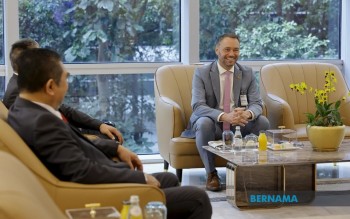
Belgium's Deputy Prime Minister and Minister of Foreign Affairs, European Affairs and Development Cooperation, Maxime Prévot has underscored his country's commitment to finalising the Malaysia-European Union Free Trade Agreement, describing it as a pivotal initiative that will reshape commercial ties between the two regions. During his visit to Kuala Lumpur, Prévot stressed that concluding the MEUFTA remains a top priority for both the EU and Belgium, with negotiations anticipated to reach completion within the coming months or by the end of the year, marking a significant milestone in deepening economic partnerships across the continent and Southeast Asia.
The proposed agreement is positioned as a transformative instrument that will facilitate substantially increased bilateral commerce and investment flows. According to Prévot, the FTA will create pathways for expanded exchanges and novel trade opportunities whilst simultaneously bolstering economic expansion across both jurisdictions. The framework is also expected to generate direct employment benefits and contribute to the sustained development of Malaysia and the European Union member states, addressing regional economic priorities that align with broader development agendas in both areas.
Belgium's particular enthusiasm for the agreement reflects its own strategic economic positioning. Despite its relatively modest population of 11.77 million people, Belgium maintains a highly open economy where exports constitute approximately 85 percent of its gross domestic product, demonstrating the country's fundamental reliance on international trade relationships. This characteristic underscores why European nations view the MEUFTA as strategically essential—such agreements directly support the economic vitality of countries whose prosperity depends heavily on access to expanding markets and trade corridors.
Prervot's two-day visit to Malaysia, which commenced on July 2, represents his first journey to the country since assuming his ministerial portfolio in February of the previous year, signalling the increasing diplomatic engagement between Belgium and Malaysia. His itinerary includes a scheduled meeting with Malaysia's Deputy Prime Minister Datuk Seri Fadillah Yusof, who additionally serves as the nation's Energy Transition and Water Transformation Minister, indicating the breadth of cooperation being pursued between the two governments.
The bilateral discussions are set to encompass several substantive areas of mutual interest and economic complementarity. High on the agenda are collaborative initiatives in renewable energy development, a sector where both nations recognise shared imperatives regarding climate transition and sustainable energy infrastructure. Additionally, talks will address Malaysia's strategic position in rare earth elements production—a critical component of global green technology supply chains—alongside cooperation in the halal industry, where Malaysia maintains distinctive expertise and market positioning. Beyond these sectoral discussions, the delegations will also exchange views on Malaysia-EU relations broadly conceived, alongside regional and international developments affecting both economies.
Current bilateral trade metrics demonstrate the already substantial commercial foundation upon which these negotiations are being conducted. In 2025, Malaysia and Belgium exchanged goods valued at RM9.74 billion, with Malaysian exports comprising RM6.85 billion of this total whilst Belgian imports to Malaysia reached RM2.89 billion. These figures reveal Malaysia's strong export competitiveness in the Belgian market, a dynamic that the FTA is intended to further accelerate by reducing tariff barriers and non-tariff obstacles to trade.
Investment flows equally underscore Belgium's confidence in Malaysia's economic environment and growth prospects. As of 2025, a cumulative total of 67 projects involving Belgian investors or companies had received approval under Malaysia's investment promotion framework, collectively representing RM5.1 billion in committed capital. These approved projects carry the potential to generate 4,605 employment positions across various economic sectors, demonstrating Belgium's tangible commitment to Malaysia's development and the confidence of Belgian enterprises in the country's business climate and regulatory stability.
The timing of these negotiations assumes particular significance within the broader context of Southeast Asian economic integration and European strategic repositioning towards the region. The EU has progressively elevated its engagement with ASEAN member states, recognising Southeast Asia's economic dynamism and geopolitical importance. Malaysia, as a leading ASEAN economy and a nation with sophisticated manufacturing, technology, and service sectors, occupies a central position in Europe's recalibrated Indo-Pacific strategy. A comprehensive FTA would therefore benefit both parties by establishing deeper structural linkages whilst complementing existing multilateral frameworks such as CPTPP and regional ASEAN agreements.
For Malaysian policymakers and business stakeholders, the MEUFTA represents opportunity to strengthen market access for Malaysian goods and services within the 27-member EU bloc, comprising over 440 million consumers and among the world's highest-income markets. The agreement is expected to facilitate greater participation by Malaysian firms in European supply chains, particularly in renewable energy, advanced manufacturing, and digital services—sectors where Malaysia aspires to develop competitive advantages. Similarly, European investors anticipate enhanced certainty and improved conditions for establishing operations and expanding existing enterprises across Malaysia's diverse economic landscape.
The discussions on renewable energy cooperation carry particular salience given Malaysia's commitment to achieving carbon neutrality by 2050 and the EU's aggressive climate targets under its Green Deal framework. Both regions require substantial investments in solar, wind, and hydrogen technologies, creating opportunities for joint ventures, technology transfer, and supply chain integration. Rare earth elements cooperation addresses another critical dimension of the global green transition, as these materials remain indispensable for manufacturing electric vehicles, renewable energy installations, and advanced electronics—sectors fundamental to both economies' future prosperity.
The halal industry dimension of these talks reflects Malaysia's distinctive market positioning and competitive advantage. As the world's largest halal food producer and a leading halal certification authority, Malaysia can leverage FTA provisions to expand halal product exports to European markets where Muslim populations and consumer demand for certified halal goods continue expanding. This sectoral approach demonstrates how modern trade agreements increasingly address specific economic strengths and emerging consumer trends rather than adopting purely generic liberalisation frameworks.
As these negotiations advance toward conclusion, Malaysian stakeholders should monitor several implementation considerations. The agreement will likely include provisions addressing intellectual property protection, labour standards, and environmental commitments—areas where Malaysia must ensure domestic regulations align with EU expectations whilst protecting legitimate national interests. Additionally, sensitive sectors including agriculture and certain manufacturing industries may require careful negotiation to balance openness with domestic political sustainability.
The successful conclusion of the MEUFTA would mark a significant achievement for multilateral economic diplomacy at a time when protectionist sentiment challenges globalisation. For Malaysia specifically, it would reinforce the country's position as an open, trade-oriented economy whilst diversifying export markets beyond established Asian partners. For Belgium and the EU, the agreement advances the strategic objective of deepening engagement with dynamic Southeast Asian economies, thereby strengthening Europe's economic resilience and geopolitical positioning in an increasingly multipolar world.

