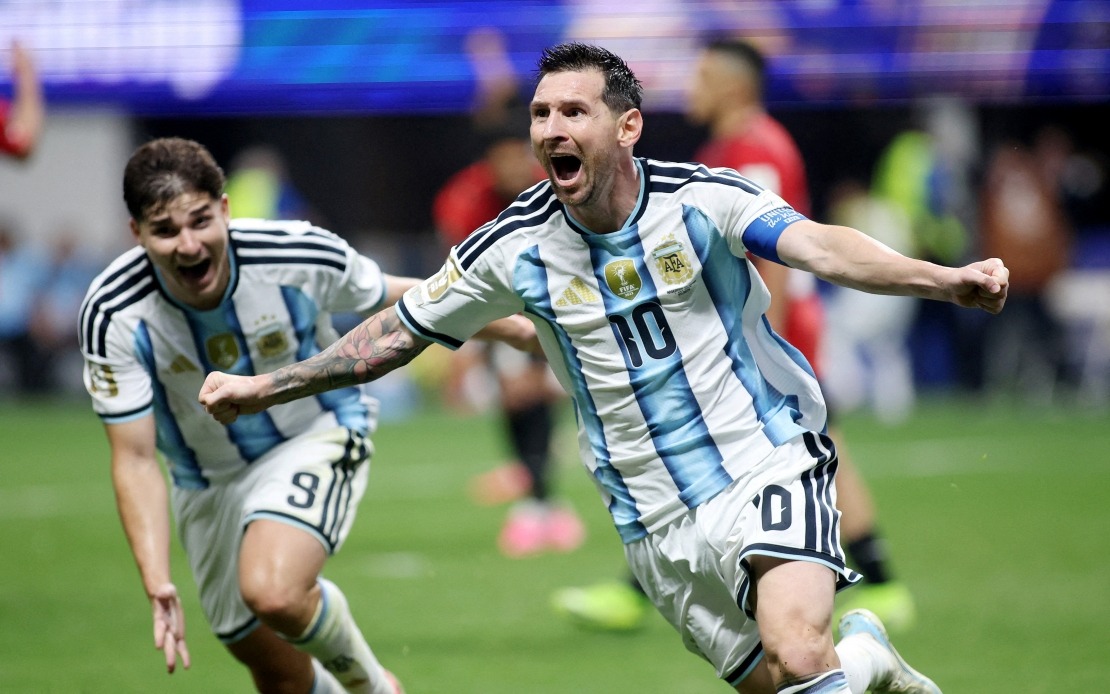
Lionel Messi's World Cup journey took an unexpected turn when the Argentine superstar, seemingly destined for retirement after lifting the trophy in Qatar two years ago, has instead returned to pursue another championship title. At 39 years old, Messi leads Argentina's charge through this summer's tournament and remains locked in a fierce battle with Kylian Mbappé for both the Golden Boot and the greater glory of a second world title. The pair have already transcended previous scoring records, fundamentally reshaping the conversation around the sport's most prestigious competition.
When Argentina claimed the 2022 World Cup in Qatar, there was a palpable sense that the victory represented a fitting crescendo to Messi's career. His seven-goal haul that tournament, capped by two in the final against France, seemed designed by fate as the perfect farewell. The entire squad appeared driven by a collective mission to deliver the trophy before their talisman stepped away from international football. Yet Messi's decision to return four years later—a gap shorter than many expected—demonstrates his hunger remains undiminished, even as youth has inevitably taken its toll.
The statistical portrait of this summer's competition reveals just how dominant Messi and Mbappé have become. Both players currently share eight goals apiece in the tournament, putting them decisively ahead of England's dual threat from Harry Kane and Jude Bellingham, each of whom has scored six times. The chasing pack has been decimated by eliminations; Erling Haaland, who might have mounted a serious challenge, has already departed. This narrow field at the top tells a story of two generational talents performing at their absolute peak when it matters most, even as the calendar continues its relentless march.
Mbappé holds the advantage in the Golden Boot race through secondary criteria—he has provided more assists and has required fewer minutes to accumulate his goals—but Messi's experience and composure under pressure remain formidable assets. The trophy for the tournament's best player, the Golden Ball, has twice belonged to Messi's mantelpiece, and his performances this summer suggest he remains capable of winning it again. Yet the prestigious Golden Boot has eluded him recently; Mbappé claimed it in 2022 despite finishing on the losing side after scoring a hat-trick in the final itself.
The broader historical context makes this tournament even more remarkable. Messi and Cristiano Ronaldo have together shattered the boundaries of World Cup participation, becoming the first men to represent their nations across six tournaments. They have also surpassed Lothar Matthäus's longstanding appearance record of 25 matches. Messi specifically is on track to make his 33rd World Cup appearance on Wednesday against England, extending his lead over Ronaldo by six matches and cementing his status as the competition's most durable performer.
When examining goal-scoring records, the transformation becomes undeniable. Messi's tally of 21 World Cup goals now sits within striking distance of Mbappé's trajectory—the French forward has 20—and together they have obliterated Miroslav Klose's previous benchmark of 16 goals. Kane, meanwhile, has climbed to 14 career World Cup goals, demonstrating that even as the generational guard shifts, elite strikers continue breaking barriers. The 2022 Qatar tournament proved to be Messi's most prolific, when at 35 he scored more goals in that single competition than across his previous four World Cups combined—a testament to his adaptation and refined finishing.
Messi's World Cup journey began modestly in 2006 when, as a teenager, he scored once in his debut appearance in Germany. The 2010 tournament in South Africa yielded no goals, a rare dry spell for the Argentine. His first significant World Cup impact came in 2014 when Brazil hosted the tournament on Argentine soil, and Messi delivered four crucial goals. Four years later in Russia, he managed a single goal before the extraordinary outpouring of 2022. This trajectory reveals a player whose peak performances have come later in his career, defying conventional wisdom about athletic decline.
Penalty conversion represents one remaining vulnerability in Messi's otherwise immaculate World Cup record. While he has scored all three of his World Cup penalty shootout attempts—against the Netherlands in 2014 and 2022, plus France in the 2022 final—his record from open play penalties tells a different story. Across his World Cup career, excluding shootouts, he has converted only four of eight spot-kicks. This summer has presented fresh challenges, including a miss against Austria during the group stage and a save by Egypt goalkeeper Mostafa Shobeir in the round of 16. These moments matter little if Argentina reaches the final, but they underscore that even greatness has its margins of fallibility.
For Malaysian and Southeast Asian observers, Messi's continued excellence at an age when most athletes have long retired carries profound implications. His performances challenge assumptions about athletic longevity and the relationship between age and performance at sport's highest levels. Furthermore, the rivalry between Messi and Mbappé represents a generational passing of the torch in global football, with broader significance for how the sport evolves. Argentina's squad composition, heavily dependent on a veteran leader despite the emergence of younger talents, reflects tactical choices that reward experience and leadership—lessons potentially applicable to how regional teams might approach their own development strategies.
The path forward for Messi against England on Wednesday will provide another chapter in what has become an improbable extended narrative. Whether this tournament concludes with a second World Cup triumph or a graceful departure from the stage, Messi has already rewritten numerous records and redefined expectations about what remains possible at 39. His statistical dominance this summer, shared though it may be with Mbappé, speaks to a competitor who refuses to accept diminishment simply because the calendar suggests he should. The records will endure long after he plays his final match; what remains to be determined is whether one more victory can crown what is already an extraordinary legacy.

