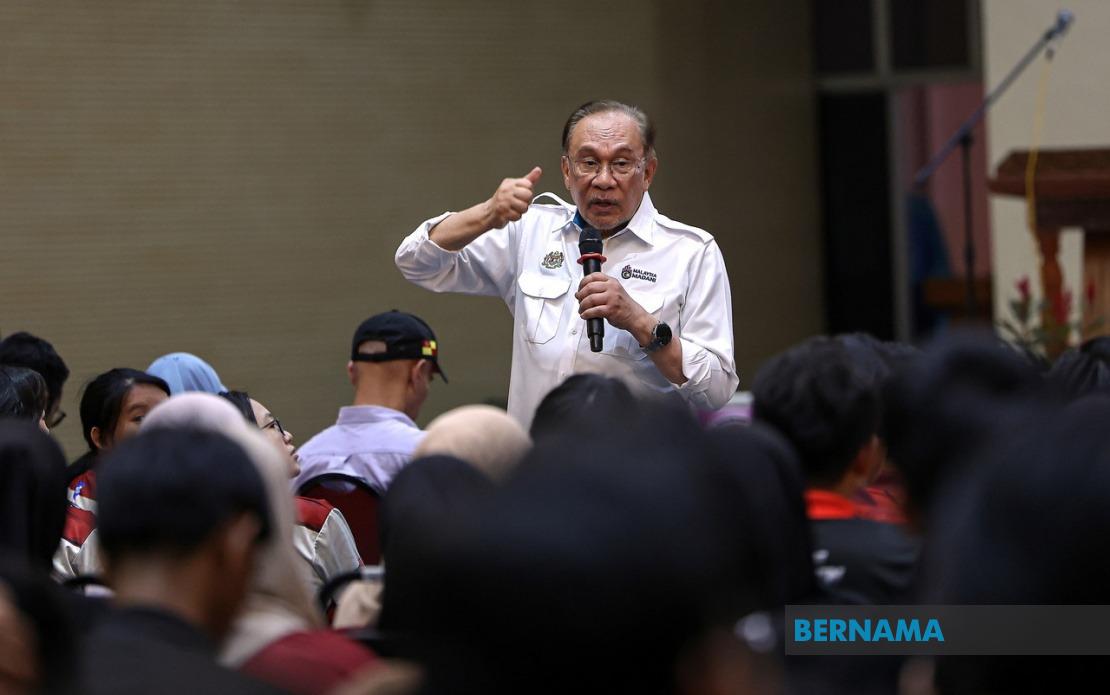
Prime Minister Datuk Seri Anwar Ibrahim has articulated a new equilibrium in Malaysia's higher education intake strategy, one that simultaneously recognises academic achievement and acknowledges the systemic inequalities that affect access to tertiary education. Speaking at a youth engagement programme in Seremban, Anwar detailed how the government intends to navigate the persistent tensions between meritocratic selection and the targeted support needed to broaden opportunity across demographic and geographic divides.
The centrepiece of this framework is an automatic admission pathway for students achieving outstanding examination results. Those who score 10As in the Sijil Pelajaran Malaysia examination will secure matriculation places regardless of their ethnic background, a direct signal that academic excellence transcends communal boundaries. By explicitly mentioning Chinese, Indian and Malay students in this context, Anwar was underscoring that the pathway operates on a truly non-discriminatory basis, signalling to high-achieving families across all communities that raw performance at SPM level will be rewarded without qualification.
This merit-based component addresses a longstanding concern among middle-class and elite families that selection processes were insufficiently rigorous or transparent. It also sends a message to top-tier students that Malaysia values and will rapidly onboard its brightest young minds, regardless of heritage. The automatic entry guarantee removes ambiguity and bureaucratic friction for an important cohort of students who might otherwise consider education abroad as their only pathway to elite institution access.
Simultaneously, the Prime Minister reaffirmed the continuing role of Bumiputera provisions within the matriculation system. Rather than positioning this as a separate or subordinate track, he framed it as an essential counterbalance that accounts for the realities of Malaysian demography and geography. The reference to demographic factors acknowledges that enrolment quotas are calibrated to reflect the constitutional place of indigenous communities, while the mention of rural and interior constituencies—including specifically Sabah and Sarawak—highlights a different equity challenge: the infrastructure and opportunity gaps that affect students from remote regions.
The dual-track approach represents an implicit recognition that merit and need operate in different registers. A 10A student from Kuala Lumpur's Damansara Heights and a bright student from a longhouse community in Sarawak face utterly different obstacles in reaching the examination hall with the same resources, coaching and environmental stability. By maintaining space for Bumiputera consideration, the government is acknowledging that pure test-score meritocracy can inadvertently entrench advantage rather than distribute opportunity. This reflects a maturing policy discourse that has moved beyond zero-sum thinking about admission pathways.
For Malaysian education observers, this statement signals a government attempting to satisfy multiple constituencies simultaneously. Affluent families concerned about meritocratic decline gain assurance through the 10A automatic pathway. Communities with historical claims to protective provisions retain their entitlements. Rural populations, particularly in East Malaysia, benefit from a framework that recognises geographical and infrastructural disadvantage. The articulation of this balance at a youth-focused public forum, alongside Youth and Sports Minister Dr Mohammed Taufiq Johari, underscores the government's intention to communicate this policy clearly to young Malaysians themselves.
The matriculation programme occupies a critical position within Malaysia's higher education pipeline. These two-year pre-university qualifications funnel students directly into degree programmes and remain among the most competitive entrance points in the Malaysian education system. How intake is structured therefore shapes not just who gains access to university but, by extension, which communities dominate professional classes across law, medicine, engineering and other fields in subsequent decades. The stated policy thus carries implications far beyond annual cohort placement figures.
Implementing this framework will require careful calibration at the Ministry of Education level. Questions about how many places are reserved for Bumiputera consideration versus merit-based automatic admission, how the definition of eligible Bumiputera students is operationalised, and how to prevent the automatic pathway from becoming so generous that other selection criteria become redundant will all require transparent technical specification. The government's willingness to articulate the principle publicly suggests awareness that credibility hinges on consistent and fair implementation.
Regionally, Malaysia's approach to balancing merit and equity in university admissions carries weight. Other Southeast Asian nations grapple with similar tensions between pure meritocratic selection and acknowledgment of unequal starting points. Singapore, Indonesia and Thailand all wrestle with questions about how to expand elite educational access while maintaining quality and managing communal expectations. Malaysia's explicit articulation of this dual framework—rather than obscuring the tension—may offer useful policy reference points for the region.
For current and prospective matriculation applicants, the messaging is one of expanded transparency and clearer pathways. Top performers know their route is secured. Students from designated communities understand that special provision persists. This clarity itself represents a shift from systems where selection criteria remain opaque or subject to political reinterpretation. Whether the system can genuinely deliver equitable access to quality education for both high achievers and students from under-resourced backgrounds will ultimately depend on how faithfully these principles translate into annual admissions decisions across Malaysia's matriculation providers.

