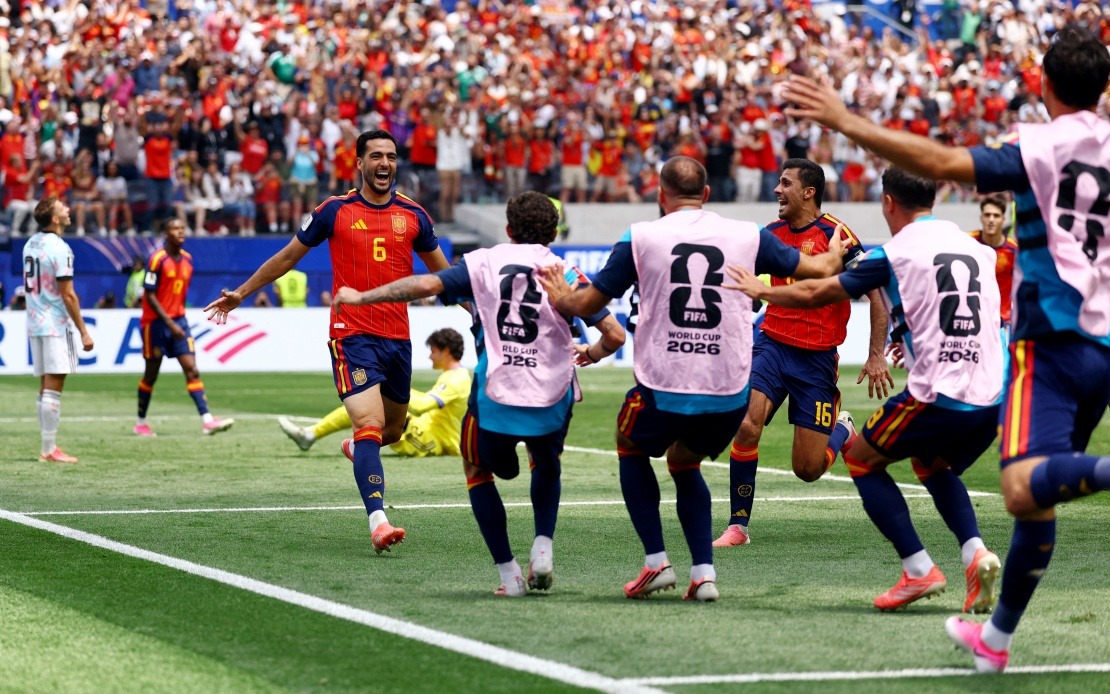
Mikel Merino's opportunistic strike in the 88th minute delivered Spain a 2-1 quarter-final victory over Belgium and secured a World Cup semi-final berth, setting up a tantalising rematch with France near Dallas on Tuesday. The Arsenal midfielder's clinical finishing has become a recurring theme in Spain's tournament run, having also netted against Portugal in the knockout stages, and his knack for appearing at decisive moments continues to define the European champions' campaign.
Spain's path to the semi-final was constructed on controlled football and clinical finishing, though the contest proved tighter than their overall dominance suggested. Fabián Ruiz opened the scoring on 30 minutes with a composed finish that reflected Spain's superiority in midfield, but Charles De Ketelaere's equaliser momentarily disrupted their narrative of control. The Belgian forward's leveller was noteworthy for another reason: it ended Unai Simón's extraordinary streak of 649 minutes without conceding a goal across two World Cup tournaments, an extraordinary testament to Spain's defensive solidity throughout the competition.
Belgium's challenge was materially compromised by injuries that depleted their midfield resources before and during the contest. Captain Youri Tielemans withdrew during warm-ups with a hamstring concern, joining Amadou Onana on the sidelines following a knee ligament injury sustained earlier in the tournament. These absences significantly diminished Belgium's capacity to control proceedings against a Spanish side hungry for possession, and the limitations became evident as the match progressed. The injury crisis deepened when goalkeeper Thibaut Courtois suffered a problem on 71 minutes, forcing Manchester United's Senne Lammens into the action at a critical juncture when Belgium desperately needed stability between the posts.
Lammens's introduction proved fateful. The substitute goalkeeper, thrust into an unfamiliar and pressurised environment, struggled with a long-range effort from Pau Cubarsi in the closing stages. His inability to command the situation cleanly left the ball vulnerable, and Merino pounced with clinical precision, finishing into the roof of the net to clinch Spain's passage through. The goal demonstrated both individual quality and Spain's tactical nous in exploiting defensive vulnerabilities through fresh attacking legs—Nico Williams had also been introduced to inject pace and directness into the closing phases.
The looming semi-final against France represents a significant escalation in difficulty for Spain, despite their unbeaten record in the tournament. France brings a formidable pedigree as two-time World Cup winners in 1998 and 2018, and they remain tournament favourites despite their runner-up finish to Argentina four years ago. The French squad possesses multiple avenues to create danger, world-class finishing options, and the experience of competing at the highest level repeatedly. For Spain, the challenge lies in maintaining their disciplined approach while managing France's capacity for explosive attacks.
The semi-final carries additional significance as a re-run of Spain's Euro 2024 semi-final victory, giving both teams recent history to analyse and tactical foundations to build upon. Spain's triumph in that European championship suggested they possess the tactical blueprint to contain France, though the World Cup context—with its heightened intensity and knockout finality—presents a different proposition. La Roja's only World Cup title arrived in 2010, over a decade ago, and reaching another final would represent a significant achievement for a generation of Spanish players intent on reclaiming global supremacy.
Spain's systematic approach to this tournament has impressed observers accustomed to their possession-based football. However, this semi-final will require them to demonstrate greater flexibility and ruthlessness than they have previously shown. Belgium, despite their injury troubles, proved capable of unsettling Spain momentarily, suggesting that France's superior technical quality and attacking sophistication could create genuine problems. The match near Dallas will likely hinge on Spain's ability to control tempo and France's capacity to break through on the counter-attack, particularly if they can leverage their pace and directness against a Spanish backline that has shown occasional vulnerabilities.
The path to the final is identical for both nations—one will progress to a showdown against either England or the Netherlands, depending on the other semi-final's outcome. For Spain, the priority remains clear: reproduce the controlling performance against Belgium while tightening defensive discipline to nullify France's attacking threat. For France, the objective involves disrupting Spain's rhythm and capitalising on moments of transition that may emerge from a team intent on dominating possession. The semi-final promises to be a compelling tactical battle between two European heavyweights with contrasting philosophies and proven records at the highest level.
Both teams will arrive with full squads available, eliminating the injury complications that hampered Belgium's quarter-final effort. This represents a return to normality for a tournament that has seen several key players sidelined at crucial moments. Spain's march through the competition has been characterised by consistency and controlled excellence, while France offers proven tournament pedigree and explosive capability. The semi-final will determine which team's approach—Spain's methodical, possession-focused strategy or France's balanced combination of control and counter-attacking potency—proves more effective on the grandest stage of international football.

