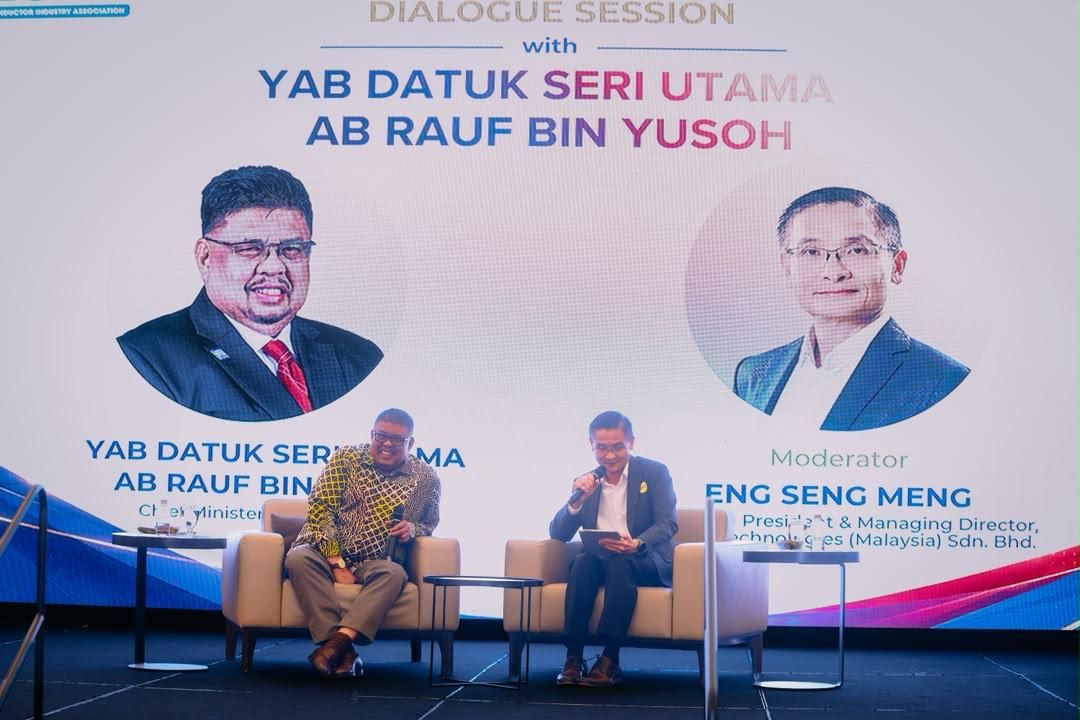
Melaka's semiconductor and electronics manufacturing sector has matured into a RM17.6 billion economic engine that anchors the state's prosperity, according to Chief Minister Datuk Seri Ab Rauf Yusoh. What began as a modest venture by an international investor in the early 1970s has blossomed into one of Malaysia's most sophisticated industrial ecosystems, underpinned by five decades of accumulated expertise, infrastructure investment and a deepening pool of skilled workers.
The sector's origins tell a story of humble beginnings transformed through sustained commitment. An early multinational operator established its initial base at an Umno building along Jalan Hang Tuah before relocating to Batu Berendam following the creation of Melaka's first Free Industrial Zone in 1976. That foundational decision to invest in the state created a domino effect, attracting successive waves of international manufacturers and establishing supply chains that have only strengthened over time. Today, the narrative has evolved from a single company's success into a broader ecosystem narrative: Melaka has become a globally recognised hub for semiconductor and electrical and electronics manufacturing, commanding respect alongside established technology centres across Asia.
The scale of Melaka's manufacturing footprint underscores the sector's systemic importance. Manufacturing now accounts for 36.1 percent of the state's economic output, a proportion that places industrial production at the centre of policymaking. Over 400 manufacturing companies operate across 18 industrial sectors, with semiconductor and E&E firms representing the crown jewels of this diversified base. This concentration of specialised manufacturing has generated employment pathways extending far beyond the multinational operators themselves, sustaining networks of local suppliers, small and medium enterprises, contractors and service providers whose revenues depend on the health of the broader manufacturing ecosystem.
For Malaysian policymakers and investors, Melaka's trajectory offers instructive lessons about industrial cluster development. The state's competitive advantages rest on three foundational pillars that have proven remarkably durable. Geographic positioning between Kuala Lumpur, Johor and Singapore provides manufacturers with efficient access to major regional markets, shipping ports, international airports and a labour pool that transcends state boundaries. Operating costs remain competitive relative to alternative regional manufacturing hubs, a factor that continues to attract cost-conscious investors even as wages and real estate prices have risen. Melaka also possesses over 2,600 hectares of developable industrial land, providing expansion flexibility that some rival locations cannot match.
Talent development has become increasingly strategised as competition for skilled workers intensifies. Recognising that semiconductor manufacturing demands highly trained technicians, engineers and specialists, Melaka has positioned itself as a technical and vocational education and training hub. Sixty-one TVET institutions across the state now produce industry-ready graduates, with curricula increasingly calibrated to the specific skill requirements emerging from semiconductor and advanced manufacturing operations. This approach addresses a perennial challenge in Southeast Asian manufacturing: the gap between general education outputs and the specific competencies that employers need. By aligning vocational training with sectoral demand, Melaka has partially solved a constraint that limits industrial growth in less organised regions.
Investor confidence has crystallised into tangible capital flows. Multinational corporations headquartered in the United States, Germany, China, Japan and other technology-leading nations have not merely invested once but repeatedly expanded their Melaka operations across decades. This pattern of reinvestment signals something deeper than opportunistic cost arbitrage: it reflects an accumulated trust in the state's business environment, regulatory reliability and political stability. In 2025 alone, Melaka attracted RM14.68 billion in investments across 312 projects, marking the highest annual inflow the state has achieved in 22 years. This recent surge suggests that despite global uncertainties, Melaka remains perceived as a secure location for technology-intensive manufacturing.
Yet Chief Minister Ab Rauf's public messaging contains an undercurrent of strategic urgency that reflects his understanding of semiconductor industry dynamics. Investment decisions made in the present moment will architect global supply chains for the next two decades, meaning that choices today between competing locations carry consequences stretching far into the future. Companies selecting where to locate new fabs, expand existing operations or establish supply chain partners are not making reversible decisions. Once multinational manufacturers establish alternative production networks or shift investment momentum toward rival jurisdictions, reversing those choices becomes extraordinarily difficult. Melaka's leadership recognises that complacency invites displacement.
The competitive pressures Melaka faces are both familiar and evolving. Established manufacturing hubs in Taiwan, South Korea and Singapore maintain deep institutional advantages accumulated over longer periods. Simultaneously, emerging competitors including Vietnam, Indonesia and India are aggressively pursuing semiconductor and E&E investment, offering combinations of lower labour costs, favourable policy incentives and political commitment that present credible alternatives to mature locations. Within Malaysia itself, Melaka competes for a finite pool of high-value manufacturing investment against Penang, Selangor and other states improving their own industrial competitiveness. Falling behind in this competition could mean not simply losing new factory investments but also forfeiting supporting industry opportunities and high-skilled employment prospects for local workforces.
Melaka's strategic response centres on the Melaka Semiconductor Strategy 2035, a forward-looking framework aimed at capturing next-generation manufacturing investments. Rather than resting on historical advantages, the strategy represents an attempt to engineer the conditions that will attract future growth. Securing high-value investments requires strengthening local technological capabilities, ensuring that Melaka-based suppliers and manufacturers can participate in increasingly complex supply chains. It demands maintaining infrastructure superiority, from industrial utilities to transportation networks to telecommunications connectivity. Beyond these tangible factors, it requires cultivating a reputation for business responsiveness: companies investing millions in new operations need governments that expedite approvals, troubleshoot operational obstacles and demonstrate sustained commitment from planning through to implementation.
For Malaysian readers and investors, Melaka's semiconductor success story carries several implications. First, it demonstrates that industrial cluster development rooted in strategic advantages, sustained investment and alignment between education and employer needs can generate durable competitive positions. Second, it illustrates that manufacturing remains economically vital to regional prosperity despite global conversations about automation and advanced services. Third, it shows that state-level governance matters: policy choices regarding land use, talent development, infrastructure and investor support can determine whether regions flourish or stagnate. Finally, it underscores that maintaining industrial competitiveness requires continuous adaptation rather than passive reliance on past achievements.
The semiconductor sector's proven importance to Melaka's economy has elevated manufacturing considerations to the centre of state strategic planning. Manufacturing's 36.1 percent contribution to economic output means that trends affecting the sector propagate throughout Melaka's broader economic fabric. Employment challenges in manufacturing ripple across supplier networks and supporting service industries. Infrastructure bottlenecks limiting manufacturing expansion constrain the state's capacity for future prosperity. Conversely, successful attraction of high-value semiconductor investments creates positive feedback loops: increased manufacturing activity supports more supplier development, justifies greater TVET investment, attracts complementary service industries and generates tax revenue for state development priorities.
Chief Minister Ab Rauf's emphasis on government-investor collaboration signals recognition that Melaka's future growth cannot result from market forces alone. Public-sector contributions remain essential: maintaining competitive utility infrastructure, supporting workforce development, expediting regulatory approvals and coordinating between private investors and state development priorities. This collaborative approach has proved effective historically and will likely shape implementation of the Melaka Semiconductor Strategy 2035. The state's demonstrated ability to sustain multinational manufacturer confidence across multiple decades suggests that this partnership model, though requiring continuous refinement and renewed commitment, remains broadly functional.
Melaka's semiconductor milestone of RM17.6 billion in sectoral value represents more than a numerical achievement. It reflects the accumulated decisions of investors, workers, policymakers and educational institutions that recognised the strategic importance of building industrial capacity over the long term. As the state positions itself for the next phase of growth, maintaining and extending these advantages will require sustained focus on the factors that created success historically: strategic geographic positioning, competitive operating environments, skilled workforce development and a government apparatus genuinely responsive to investor needs. The decisions made now regarding infrastructure, education and policy will ultimately determine whether Melaka's semiconductor sector continues prospering or gradually yields ground to more agile competitors.

