Melaka's Chief Minister Datuk Seri Ab Rauf Yusoh has launched a push to reshape the state's property development landscape by making elevator installations a requirement rather than an optional amenity in multi-storey commercial and residential projects. Speaking in Melaka on July 7, he directed developers to treat lift facilities as fundamental infrastructure for future construction, signalling the state government's intention to introduce formal policy requiring lifts in shoplots and three-storey residential developments across the jurisdiction.
The Chief Minister's pronouncement carries particular weight given the state's inventory challenges. He highlighted that numerous multi-storey properties in established residential areas including Kota Laksamana, Banda Hilir and Melaka Raya have languished on the market, with accessibility constraints identified as a material factor deterring purchases. By positioning lift installation as a baseline expectation rather than a luxury upgrade, the state aims to unlock demand among buyers who currently find climbing multiple flights of stairs impractical or impossible. This approach acknowledges demographic realities: Melaka's ageing population increasingly requires barrier-free environments to maintain independence and quality of life.
The policy framework under consideration reflects broader thinking within the Melaka administration about inclusive urban development. Ab Rauf articulated a vision wherein homeownership transcends mere property acquisition, becoming instead a pillar supporting family stability, social cohesion and equitable economic participation across communities. This framing positions housing policy within the wider Melaka Sayang Rakyat (MeSRa) initiative, a state-level development agenda emphasising affordable access and citizen welfare. The Chief Minister stressed that adequate housing forms the bedrock upon which sustainable and inclusive progress can be constructed.
Melaka's ambitions extend significantly beyond regulatory tightening around lift installation. The state government has committed to constructing more than 38,440 affordable housing units in coming years, building upon the 23,514 units already delivered. This expansion programme sits at the intersection of affordability targets and market-rate development, reflecting government recognition that inclusive housing systems require mixed-income communities and diverse product offerings. The sheer scale of the undertaking—potentially adding tens of thousands of units—suggests Melaka is treating housing as a priority capable of reshaping demographic and economic patterns across the state.
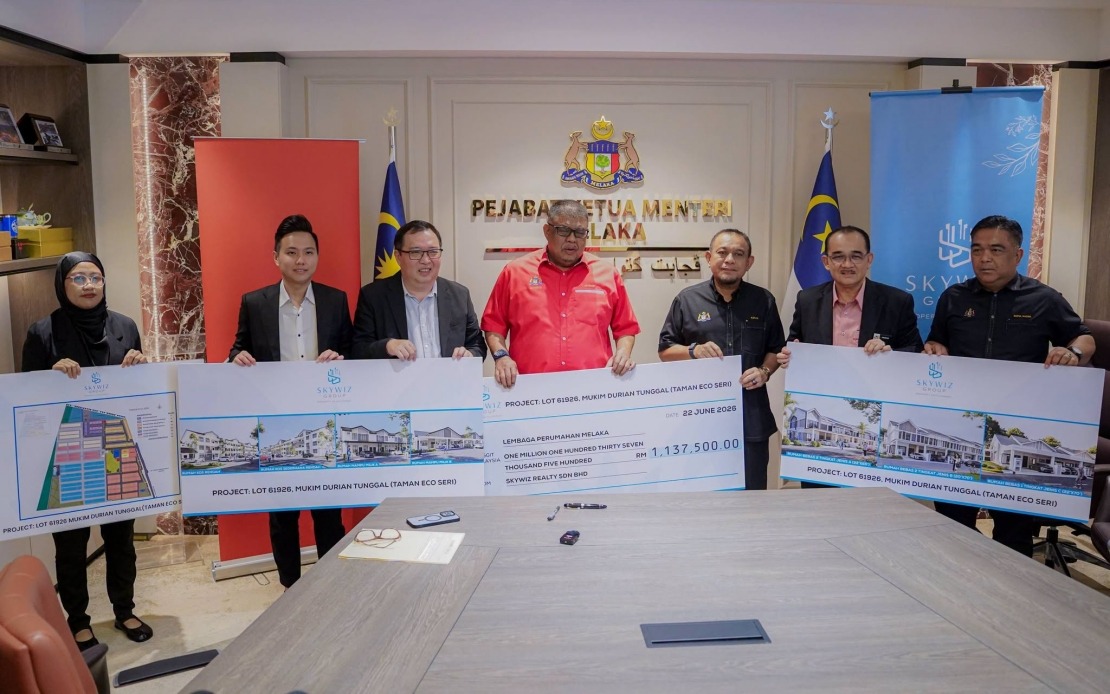
One transaction announced alongside the Chief Minister's policy comments illustrates the implementation machinery in motion. The Melaka Housing Board (LPM) executed an Affordable Housing Development Agreement with Skywiz Reality Sdn Bhd, a framework governing development of 903 units across 26.56 hectares in Mukim Durian Tunggal, Alor Gajah. The project represents a carefully calibrated blend of affordability and market viability: 453 units are designated affordable, subdivided into low-cost housing, low-medium cost housing, and two categories of affordable homes, whilst 450 units target open-market buyers at commercial returns.
This bifurcated structure reveals strategic thinking about cross-subsidy and financial sustainability. By embedding affordable units within larger developments that include market-rate properties, developers achieve sufficient margins to absorb lower returns on subsidised housing whilst delivering mixed-income neighbourhoods. The Skywiz project is anticipated to generate RM2.38 million in returns to LPM, creating a reinvestable revenue stream to support future affordable housing initiatives. The financial model thus becomes self-perpetuating: surpluses from mixed developments fund further subsidised housing, expanding the overall stock without imposing unmanageable fiscal burdens on state finances.
Construction timelines embedded within the agreement underscores government commitment to execution oversight. The developer faces a 90-day window from issuance of Form B by the Hang Tuah Jaya Municipal Council (MPHTJ) to commence on-site work, with the state government committing to continuous project monitoring to ensure adherence to specifications, quality standards and schedules. This supervisory posture reflects lessons learned from previous development cycles where project delays, quality shortfalls or abandoned sites created public dissatisfaction and wasted resources. By contractualising accountability mechanisms, the state attempts to translate policy ambitions into tangible residential stock meeting predetermined standards.
The lift mandate proposal must be understood within Malaysia's broader context of ageing demographics and rising disability awareness. As the population ages, accessibility becomes an economic as well as ethical imperative: properties equipped with lifts command stronger resale values, appeal to broader buyer pools and maintain utility across household lifecycles. This differs fundamentally from earlier development eras when stairs posed acceptable barriers. Contemporary Malaysian real estate increasingly incorporates universal design principles recognising that accessibility benefits entire communities, not merely elderly or disabled residents. Lift installation thus operates as a marker of forward-thinking development aligned with global best practices.
For property developers operating in Melaka, the proposed requirement necessitates cost recalculation and design reconsideration. Lift installation in shoplots—typically involving smaller floor plates and narrower margins—presents engineering and financial challenges absent in larger residential towers where lift infrastructure achieves economies of scale. The transition from current market practice, wherein many two-to-three storey shoplots lack lifts, to a mandated requirement will require adjustment across procurement, design and construction practices. Developers may initially resist perceived cost escalations, yet the Chief Minister's framing—emphasising that lifts constitute essential infrastructure rather than optional luxury—signals that objections carry limited political weight.
Melaka's approach carries implications extending beyond state boundaries. As Malaysia's regional states grapple with ageing populations, property stagnation and inclusive development imperatives, other jurisdictions may study the Melaka model. Should the policy succeed in improving turnover of previously problematic inventory whilst expanding affordable housing stock, the template becomes replicable elsewhere. Conversely, should implementation encounter obstacles—whether developer resistance, cost escalations, or insufficient demand response—other states will note the challenges. The current initiative thus represents an experiment with outcomes potentially informing national housing policy conversation.
The Chief Minister's push also reflects evolving stakeholder expectations around corporate social responsibility in property development. Increasingly, buyers and public officials view accessibility features not as discretionary additions generating marginal value, but as baseline societal expectations. Developers failing to incorporate such provisions face reputational risk and market resistance, whilst those embracing inclusive design position themselves as progressive corporate actors aligned with community values. This shift in norms, subtle but significant, gradually reshapes what constitutes acceptable practice within Malaysia's development industry, creating competitive advantage for forward-thinking operators.
Looking ahead, successful implementation of Melaka's affordability and accessibility agendas will depend substantially on sustained political commitment, adequate funding mechanisms, effective inter-agency coordination and realistic timelines. The state government faces the task of translating rhetorical commitment into regulatory architecture, developer compliance and quality outcomes. Monitoring mechanisms, penalty provisions for non-compliance, and dispute resolution procedures must be clearly articulated and fairly administered. Should the state successfully navigate these implementation challenges whilst delivering affordable, accessible housing at scale, Melaka may establish itself as a model for inclusive development that other Malaysian jurisdictions and Southeast Asian neighbours might emulate.

