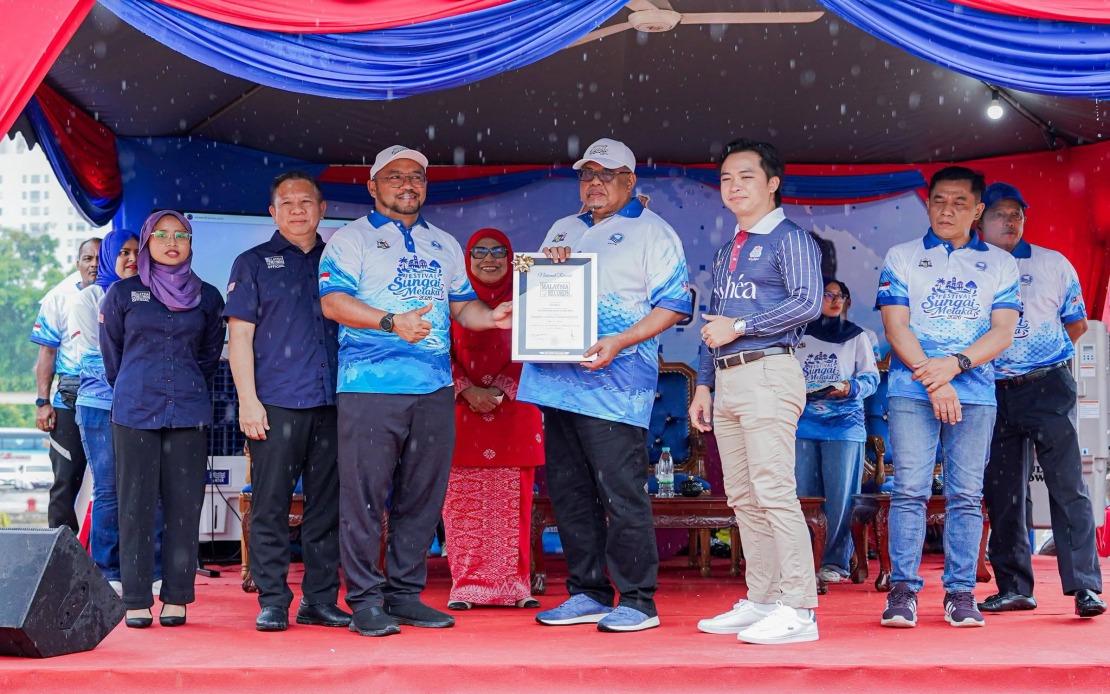
Melaka has consolidated its position as a tourism hotspot by securing four Malaysia Book of Records (MBOR) recognitions within the past three years, signalling the state's growing prominence in Malaysia's tourism landscape. The latest achievement represents another milestone for the state, building on a track record of distinctive tourism initiatives that have garnered national recognition. This accumulation of records reflects a deliberate strategy by the Melaka state government to position itself as a destination that combines heritage appeal with contemporary innovation.
Chief Minister Ab Rauf Yusoh stressed during the MBOR Certificate Presentation and Prize Giving Ceremony at Dataran Pengkalan Rama that these accolades must translate into tangible economic benefits for residents, not merely serve as decorative certificates in government offices. His remarks captured a pragmatic perspective on the relationship between tourism marketing and grassroots prosperity, acknowledging that international recognition alone does not guarantee sustainable livelihoods. The ceremony, held in conjunction with the Sungai Melaka Festival 2026, underscored the state's commitment to leveraging river-based attractions as a cornerstone of its tourism ecosystem.
The state's tourism expansion strategy has centred on Sungai Melaka, which the government views as a focal point for diversified, community-driven activities that can engage both local populations and visiting tourists. By investing in river-related events and infrastructure, Melaka aims to create multiple touchpoints for visitor engagement, extending stays and multiplying spending across hospitality, food, retail, and entertainment sectors. This approach contrasts with single-attraction models, which often struggle to retain visitors for extended periods or generate widespread economic participation.
The 17th Sungai Melaka Festival exemplifies this diversification strategy, featuring more than 30 programmes distributed across all three districts within Melaka. The breadth of offerings ensures that the festival reaches beyond the capital and into peripheral districts, preventing tourism revenue concentration and promoting equitable development. Such geographic dispersal also addresses a common criticism of Malaysian tourism development, which often concentrates investment and visitor traffic in urban centres, leaving rural and semi-urban communities underserved.
A highlight of this year's festival iteration is a freshwater fishing competition that attracted 1,123 participants from Melaka and neighbouring states. The competition offered RM30,000 in aggregate prizes, with the winner receiving RM10,000, an incentive level calibrated to generate enthusiasm among competitive anglers. The substantial turnout demonstrated that niche tourism markets—in this case, sport fishing—possess genuine commercial potential if properly resourced and marketed. The diversity of the participant base, encompassing both local and interstate competitors, provided evidence that Melaka's positioning as a fishing destination had penetrated markets beyond its immediate hinterland.
The Chief Minister identified the fishing competition as a prototype for future tourism product development, indicating plans to expand it in scale, appeal, and prize structures. This iterative approach to tourism development—testing concepts through initial events, measuring response, then scaling successful models—reflects international best practice in destination marketing. By treating the 2026 competition as a proof-of-concept, Melaka can refine operational logistics, assess marketing effectiveness, and adjust pricing and prize structures before committing to a permanent, large-scale fixture.
Beyond specific events, Melaka's accumulation of MBOR recognitions signals that the state possesses institutional capacity to conceptualize, execute, and validate novel tourism experiences that meet national record standards. This capability represents a competitive advantage in Southeast Asia's crowded tourism marketplace, where differentiation through distinctive experiences increasingly determines visitor preference. The state's track record suggests that subsequent MBOR recognitions are likely to follow as the administration continues to explore and develop unique attractions aligned with record-setting criteria.
The involvement of the Melaka River and Beach Development Corporation (PPSPM), represented by chief executive officer Shaharul Azuar Idris, underscores the institutional coordination required to execute complex tourism initiatives. Dedicated agencies with specialized expertise, adequate funding, and operational autonomy can implement projects more efficiently than dispersed government departments. PPSPM's presence at the ceremony reflected its role as a focal point for river-related tourism development, a model that other Malaysian states have begun to replicate.
For Malaysian readers and regional observers, Melaka's tourism trajectory holds several implications. First, it demonstrates that states without world-heritage sites or iconic natural features can still establish competitive tourism positions through strategic innovation and creative packaging of existing assets. Second, it shows that government-led tourism development, when coupled with community engagement and commercial viability assessment, can generate inclusive economic growth rather than elite-concentrated benefits. Third, it suggests that MBOR recognitions, while sometimes dismissed as superficial branding exercises, can serve practical purposes in marketing and investor attraction if properly leveraged.
The state's emphasis on converting records into sustained economic activity reflects lessons learned in Malaysian tourism development, where previous initiatives sometimes generated short-term publicity without lasting economic impact. By framing the MBOR achievements as platforms for expansion rather than endpoints, Ab Rauf Yusoh signalled a maturation in tourism governance philosophy. This approach aligns with global trends toward measuring tourism success not by visitor numbers alone but by quality of experience, length of stay, and total spending per visitor.
Melaka's multi-year accumulation of tourism records also occurs within a competitive regional context. Other Malaysian states and neighbouring countries continue to develop and market tourism offerings, intensifying pressure on Melaka to sustain innovation and investment. The state's current momentum provides a window to consolidate competitive advantages before regional competitors develop similar attractions or attain comparable recognition levels.
Looking forward, the combination of specific events like the fishing competition, broader festivals, and record-setting initiatives provides Melaka with a diversified tourism portfolio less vulnerable to market fluctuations or seasonal disruptions. If the state can maintain this development pace while ensuring that economic benefits reach grassroots communities rather than concentrating among large operators, it may establish a model increasingly applicable to other Malaysian destinations facing similar competitive pressures in the regional tourism marketplace.

