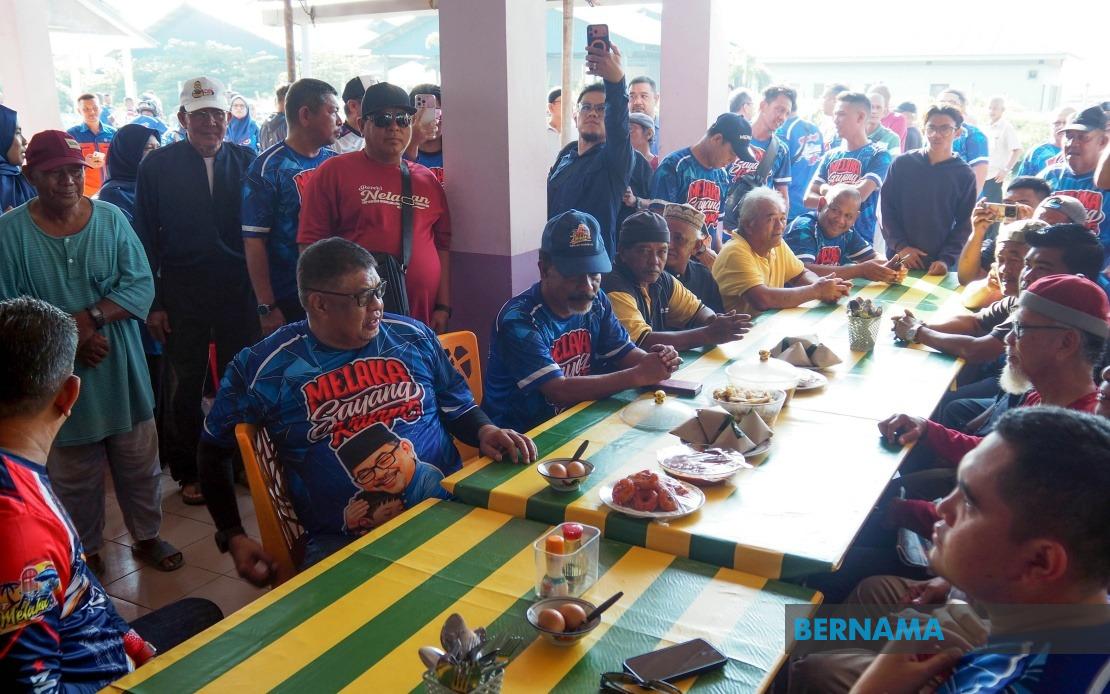
Melaka's state government has announced a comprehensive package of support measures aimed at transforming the livelihoods of registered fishermen across the state, introducing both traditional welfare protections and modern fishing technology. Chief Minister Datuk Seri Ab Rauf Yusoh unveiled the initiatives during the fifth instalment of his 'Jelajah Ketua Menteri Sayang Rakyat' (Chief Minister Caring for People) tour, held at Kuala Sempang Jetty in the Merlimau constituency, as part of a broader strategy to maintain direct contact with grassroots communities and responsively address their specific concerns.
The Chief Minister emphasised that these policy decisions emerged from substantive engagement with the fishing community rather than desk-bound planning. He stressed the importance of government leaders venturing into the field alongside members of the State Executive Council to observe conditions firsthand and calibrate assistance programmes accordingly. This philosophical approach underpins Melaka's current governance model, which prioritises immediate accessibility to decision-making structures for ordinary citizens, particularly those in economically vulnerable sectors such as traditional fishing.
The centrepiece of the new programme is universal PERKESO coverage for all state-registered fishermen. The Social Security Organisation (PERKESO) provides occupational injury insurance and disability benefits, addressing a significant protection gap that has long exposed fishing communities to economic catastrophe following workplace accidents or chronic health complications. Given that fishing remains one of Malaysia's most hazardous occupations, with workers regularly exposed to drowning risks, equipment-related injuries, and respiratory illnesses, this extension of statutory coverage represents meaningful acknowledgment that fishermen deserve the same social safety net extended to industrial and construction workers.
Equally significant is the distribution of fish finder technology to eligible fishermen. These electronic devices, which employ sonar technology to detect fish schools beneath the water's surface, represent a dramatic departure from the experiential knowledge systems that have governed traditional fishing for generations. According to community representatives interviewed at the event, commercial fish finders typically retail between RM1,000 and RM2,000, placing them financially beyond reach for many small-scale operators working with limited capital. By subsidising or distributing this equipment, Melaka is effectively modernising the fishing sector's productive capacity while simultaneously lowering entry barriers for younger generations considering maritime livelihoods.
During the Kuala Sempang event, 107 registered fishermen each received RM200 under the 'Bantuan Jaring Nelayan' (Fishermen's Net Assistance) scheme, representing a combined disbursement of RM21,400. Though modest in individual terms, this direct cash transfer carries symbolic weight as recognition of fishing communities' economic contributions and immediate cash flow pressures. The state government supplemented this by distributing 360 kilogrammes of fish valued at RM3,600 to the general public, with each recipient receiving approximately 1.5 kilograms, effectively broadening the initiative's reach beyond the organised fishing sector to encompass vulnerable households more generally.
Amirul Shah Fuad Shah, a 35-year-old fisherman from Kuala Merlimau with over two decades of maritime experience, articulated the practical significance of fish finder technology from the perspective of working professionals. He explained that these devices enable fishermen to transition from guesswork and accumulated experience to evidence-based fishing practices, allowing them to identify high-concentration fish areas and deploy nets with precision rather than casting broadly in hopes of encountering productive grounds. This technological shift promises meaningful productivity improvements, potentially translating to higher catches per expedition and reduced time-at-sea exposure, thereby enhancing both economic returns and occupational safety.
Regarding the PERKESO extension, Amirul emphasised that social security coverage addresses profound vulnerabilities inherent to maritime work. Fishermen operating at sea face constant exposure to occupational hazards—capsizing risks, equipment malfunctions, weather-related emergencies, and chronic health deterioration from salt exposure and repetitive strain. Many operators lack alternative income sources or family safety nets, meaning even temporary work interruption resulting from injury constitutes a household financial emergency. PERKESO's disability and medical benefit structures, combined with its death benefit provisions, fundamentally alter the economic calculus of risk for fishing families.
Md Khalil Md Jadi, chairman of the Kampung Sempang Fishermen's Association at 67 years old, represented the established leadership perspective within fishing communities. His remarks highlighted how these initiatives validate the fishing sector's status as worthy of modern state investment, reversing historical patterns wherein maritime livelihoods have been chronically underserved relative to agricultural or industrial sectors. He particularly underscored how modernisation through fish finder distribution addresses a genuine technological lag within traditional fishing, where practitioners have historically relied almost exclusively on environmental reading skills and experiential knowledge accumulated over decades. By introducing sonar-based fish detection, Melaka simultaneously facilitates income enhancement and creates opportunities for knowledge transfer across generational boundaries, since younger fishermen can acquire fish-finding skills more rapidly through technological mediation than through apprenticeship-based knowledge transmission alone.
These Melaka initiatives merit regional attention for several reasons. First, they demonstrate a state-level approach to fisheries welfare that extends beyond quota management or catch-value regulation, addressing instead the human dimensions of maritime livelihoods through integrated support covering social protection, technology access, and direct income assistance. Second, they illustrate how state governments within Malaysia's federal structure can responsively address sectoral needs through targeted programmes when political will exists. Third, the explicit emphasis on grassroots engagement and community consultation, articulated through the Chief Minister's tour framework, provides a governance model potentially applicable to other constituencies and sectors.
The extension of PERKESO to all registered fishermen also carries implications for national social protection architecture. Currently, many maritime workers remain outside formal social security systems, either through informal employment arrangements or through registration gaps. Melaka's initiative creates precedent and pressure for other states and the federal government to reconsider coverage frameworks, particularly as climate change, resource depletion, and market volatility increasingly threaten fishing sector sustainability. Anticipating income volatility and occupational injury through expanded social security becomes economically rational public policy, not merely compassionate welfarism.
Looking forward, the success of these initiatives will depend substantially on implementation capacity and effective communication to ensure eligible fishermen understand and access available benefits. The PERKESO coverage requires accurate fishermen registries and efficient premium payment mechanisms; the fish finder distribution requires training, maintenance support, and battery/fuel provision systems. Whether Melaka's state government and its partner agencies can sustain these commitments over multiple budget cycles will determine whether announced initiatives translate into tangible, durable improvements in fishermen's welfare and economic security. The initial reception from community leaders suggests strong demand and appreciation, establishing a foundation upon which longer-term programme expansion might be built.

