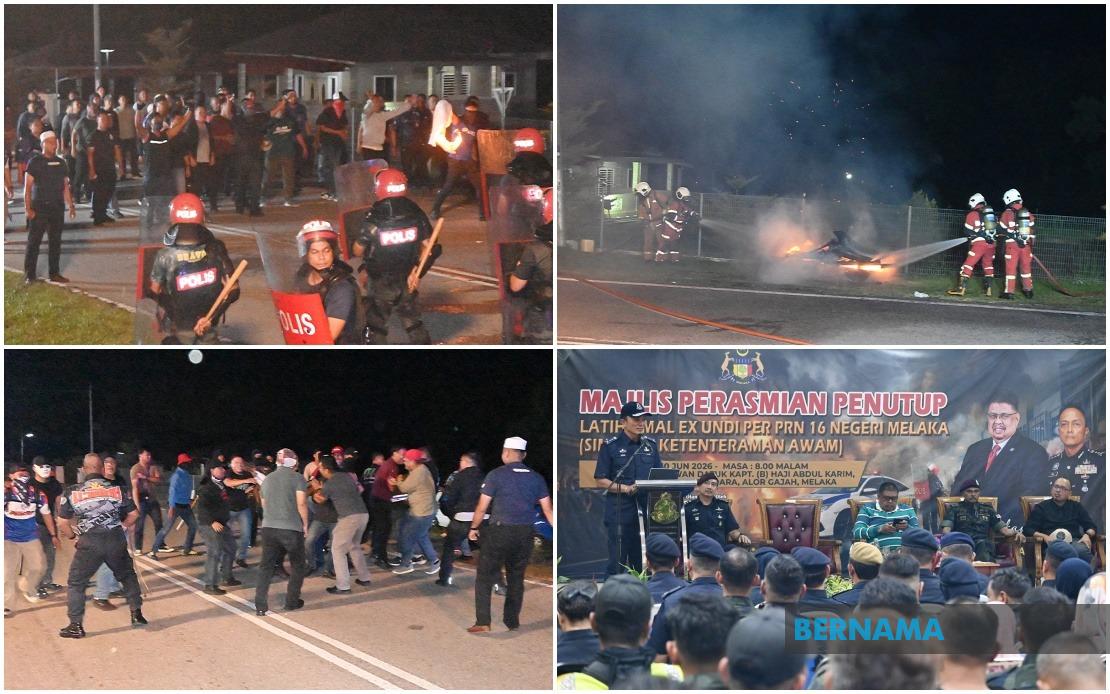
Melaka Chief Minister Datuk Seri Ab Rauf Yusoh has issued a clear warning that the 16th state election must not become a vehicle for provocative activities that could jeopardise public order, signalling the state government's determination to maintain stability during the electoral process. Speaking at a civil order simulation exercise in Alor Gajah on July 1, Ab Rauf underscored that whilst democratic competition is fundamental to Malaysia's political system, the protection of state security and public welfare must transcend partisan considerations.
The emphasis on maintaining tranquillity reflects broader concerns about election-related tensions that have surfaced during recent polls across Malaysia. Ab Rauf articulated that citizens retain the fundamental right to support competing parties and espouse diverse political ideologies, yet this freedom operates within the framework of collective responsibility for communal safety. His statement effectively establishes a boundary between legitimate political discourse and activities deemed destabilising, framing the election narrative around institutional security rather than merely partisan competition.
The simulation exercise itself represented a substantial undertaking, mobilising 395 officers and personnel from multiple government agencies to rehearse response protocols for potential disruptions during the electoral period. This comprehensive drill encompassed scenarios ranging from ballot box security breaches and riot control operations to management of deliberate provocations, fire emergencies, and crowd dispersal procedures. The exercise demonstrated that security preparations had progressed significantly beyond theoretical planning into practical, coordinated field operations involving the National Security Council, the Election Commission, the Fire and Rescue Department, the Civil Defence Force, and the Health Ministry.
Melaka Police Chief Datuk Dzulkhairi Mukhtar disclosed that intelligence assessments indicated the state remained secure and under control, though authorities recognised certain elements remained capable of generating public disorder. The decision to conduct the simulation represented the first of such magnitude in Melaka's electoral history, signifying an elevated commitment to procedural refinement and interagency coordination. Dzulkhairi noted that while riot scenarios were not anticipated, the preparatory framework ensured authorities could respond rapidly to unexpected developments throughout the election timeline.
The operational scale of the election campaign itself underscores the logistical complexity involved in managing 685,455 registered voters across 264 polling centres, distributed through 1,198 voting streams throughout the state. Police deployment has been calibrated to approximately 3,300 officers and personnel, supplemented by specialised units including a Public Order Riot Unit and a Federal Reserve Unit troop. Four operations rooms positioned at contingent and district levels will coordinate response activities, enabling real-time communication and decision-making during the polling period.
For Malaysian readers and Southeast Asian observers, the Melaka election carries particular significance as a potential indicator of electoral dynamics in a crucial state that has experienced considerable political volatility. The state has witnessed multiple changes in government leadership in recent years, reflecting deeper national currents of voter fragmentation and shifting coalition alignments. The security-focused messaging from state leadership suggests authorities are anticipating a competitive and potentially contentious campaign, with explicit concern that rival political camps might exploit election momentum to mobilise supporters in ways that transcend conventional campaigning.
The timing of the election in September carries additional weight given Malaysia's broader political trajectory. National attention will focus on how Melaka voters respond to competing visions offered by different coalitions, potentially offering early indicators of voter sentiment ahead of other electoral contests. The state's strategic importance to Malaysia's political equilibrium, combined with its proximity to the federal capital region, elevates the stakes beyond routine state-level politics.
Ab Rauf's framing of the election around stability principles rather than partisan advantage represents a calculated rhetorical strategy aimed at setting expectations for campaign conduct. By positioning security and public order as non-negotiable priorities transcending political differences, the Chief Minister attempted to establish moral authority that transcends party affiliation. This approach reflects recognition that campaign-related tensions, if inadequately managed, could undermine electoral legitimacy and generate resentment extending beyond the immediate contest.
The refinement of standard operating procedures emerging from the simulation exercise will shape how security forces respond to various scenarios throughout the campaign and polling periods. The identification and correction of weaknesses during rehearsals provides an opportunity to enhance coordination mechanisms, clarify communication protocols, and ensure personnel at all levels understand their assigned responsibilities. Such preparation reduces reactive decision-making during actual events, when time pressure and uncertainty typically complicate coordination between agencies with different operational priorities.
For the broader Southeast Asian context, Melaka's approach to election security demonstrates how Malaysian authorities balance democratic principles with institutional stability concerns. The explicit acknowledgment that provocative elements exist and require management acknowledges regional realities where electoral periods sometimes generate tensions reflecting deeper social divisions. The Melaka model prioritises professional security responses grounded in predetermined protocols rather than ad hoc reactions that might escalate confrontations.
The Chief Minister's emphasis on elected officials and security personnel maintaining consistent commitment to stability across partisan divides offers a counternarrative to polarisation dynamics that characterise some electoral environments. By articulating shared responsibility for state wellbeing as superior to electoral advantage, Ab Rauf positioned governance continuity as requiring cooperation between competing political actors. This principle, if operationalised, could provide a template for managing elections in polarised environments where political competition tends toward escalation.
Looking forward to the September election, the security preparations and rhetorical positioning established in July suggest Melaka authorities are approaching the contest with seriousness typically associated with electoral events carrying significant national implications. The substantial investment in simulation exercises, personnel deployment, and inter-agency coordination reflects confidence that professional security management can accommodate competitive politics without requiring restrictions on democratic participation. The coming weeks will test whether this balance between openness and security can be maintained as actual campaigning intensifies.

