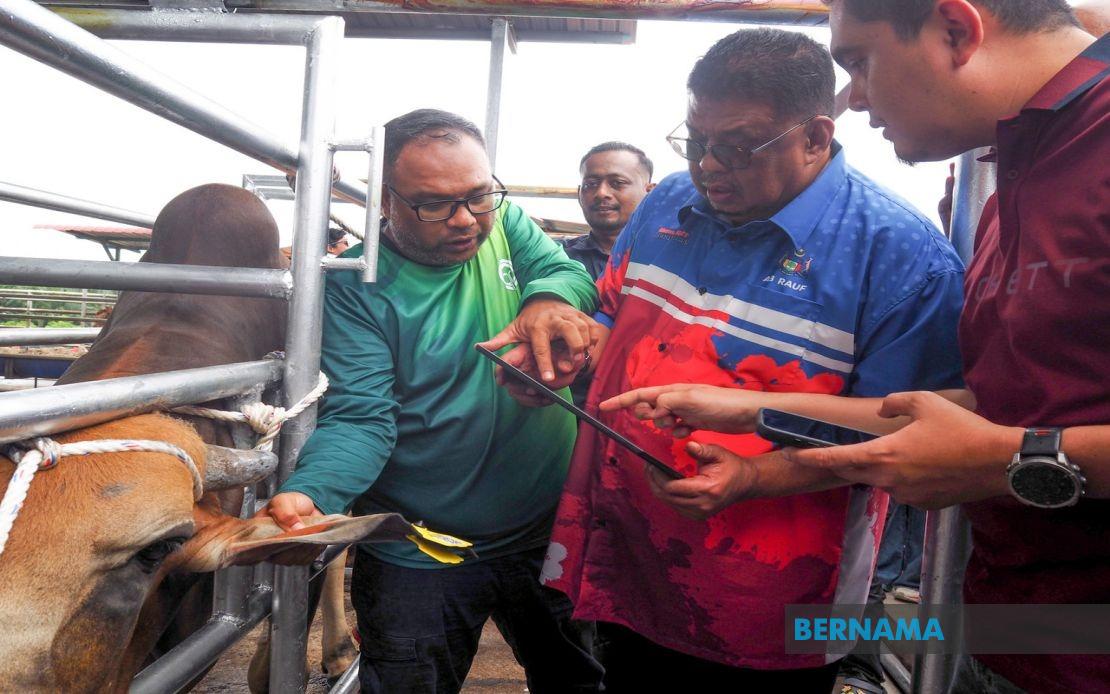
Melaka's state government has taken a significant technological leap by introducing QR-coded identification tags for livestock, marking a pivotal shift toward digitalised agricultural management in the state. The initiative, conceived by Chief Minister Datuk Seri Ab Rauf Yusoh and executed through collaboration between the Melaka Veterinary Services Department and the Local Government Unit, reflects a broader strategic vision of transforming Melaka into a smart and sustainable state. According to Mahathir Mustafa, chief assistant secretary of the Local Government Unit within the Chief Minister's Department, this system represents a contemporary approach to managing the growing challenges posed by uncontrolled livestock movement and ownership accountability across the state.
The mechanics of the system are straightforward yet effective. Each registered animal receives a durable tag embedded with a unique QR code and identification number, allowing instantaneous access to essential farming information through smartphone scanning. Once an owner registers their livestock with the Melaka Veterinary Services Department, basic data—including the breeder's name, premises identification, and farm location—becomes immediately retrievable by any authorised user. This democratisation of information transforms emergency response and enforcement operations from time-consuming investigations into rapid confirmations, fundamentally altering how authorities manage livestock-related incidents.
The urgency behind this initiative stems from escalating public safety concerns. Melaka recorded 835 livestock-related accidents and over 50 formal complaints regarding stray animals since 2023, a trend that authorities characterise as both a liability concern and an animal welfare issue. Stray cattle and buffalo have emerged as significant hazards on state roads, occasionally causing serious injuries and property damage. By enabling rapid owner identification at the point of incident, the system promises to shift accountability upstream, making animal containment a matter of enforceable responsibility rather than mere suggestion.
Implementation commenced modestly but with clear ambition. As of early June 2024, approximately 2,000 animals had been fitted with QR tags, establishing proof of concept across Melaka's diverse agricultural landscape. The state government aims to progressively extend coverage to the entire registered population of cattle and buffalo, estimated at over 32,000 head. This phased rollout approach allows for operational refinement and cost management while demonstrating genuine commitment to comprehensive implementation rather than a symbolic gesture limited to a subset of animals.
The system addresses a persistent challenge in livestock management: tracking ownership across transactions. Traditionally, when animals change hands through sale or transfer, updating government records becomes administratively burdensome and frequently neglected. Melaka's solution elegantly sidesteps this problem by permanently anchoring each tag to the individual animal for its entire lifespan, irrespective of ownership changes. Only ownership information within the eVetPermit Malaysia digital system requires updating, ensuring that while animals retain their fixed identifiers, human accountability records remain current and accurate. This design eliminates the administrative friction that often undermines compliance with livestock registration requirements.
Beyond incident response, the system generates valuable data for disease surveillance and movement monitoring—capabilities particularly relevant in a region increasingly concerned with animal health security. Veterinary authorities can now track livestock movements more systematically, improving their capacity to contain and respond to disease outbreaks. The ability to rapidly identify animals, their movement history, and associated premises transforms biosecurity from reactive crisis management into proactive risk mitigation. This dimension holds particular significance for Malaysia, where agricultural exports and domestic food security depend on maintaining robust disease control.
Industry reception has reportedly been encouraging, suggesting that farmers perceive genuine value beyond regulatory compliance. Breeders recognise that systematic identification and movement tracking protects their own economic interests by reducing livestock theft, establishing clear ownership documentation, and improving the professional standing of Melaka's agricultural sector. This alignment between regulatory objectives and industry interests proves crucial for implementation success, as voluntary compliance typically surpasses coercive adoption in agricultural sectors where relationships between government and producers carry historical complexity.
The state government's financial commitment further signals genuine intent. Until the end of 2024, the government bears the entire cost of tag installation at RM6.50 per head, with breeders requiring only to register their animals through the Veterinary Services Department to receive tags at no charge. This subsidy effectively removes financial barriers to adoption during the critical launch phase. Subsequently, from 2027 onwards, breeders assume the cost at RM5 per head for new installations or replacements—a modest expense substantially lower than the initial implementation cost, suggesting genuine intention to transition toward self-sustaining operations rather than permanent government subsidy.
The initiative exemplifies how targeted digital investment can address concrete agricultural governance challenges without requiring wholesale transformation of farming practices. Melaka's farmers continue raising livestock using established methods; the technology layer adds accountability and traceability without disrupting underlying operations. This pragmatic approach contrasts sharply with agricultural digitalisation initiatives that impose comprehensive system changes, often generating resistance and disappointing adoption rates. By focusing narrowly on identification and ownership verification, Melaka has created a system that enhances governmental capacity while minimising farmer disruption.
For other Malaysian states grappling with similar stray livestock problems and incomplete agricultural registration, Melaka's model offers demonstrable proof that technology can meaningfully address decades-old governance challenges. The system's scalability across different agricultural environments—from smallholder subsistence farmers to large commercial operations—remains to be fully tested, yet initial reception suggests broad applicability. The successful demonstration of this system may catalyse similar initiatives across Southeast Asia, where livestock-related safety issues increasingly demand systematic solutions.
Implementation success will ultimately depend on sustained political commitment beyond the initial launch phase and genuine integration between the Veterinary Services Department, Local Government Unit, and local authorities charged with enforcement. Technology alone cannot guarantee compliance; the critical factor becomes whether government resources dedicated to this system persist when initial enthusiasm wanes and competing budget priorities emerge. Early indicators suggest bureaucratic buy-in exists, but the true test arrives when maintaining and updating QR tag databases requires ongoing investment over subsequent years.
Melaka's livestock QR tagging initiative represents a small but significant step toward accountable, transparent agricultural governance. By making ownership immediately traceable and reducing the administrative burden of livestock registration, the system attacks root causes of recurring problems rather than merely treating symptoms through periodic enforcement campaigns. As Malaysia continues its transition toward more sophisticated state administration, such targeted technological applications demonstrate that innovation need not be grandiose to prove effective—sometimes the most profound improvements emerge from solving specific, well-defined challenges with pragmatic, accessible solutions.

