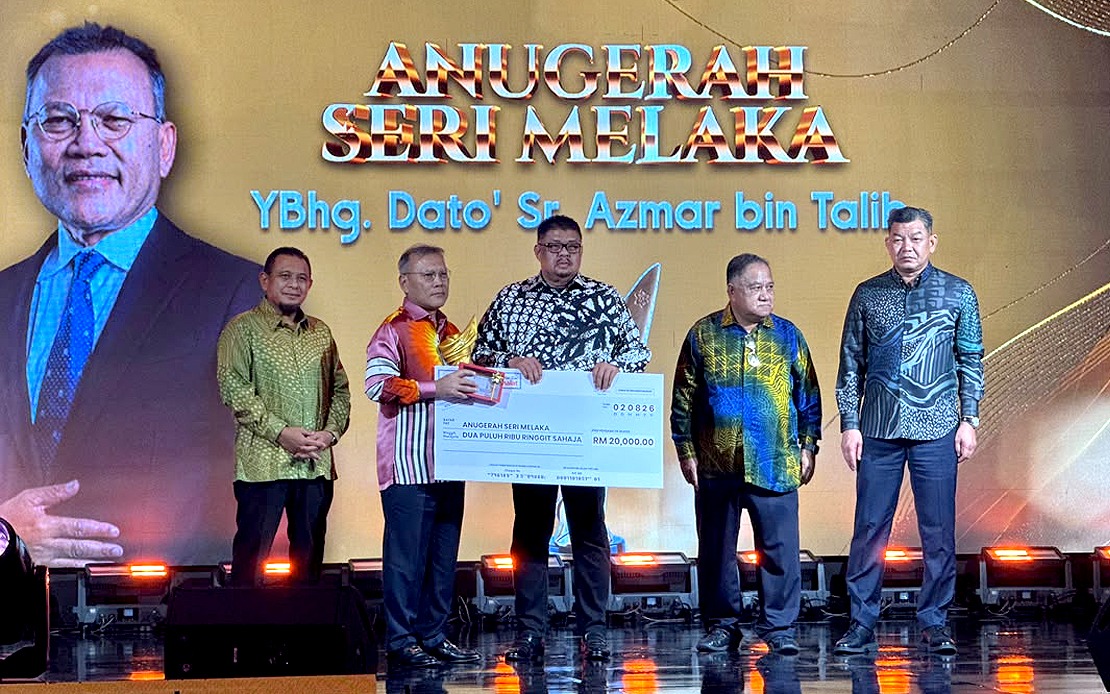
Chief Minister Datuk Seri Ab Rauf Yusoh has extended an invitation to Melaka's accomplished professionals to assume a more active role in advancing the state's development, framing their involvement not as obligation but as partnership grounded in mutual benefit. Speaking at the Anugerah Seri Melaka (ASM) awards ceremony at the Melaka International Trade Centre in Ayer Keroh, Ab Rauf articulated a vision in which individuals who have achieved prominence in their respective disciplines become catalysts for broader economic and social progress across the state.
The overarching framework underpinning this appeal is the Melaka Sayang Rakyat (MeSRa) initiative, a comprehensive strategy designed to transform personal success stories into public resources. Rather than allowing achievements to remain as isolated accomplishments, the state government seeks to systematically document and disseminate these narratives as inspirational touchstones for younger Melakans considering their own career trajectories. This approach recognizes that success, when properly communicated and contextualized, carries demonstrable influence on aspiration and opportunity perception among emerging professionals.
Ab Rauf's message to award recipients emphasized a particular understanding of leadership and social responsibility. The accumulated expertise, professional networks, and institutional knowledge held by successful individuals represent tangible assets that can be mobilized to generate fresh opportunities for the broader population. Rather than concentrating these resources within individual spheres, the Chief Minister proposed that strategic deployment of such advantages serves not only collective interest but also creates a reinforcing cycle in which success becomes multiplicative rather than zero-sum. This philosophy reflects broader recognition within Malaysian governance of the need to bridge persistent gaps between elite achievement and grassroots opportunity.
The ASM framework encompasses four distinct categories that span Malaysia's principal sectors of advancement: Public Service, Corporate, Sports, and Arts and Culture. This deliberately expansive structure acknowledges that excellence and contribution manifest across diverse professional domains, from business leadership to athletic achievement to cultural stewardship. The initiative received more than 200 nominations, a figure that itself demonstrates substantial public engagement with the recognition program and suggests considerable depth of talent within the state population.
The award structure itself carries material significance. Recipients designated for the Special Category award, comprising individuals of exceptional national or international standing, received RM20,000 in addition to formal recognition. Category winners received RM10,000, amounts that represent not merely ceremonial gestures but tangible investment in recognized excellence. Dr Saiful Anuar Singar, whose work in international medical science has garnered prominence, secured the Special Category designation, reflecting Melaka's contribution to research-oriented advancement within Malaysia's knowledge economy.
The corporate sector representative, Datuk Azmar Talib of TRX City Sdn Bhd, brings leadership experience from one of Malaysia's most prominent urban development initiatives. National badminton player Aaron Chia, recognized in the Sports category, represents Malaysia in a discipline where the nation maintains consistent international standing. Lokman Abd Ghani's recognition in performing arts acknowledges the cultural dimensions of state development often overshadowed by economic metrics. Datuk Zamri Misman's public service award reflects the administrative infrastructure required to translate policy into effective implementation.
Each nomination and subsequent award reflects documented trajectories of sustained endeavor marked by considerable sacrifice and persistence, patterns that Ab Rauf identified as foundational to individual accomplishment. These pathways, when examined collectively, furnish evidence that Melaka possesses institutional and cultural capacity to nurture individuals capable of achieving regional and national prominence. This demonstration carries broader significance for state identity and reputation, particularly in an increasingly competitive environment where regional competitiveness depends significantly upon the caliber and visibility of successful professionals originating from particular jurisdictions.
The philosophical underpinning of this initiative addresses a persistent challenge within Malaysian development: ensuring that success achieved at individual or corporate levels generates positive externalities for broader populations rather than remaining concentrated. The concept of "legacy" that Ab Rauf articulated extends beyond personal accomplishment to encompass intergenerational knowledge transfer and opportunity creation. By positioning successful individuals as strategic partners capable of influencing systemic conditions rather than merely as exemplars to be celebrated, the government creates structural incentives for expertise to be deployed for collective advancement.
For Malaysian policymakers and regional observers, this initiative illuminates approaches to talent retention and productive engagement of accomplished professionals. Melaka's strategy recognizes that brain drain—the departure of successful individuals to more prominent centers—represents a genuine challenge, and that meaningful engagement requires frameworks integrating recognition, compensation, and purposeful collaboration. The invitation extended to corporate leaders, international researchers, and cultural practitioners suggests an understanding that state-level advancement depends upon multisectoral contribution rather than concentration within particular domains.

