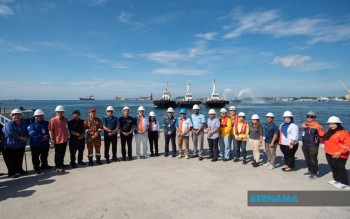
Megah Port Management Sdn Bhd (MPM) has officially commenced marine services operations at Labuan Port, marking a significant infrastructure milestone for the federal territory's maritime industry. The launch, held at Dermaga Merdeka Jetty, was underpinned by the acquisition of four tugboats valued at RM23 million—a substantial capital commitment that signals the company's determination to transform port operations and safety standards across the facility.
Managing director Datuk Seri Patrick Tiong emphasised that the tugboat acquisition represents far more than equipment procurement; it reflects MPM's strategic vision for Labuan Port as a modern, efficient maritime hub. The investment directly fulfils obligations outlined in the Operation, Facility and Management Continuation Agreement recently signed between MPM and the Labuan Port Authority (LPA), making marine services a core operational mandate rather than an optional enhancement. This contractual framework ensures that vessel assistance and safety functions are now embedded within the port's governance structure, creating accountability mechanisms that benefit both operators and users.
The tugboat fleet will handle multiple critical functions essential to modern port operations. Vessels entering and exiting Labuan Port will receive professional assistance during the technically demanding phases of berthing and unberthing—operations where even minor miscalculations can result in environmental contamination or vessel damage. The tugboats will maintain precise control over ship movements in confined waters, particularly important given Labuan's geography and the sensitivity of operations near major petrochemical terminals. During adverse weather or challenging sea conditions, the vessels provide stabilising power to prevent accidents that could cascade into environmental disasters or extended port closures affecting regional trade.
Perhaps most significantly, the tugboat deployment strengthens Labuan Port's emergency response architecture. Maritime incidents—fires, mechanical failures, collisions—demand immediate intervention capacity that only dedicated vessels can provide. The launch event included a live demonstration of emergency response capabilities, showcasing how the tugboats can provide firefighting support, relocate endangered vessels away from high-risk zones and coordinate seamlessly with Malaysian Maritime Enforcement Agency personnel and Marine Police Force units. This integrated approach to emergency management acknowledges that modern ports require multi-agency coordination where port operators serve as first responders working within broader maritime security ecosystems.
The marine services network extends across several strategically important operational zones within Labuan's jurisdiction. The DG Terminal, Petronas Chemicals Methanol Labuan Terminal, Asian Supply Base Fuel Terminal and Shell Timur Terminal collectively represent hundreds of millions of ringgit in industrial infrastructure and international supply chain connections. Each facility handles hazardous materials or high-volume operations where vessel movement errors carry amplified consequences. By concentrating professional tugboat services under unified MPM management, the port achieves operational coherence and standardised safety protocols that would be impossible if individual terminals managed their own towing arrangements.
Labuan's status as a regional maritime hub makes this investment particularly consequential for Southeast Asian shipping patterns. The federal territory serves as a transhipment point, bunkering station and industrial processing centre that connects Malaysian energy exports, Asian petrochemical markets and global trade routes. Operational inefficiencies or safety gaps at Labuan directly impact shipping schedules, insurance costs and environmental compliance across the broader region. A modern tugboat fleet operated to international standards strengthens Labuan's competitive position against rival ports in Singapore, Brunei and Indonesia, where vessel operators increasingly demand rigorous safety assurance and professional port services.
Coordination with maritime enforcement authorities represents another dimension of this service expansion. Tiong's emphasis on working closely with the Malaysian Maritime Enforcement Agency, Marine Police Force and other security bodies reflects contemporary port governance realities where drug trafficking, illegal fishing, smuggling and maritime terrorism require integrated surveillance and response capabilities. Professional tugboat operators positioned throughout port waters provide additional eyes and mobility resources that enhance enforcement agencies' situational awareness. This public-private collaboration model, increasingly common in developed port systems, leverages operator assets for national security purposes while maintaining clear operational and legal boundaries.
The RM23 million capital commitment also signals broader confidence in Labuan's economic trajectory. Port infrastructure investments of this magnitude typically reflect management confidence in sustained traffic growth, regulatory stability and return-on-investment prospects. For Malaysia's federal territory, recovering from economic headwinds during recent years, such private sector confidence represents validation that strategic port assets retain genuine strategic value. The investment suggests that MPM anticipates growing vessel volumes, particularly from petrochemical and energy sectors dependent on Labuan's unique position as a regional processing and trading hub.
Operational excellence standards embedded within this service launch deserve scrutiny regarding Malaysian port competitiveness more broadly. International vessel operators increasingly evaluate ports not merely on tariff structures but on safety records, professional personnel standards and emergency response capabilities. By adopting professional tugboat services as a foundational operational commitment rather than an afterthought, MPM positions Labuan alongside premium regional competitors. This approach contrasts with some regional ports where safety enhancements remain reactive, implemented only after incidents expose operational gaps. Proactive investment in safety infrastructure demonstrates that Malaysian port operators understand contemporary market dynamics where operational excellence and environmental stewardship directly influence shipping companies' berth allocation decisions.
The launch event's inclusion of an emergency response demonstration served practical purposes beyond ceremonial function. Real-world exercises identifying operational gaps, communication delays or equipment limitations allow corrections before actual emergencies occur. For port users, enforcement agencies and the broader maritime community, witnessing demonstrated emergency capabilities builds confidence that Labuan Port management has moved beyond theoretical commitments to proven operational readiness. This transparency regarding actual capabilities rather than aspirational statements represents sophisticated modern port governance where demonstrable competence matters more than promotional rhetoric.
Looking forward, Megah Port Management's marine services launch establishes baseline expectations that Labuan Port will maintain contemporary standards for vessel assistance, emergency response and maritime safety. The four-tugboat fleet provides immediate operational capacity while creating a platform for future expansion if traffic growth and operational demands warrant additional vessels. For Malaysia's maritime sector, the investment reinforces Labuan's importance within regional trading networks while demonstrating that sustained infrastructure commitments can enhance competitive advantages even for smaller ports competing against larger regional hubs. The professional standards embedded within this launch may ultimately prove as valuable as the vessels themselves, establishing a culture where safety, efficiency and maritime excellence shape daily operations.

