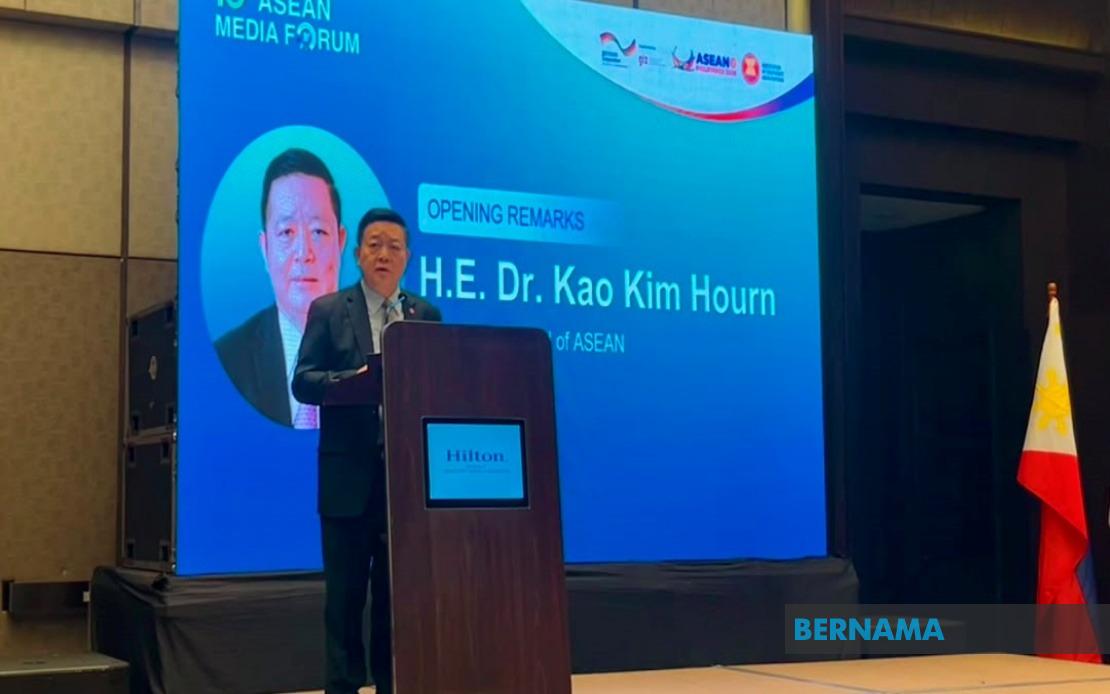
The media industry faces unprecedented responsibility in cementing ASEAN's vision for 2045, according to a call made at the 10th ASEAN Media Forum held in Manila this week. ASEAN Secretary-General Dr Kao Kim Hourn underscored that journalists and news organizations occupy a unique position to shape how the region's 650 million people engage with the bloc's policies and shared aspirations. Speaking to gathered media leaders and policymakers, Kao emphasized that as ASEAN navigates complex geopolitical terrain and economic integration, the role of credible information flows has become inseparable from the organization's success in connecting with ordinary citizens across the ten member states.
The landscape of news production and consumption has shifted dramatically over the past decade, creating both opportunities and significant challenges for regional engagement. Digital platforms, social media networks and artificial intelligence technologies have fundamentally altered how information moves across borders and reaches audiences. These innovations enable faster dissemination and reach, yet they simultaneously create pathways for misinformation and distorted narratives to proliferate with alarming speed. Kao acknowledged that this tension between technological capability and editorial responsibility now defines the environment in which journalists operate. The implications extend beyond newsrooms—they touch directly on public trust, national understanding of regional initiatives, and ultimately the viability of ASEAN's collective endeavor to build deeper integration.
Generative artificial intelligence represents both a transformative tool and a concerning development that demands careful stewardship from media institutions. The technology can enhance newsroom productivity, enable real-time multilingual reporting across Southeast Asia's diverse linguistic landscape, and improve access to information. Simultaneously, it introduces serious vulnerabilities including questions about editorial oversight, the authenticity of sourced material, intellectual property protections, and the emerging threat of deepfakes and synthetic media. These technical capabilities intersect with democratic values and public accountability in ways that few industries have previously confronted. Kao stressed that professional journalism grounded in rigorous verification, contextual understanding, and ethical frameworks becomes more essential precisely as technological tools proliferate. When media credibility erodes, rebuilding public confidence becomes extraordinarily difficult—a lesson relevant to newsrooms across Southeast Asia facing audience skepticism.
The connection between regional media quality and ASEAN's institutional effectiveness is more direct than often appreciated. Journalists serve not merely as chroniclers documenting the bloc's decisions and initiatives, but as active participants in translating complex regional policies into accessible narratives that resonate with diverse populations. ASEAN's political-security decisions, economic integration measures, and socio-cultural initiatives all depend partly on informed public understanding and acceptance. When media outlets effectively explain how a regional trade agreement affects local employment, or how ASEAN diplomatic efforts address security concerns, citizens develop informed perspectives that strengthen social cohesion around shared regional projects. Conversely, when reporting becomes fragmented or influenced by misinformation, public understanding fragments and political support for regional cooperation weakens.
The Philippines, currently holding the ASEAN Chair, has articulated the strategic importance of deliberate communication alongside deliberate decision-making. Undersecretary for Foreign Affairs Leo M. Herrera-Lim characterized media not as passive observers of ASEAN's development but as essential partners in shaping the region's future trajectory. This framing reflects recognition that institutional decisions made in ASEAN forums require sustained engagement with diverse constituencies across member states. News organizations in Malaysia, Indonesia, Thailand, Vietnam and other member countries serve as critical conduits connecting bureaucratic deliberations in Bangkok or Manila with public consciousness in provincial cities and rural communities. The quality of that translation directly affects whether ASEAN's Vision 2045 becomes a shared project with broad legitimacy or remains an elite-level initiative disconnected from grassroots sentiment.
Geopolitical complexity in Southeast Asia intensifies the demand for responsible journalism capable of resisting external pressures and domestic political manipulation. The region faces strategic competition between major powers, overlapping territorial claims, transnational security challenges, and divergent economic interests among member states. In such an environment, the temptation for various actors to weaponize media narratives or sponsor disinformation campaigns increases substantially. Malaysian journalists and editors understand this pressure intimately, operating in a region where information has become a dimension of strategic competition. The 10th ASEAN Media Forum provided space for regional media leaders to examine how journalism can maintain integrity and public service orientation amid such pressures, strengthening collective resilience against coordinated information warfare.
The evolution of the ASEAN Media Forum itself reflects growing institutional recognition of journalism's strategic role. Established in Manila in August 2017 to commemorate ASEAN's 50th anniversary, the forum has developed into a regular platform where journalists, media executives, and government officials exchange insights on regional challenges and collaborate on improving public communication. This development indicates that ASEAN leadership increasingly understands media engagement not as peripheral public relations but as fundamental to institutional legitimacy and policy effectiveness. The involvement of international partners, including the German government through its development cooperation agency GIZ, demonstrates that fostering professional journalism in Southeast Asia has broader international significance.
For Malaysian media organizations operating within ASEAN's largest economy and geographically central location, the responsibilities outlined at the forum carry particular weight. Malaysian journalism has historically served as a bridge between the region's diverse cultural and political traditions, and contemporary challenges require sustained commitment to that bridging function. The proliferation of misinformation across social media platforms and messaging applications affects Malaysian audiences as acutely as those in any ASEAN state. Simultaneously, Malaysian news organizations have the capacity to produce sophisticated analysis of regional economic integration, political developments, and cultural exchange that influences how the wider Southeast Asian media ecosystem frames ASEAN initiatives.
The challenge of rebuilding public trust, once damaged by sensationalism or misinformation, demands strategic investment in institutional credibility. Media organizations that prioritize verification, contextual reporting, and transparent editorial standards distinguish themselves in crowded information environments increasingly cluttered with unreliable sources. This competitive advantage becomes more pronounced as audiences grow frustrated with low-quality or manipulated content. Malaysian news organizations that maintain rigorous professional standards position themselves as reliable sources for both domestic audiences and regional readers seeking trustworthy information about Southeast Asian developments. Such credibility becomes increasingly valuable as ASEAN's integration deepens and citizens require sophisticated understanding of how regional decisions affect their economic prospects and security.
The forward trajectory toward 2045 depends substantially on whether ASEAN societies develop shared understanding of collective challenges and opportunities. Climate change, economic inequality, pandemic preparedness, and transnational crime all require coordinated regional responses that gain legitimacy from informed public consent. Professional journalism capable of explaining these interconnections and making abstract regional initiatives tangible for ordinary people represents essential infrastructure for ASEAN's future. The 10th Media Forum highlighted that this is not work that happens incidentally or automatically—it requires deliberate commitment from media institutions, supportive institutional frameworks, investment in journalist training and protection, and sustained dialogue between newsrooms and policymakers about how information systems can serve democratic values while strengthening regional solidarity.

