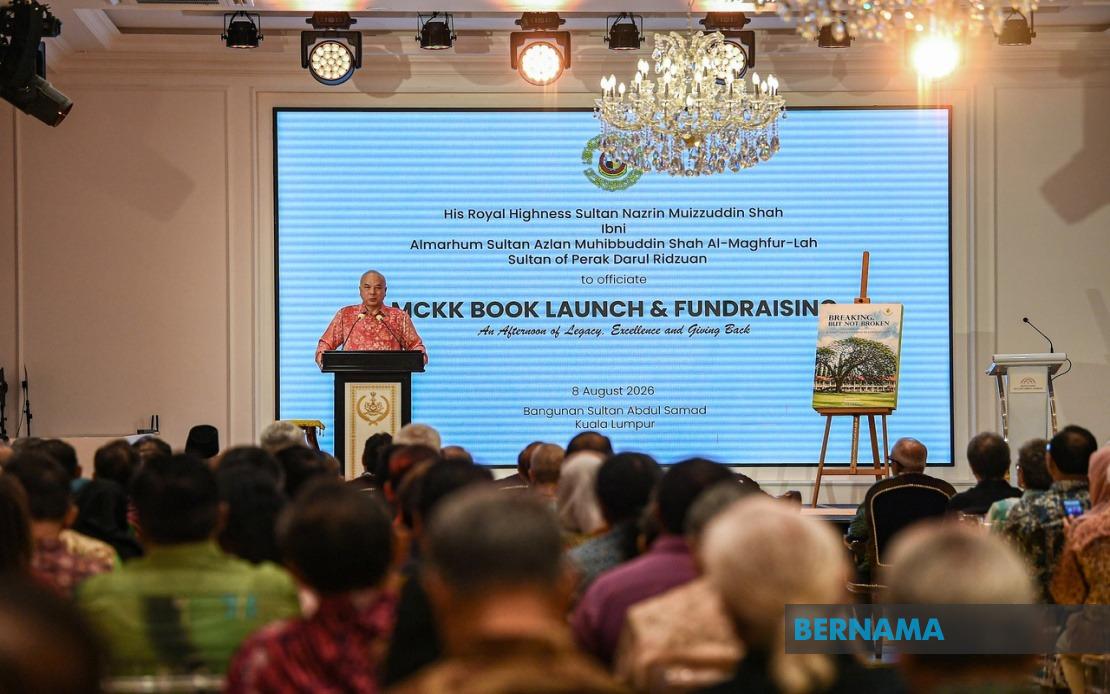
Malaysia's premier heritage schools can chart a new course in the modern era by embracing transformative change while anchoring themselves in the values that built their reputation, according to Sultan Nazrin Shah, the Sultan of Perak and Royal Patron of the Malay College Kuala Kangsar board. Speaking at the launch of a book examining the institution's trajectory, His Royal Highness outlined how selective residential schools must navigate a landscape fundamentally reshaped by artificial intelligence and accelerating technological disruption.
The challenge before these storied institutions goes beyond mere modernisation of facilities or curriculum. Sultan Nazrin stressed that the education framework itself requires reimagining to equip the next generation with capacities that current systems may not yet prioritise. The traditional strengths that made schools like MCKK household names—rigorous discipline, linguistic mastery, critical thinking, and a commitment to public service—remain valuable, yet their delivery mechanisms must adapt to an era where technology mediates learning in unprecedented ways.
The Sultan's remarks acknowledge a troubling reality: Malaysia's most celebrated schools, once reliably producing leaders and high achievers, have experienced a perceptible decline in their output and influence. The book being launched, authored by Ghazally Ismail, Ahmad Ibrahim, and Hisham Badrul Hashim, approaches this uncomfortable subject with unflinching honesty. His Royal Highness praised the authors for their willingness to examine what some might regard as sensitive institutional vulnerabilities, noting that their analysis extends across the ecosystem of similar elite boarding schools whose power and prestige have measurably dimmed.
What most concerns observers is not merely a slip in examination results but a broader erosion in the qualities that distinguished these institutions. Graduates today are perceived as lacking the command of language, depth of analytical capacity, and service orientation that characterised cohorts from decades past. This gap represents more than an academic concern—it signals a potential disadvantage for Malaysia's future leadership pipeline at a moment when complex global and regional challenges demand precisely the kind of rounded, morally grounded thinking these schools traditionally cultivated.
Sultan Nazrin articulated a dual imperative for educational reform in this new context. First, schools must develop human capital capable of thriving within rapidly evolving economic structures driven by technological innovation—a practical, market-oriented objective. Second, and equally vital, they must continue nurturing well-rounded individuals whose ethical sensibilities, emotional intelligence, and values equip them to serve society constructively. The Sultan emphasised that while both dimensions have always mattered, the current period of profound uncertainty makes their simultaneous delivery non-negotiable.
The integration of artificial intelligence into educational systems presents both opportunity and threat. On one hand, AI tools can personalise learning, accelerate skill acquisition, and expose students to global knowledge resources previously inaccessible. On the other, over-reliance on algorithmic instruction risks atrophying the very capacities—creative problem-solving, ethical reasoning, human connection—that distinguished Malaysian heritage schools from more regimented or purely technical institutions. The Sultan's call for reimagined systems suggests these schools must harness AI's potential while deliberately preserving space for the slower, messier, more human dimensions of education that cannot be algorithmically optimised.
Meanwhile, the Malay College's board has documented substantial progress in resource mobilisation and infrastructure renewal. Chairman Tan Sri Dr Ahmad Tajuddin Ali reported that the MCKK Foundation has accumulated more than RM36 million in donations since its 2008 establishment. This injection of capital has funded significant physical improvements: the IB Complex and Auditorium Tun Abdul Razak represent flagship additions, while over RM3.5 million has gone toward refurbishing hostels, sports facilities, and heritage buildings that require ongoing maintenance.
Beyond brick-and-mortar development, the institution has built an endowment exceeding RM16 million, notably supported by corporate benefactors including PETRONAS and the Sultan of Brunei. This financial foundation generates annual investment income approaching RM7 million, funds redirected toward scholarships for disadvantaged scholars, leadership programmes, international competition participation, and teacher professional development. Such endowment structure insulates the college from year-to-year budget volatility and enables strategic, long-term investments in educational quality.
Yet resource accumulation alone cannot address the deeper institutional challenges these schools face. The book authors' critique, embraced by the Sultan himself, suggests that MCKK must confront questions of relevance, pedagogy, and cultural positioning that money cannot resolve. How should a school founded during the British colonial era—steeped in traditions of boarding-school elitism and imperial aesthetics—communicate its purpose to students whose frames of reference have been shaped by social media, global mobility, and plural identity? How can it maintain selectivity and excellence without breeding insularity or irrelevance?
For Malaysia and Southeast Asia more broadly, the fate of institutions like MCKK carries systemic importance. These schools have traditionally functioned as connective tissue linking educational excellence, political leadership, and social cohesion. If they decline, the nation loses not just educational capacity but also nodes of institutional continuity and moral authority. Conversely, if they successfully reinvent themselves—integrating technological sophistication with humanistic depth, balancing competitive rigour with inclusive access, updating traditions without abandoning them—they could model how heritage institutions navigate modernity elsewhere in the region.
The Sultan's intervention, framed as both supportive and cautionary, signals that Malaysia's leadership recognises the stakes. Heritage schools must not merely endure but evolve, offering future generations the analytical sophistication and ethical grounding to harness rather than be harmed by technological transformation. This demands intellectual courage from school leaders, willingness to question inherited practices, and commitment to excellence defined not by nostalgia but by genuine preparedness for an unknowable future.

