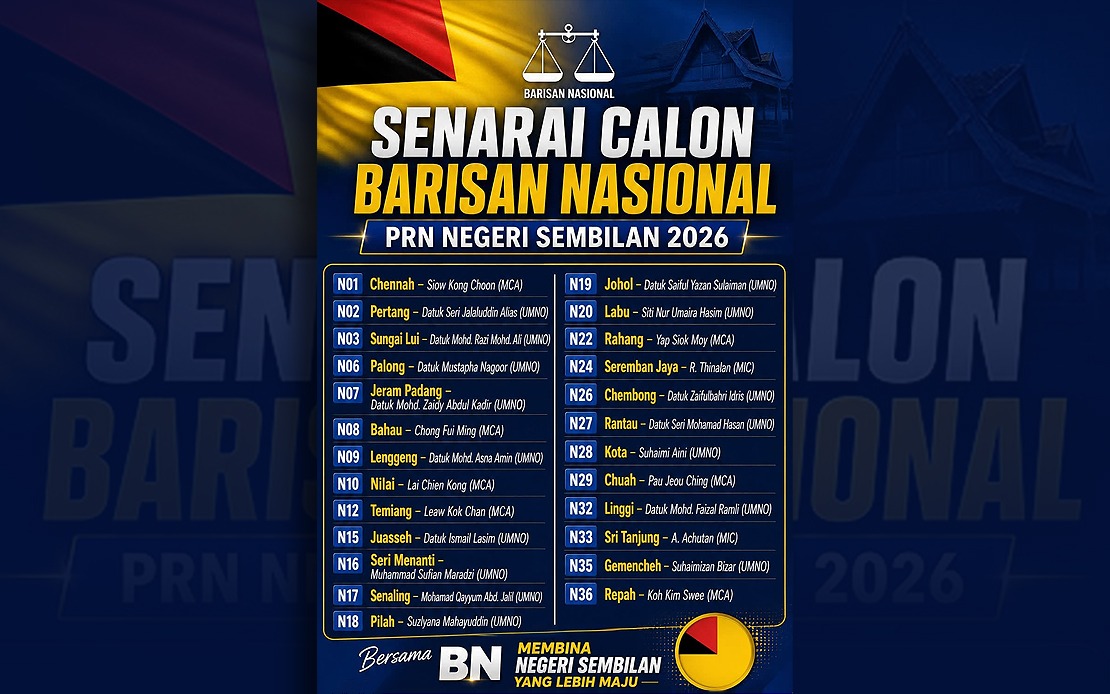
The Barisan Nasional coalition has finalised its seat distribution for the upcoming Negeri Sembilan state election, with the MCA receiving seven State Legislative Assembly seats and MIC securing four, according to BN chairman Datuk Seri Dr Ahmad Zahid Hamidi. The Deputy Prime Minister made the announcement in Seremban after meeting with prospective BN candidates, signalling the coalition's readiness to contest the 16th state election following a challenging period of political realignment in the state.
Ahmad Zahid explained that the allocation methodology centred on a rigorous assessment of electoral viability across constituencies. Rather than relying solely on historical performance or party seniority, BN's leadership evaluated each prospective candidate's chances of securing victory in their designated area. This approach reflects broader coalition dynamics within BN, where component parties must justify their territorial claims through demonstrable ground strength and candidate quality. The formula balances maintaining the coalition's internal equilibrium whilst optimising the chances of reclaiming state government control from the incumbent opposition.
The BN chairman disclosed that he had personally conducted meetings with all prospective candidates standing under the coalition banner, requiring them to sign undertakings and pledge allegiance to his leadership. This formalised vetting process underscores BN's determination to maintain party discipline and prevent defections, a critical consideration given recent political volatility across Malaysian states. Such ceremonial pledges, whilst routine during state elections and general elections, carry symbolic weight in reassuring the coalition leadership that candidates remain committed to the BN platform and will not fracture the coalition's unity during the campaign period.
The announcement comes amid a compressed electoral timeline set by the Election Commission. Nomination day is scheduled for July 18, with early voting occurring on July 28 and polling day on August 1. This compressed schedule leaves limited time for extensive campaigning, placing emphasis on the strength of BN's ground machinery and the appeal of its candidates. Ahmad Zahid is scheduled to unveil the complete list of BN candidates the same evening at Stadium Tuanku Abdul Rahman Paroi, allowing the coalition to begin its formal campaign mobilisation immediately.
The context of this election reveals BN's strategic challenge in Negeri Sembilan, where the coalition experienced a significant reversal in the 15th state election. BN secured only 14 seats whilst Pakatan Harapan claimed 17 and Perikatan Nasional captured five of the 36 available seats. This outcome left BN in opposition, a position the coalition is determined to reverse through this election. The seat allocation to MCA and MIC, though modest in absolute terms, represents a commitment to maintaining the coalition's multi-ethnic character and ensuring Malay-Muslim, Chinese, and Indian communities are represented within BN's electoral slate.
For MCA specifically, receiving seven seats in Negeri Sembilan represents a meaningful platform to demonstrate its relevance and electoral competitiveness. The party has faced declining support in recent years across Malaysia, making state elections crucial venues for rebuilding credibility with Chinese voters. The seven seats offered by BN provide MCA with sufficient representation to claim a stake in potential government formation whilst testing whether internal party reform and leadership changes have resonated with its traditional voter base. These seats are likely concentrated in constituencies with significant Chinese populations, where MCA retains organisational presence.
MIC's allocation of four seats similarly reflects the coalition's effort to maintain Indian community representation, though this number signals the relative weakness of MIC's current electoral standing. Like MCA, MIC has struggled to maintain electoral momentum, and state elections provide opportunities to demonstrate viability and attract resources from the national leadership. The four seats will probably be distributed across areas with notable Indian constituencies, allowing MIC to contest in environments where it has established community networks.
The seat allocation formula employed by BN carries implications for coalition dynamics within Malaysian politics. By emphasising electoral viability rather than proportional representation based on party membership or seniority, Ahmad Zahid's approach prioritises victory over symbolic power-sharing. This pragmatic stance may generate internal tensions within the coalition if smaller component parties feel marginalised, yet it reflects the electoral mathematics reality facing BN. In competitive states like Negeri Sembilan where BN holds opposition status, maximising seat efficiency becomes paramount to achieving government formation.
The broader political context sees Negeri Sembilan as a significant battleground within Malaysia's electoral landscape. The state's mixed demographics and swing voter populations make it highly contestable, and control of the state government carries implications for national coalition strength. A BN victory would strengthen Prime Minister Anwar Ibrahim's overall coalition position and validate the electoral strategy of seeking opposition state government recapture. Conversely, any Pakatan Harapan or PN gains would demonstrate continued resistance to BN's revival efforts in states where the coalition lost ground.
For Malaysian readers and regional observers, this election represents a test of whether BN's reconstituted leadership under Ahmad Zahid can reverse recent electoral losses. The allocation of seats to MCA and MIC indicates the coalition's commitment to ethnic pluralism, though whether these parties can mobilise sufficient votes remains uncertain. The compressed timeline, competitive electoral landscape, and symbolic importance of Negeri Sembilan to Malaysia's broader political trajectory make this state election significant beyond its immediate geographic boundaries, offering early indicators of voter sentiment before potential future national electoral contests.

