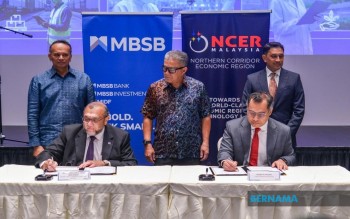
Malaysia's financial sector is taking concrete steps to support regional economic development with the signing of a significant partnership between MBSB Bank Bhd and the Northern Corridor Implementation Authority (NCIA). The two organisations inked a memorandum of understanding in Petaling Jaya on July 17, committing to provide financing facilities totalling up to RM1 billion for small and medium enterprises seeking to establish or expand operations across the Northern Corridor Economic Region (NCER).
The initiative represents a strategic response to the government's broader economic development agenda, particularly under the 13th Malaysia Plan. MBSB Bank chairman Datuk Wan Kamaruzaman Wan Ahmad underscored the partnership's potential to generate meaningful commercial opportunities for SMEs throughout the Northern region. He outlined how the financing mechanism would enable businesses to enhance production capabilities, integrate into established supply chains, and contribute substantively to the corridor's medium and long-term economic trajectory. The RM1 billion commitment signals serious institutional backing for regional growth beyond Malaysia's more developed southern zones.
The Northern Corridor itself encompasses four states—Perlis, Kedah, Penang, and Perak—forming a geographical and economic cluster that has emerged as one of the country's most dynamic regions. Over recent years, this area has successfully attracted both domestic and international capital flows, particularly in technology-intensive and value-added sectors. The NCER's performance reflects broader efforts to decentralise Malaysia's economic activity and reduce regional disparities in industrial development and employment opportunities.
MBSB Bank group chief executive officer Rafe Haneef articulated a dual purpose for the collaboration. Beyond simply providing credit facilities, the bank aims to attract high-potential companies with export capabilities to access MBSB's financing products and expertise. This distinction matters considerably: the partnership is not merely about deploying capital within the region, but about identifying and supporting firms with genuine growth trajectories and international competitiveness. The bank's existing partnership with Santander Group, a major European banking institution, adds another dimension to this offering, creating potential pathways for participating SMEs to access international markets and cross-border transaction expertise.
The formal signatories—MBSB Bank group chief commercial banking officer Noor Mohamed Amin and NCIA chief operating officer Hasri A Hassan—represent the operational level at which this partnership will be implemented. This distinction between ceremonial and working-level signatures matters for tracking subsequent execution. The involvement of NCIA's chief operating officer suggests the initiative will receive substantive administrative support from the statutory body responsible for directing economic development in the corridor region.
NCIA chief executive Datuk Mohamad Haris Kader Sultan positioned the partnership within the broader context of NCER's sectoral development strategy. Six priority sectors have been identified for the corridor's future growth: electrical and electronics manufacturing, advanced manufacturing, agri-food production, logistics, the digital economy, and green technology. These sectors represent both traditional manufacturing strengths and emerging innovation-driven industries, indicating a sophisticated understanding of how the Northern region can position itself competitively within global value chains while adapting to technological and environmental shifts.
The emphasis on these particular sectors reveals strategic thinking about how the NCER can differentiate itself and complement rather than duplicate economic activities already established elsewhere in Malaysia. Electrical and electronics manufacturing, for instance, has deep roots in Penang's industrial ecosystem, while agri-food development leverages the agricultural potential of inland states like Perak and Kedah. The inclusion of digital economy and green technology alongside traditional sectors indicates recognition that future competitiveness requires innovation infrastructure alongside manufacturing capacity.
For SMEs operating in these designated sectors, the RM1 billion financing facility potentially addresses a persistent constraint on regional business expansion. Access to capital at reasonable rates remains a significant challenge for many Malaysian small and medium enterprises, particularly those located outside major metropolitan centres. By institutionalising a dedicated financing mechanism through MBSB Bank rather than requiring SMEs to navigate standard commercial lending channels, this partnership reduces friction and information asymmetries that often disadvantage regional businesses when competing for credit.
The partnership also reflects evolving approaches to economic development policy in Malaysia. Rather than relying solely on government budget allocations for infrastructure or direct business subsidies, policymakers are increasingly leveraging private sector financial institutions to channel development support. This approach distributes risk, builds commercial sustainability into development initiatives, and aligns growth strategy with profit motives, creating incentives for effective capital deployment and borrower performance monitoring.
For Malaysian SMEs contemplating Northern Corridor operations, the immediate practical implication is improved financing accessibility. The RM1 billion facility, while substantial, will ultimately be distributed across multiple borrowers and projects. SMEs interested in accessing this financing will need to demonstrate viability within the identified strategic sectors and meet MBSB Bank's credit assessment standards. The involvement of Santander Group opens additional possibilities for businesses with export ambitions, though operational details regarding how this partnership functions remain to be clarified through implementation.
The broader regional dimension deserves consideration as well. Malaysia's Northern Corridor competes for investment and talent with comparable regions in Thailand, Indonesia, and Vietnam. Economic development initiatives like this MBSB-NCIA partnership contribute to the NCER's competitive positioning within Southeast Asia. Access to dedicated financing facilities, combined with infrastructure development and regulatory support, helps make the Northern region an attractive destination for regional and multinational SME operations and supply chain operations.
Looking forward, the success of this partnership will depend on how effectively MBSB Bank and NCIA execute the MoU's commitments. Financial institutions regularly sign cooperative agreements; transformation into sustained, meaningful impact requires consistent operational focus. The real test will emerge over the coming quarters as actual financing disbursements occur, borrower experiences accumulate, and measurable economic outcomes materialise across the four Northern Corridor states.

