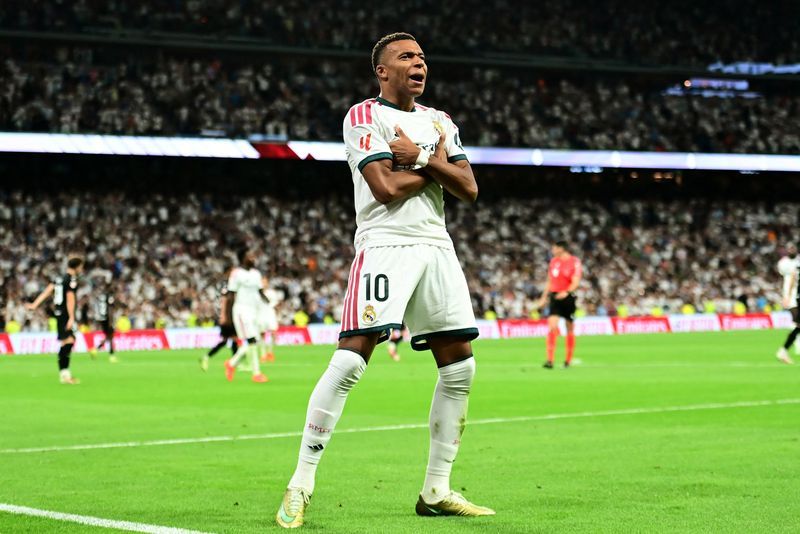
Real Madrid launched their LaLiga campaign with an emphatic display on Wednesday, overwhelming Real Sociedad 4-1 at home with Kylian Mbappe producing a magnificent three-goal performance that showcased the club's attacking prowess. The French forward's clinical finishing proved decisive as the Whites recovered from an unconvincing first-half showing to dismantle their Basque opponents after the interval, underlining the calibre of their newly assembled squad heading into the season.
The opening 45 minutes told a starkly different story from what unfolded in the second half. Real Madrid appeared disjointed and vulnerable, moving the ball carelessly through midfield while struggling to impose their usual control. The home crowd's frustration was palpable as Real Sociedad threatened repeatedly, with the visitors enjoying the sharper early momentum. The Bernabeu faithful aired their displeasure before halftime, sensing their team had yet to find the required intensity and cohesion. Such criticism is customary at Madrid's stadium, where supporters demand nothing less than championship-standard football from their players every matchday.
Real Sociedad's threat in the opening period was genuine and well-executed. In the 10th minute, Take Kubo intercepted a wayward pass near the penalty area and fed Mikel Oyarzabal for a close-range effort that Thibaut Courtois was called upon to repel. The visiting team continued this pressure throughout the half, with Sergio Gomez nearly catching Madrid cold when his volley from distance swerved enticingly wide of the post. Had the Basques capitalised on their dominance, the complexion of the match would have shifted considerably.
Mbappe, however, provided the pivotal moment just before the interval. Federico Valverde collected possession deep in Madrid's half and executed a perfectly weighted pass that sliced open Real Sociedad's defence. The striker accelerated into the box with his trademark composure, cut infield and unleashed a powerful finish into the top corner to silence the jeers momentarily. Yet Madrid's defensive fragility resurfaced almost immediately. Four minutes after falling behind, the hosts conceded when Job Ochieng latched onto a long ball and his deflected touch fell to Luka Sucic on the right flank, who steadied himself and buried a low drive beyond Courtois to level the score as halftime approached.
Jose Mourinho's tactical adjustment at the break proved transformative. The Portuguese coach introduced Marc Cucurella at left-back, and Madrid emerged from the tunnel as a reformed outfit entirely. The team's intensity, pressing, and directness increased markedly, with Vinicius Jr and Mbappe stretching the visitors relentlessly on the wings. This was the Real Madrid supporters expected to witness—commanding, fluid, and suffocating opponents through aggressive ball recovery and incisive transitions. The difference between the two halves demonstrated not only Madrid's quality but also Mourinho's capacity to read matches and implement decisive changes.
Mbappe restored Madrid's lead on the hour mark with a demonstration of intelligent movement and finishing. After exchanging a crisp one-two combination with Jude Bellingham near the box, the France international found space to receive the return pass and converted with a low strike that left Alex Remiro helpless. Eight minutes later, Bellingham's relentless pressing near the byline forced Real Sociedad into an error, allowing the England midfielder to deliver a low cross that presented Vinicius Jr with a tap-in from close range. The Whites had seized complete control, their attacking instincts overwhelming a visiting side that had faded considerably.
Mbappe completed his hat-trick in the 80th minute with a finish befitting his status as one of Europe's elite strikers. Vinicius Jr slipped a perfectly weighted pass behind Real Sociedad's backline, and the forward demonstrated exceptional composure by lifting a delicate chip over the goalkeeper to seal a comprehensive victory. The goal epitomised Madrid's transformation—constructed through precision movement, incisive passing, and ruthless execution in the final third.
For Mourinho, the evening represented a triumphant return to the Santiago Bernabeu, where he had managed Madrid to notable success years earlier. His last home match in charge of the club occurred more than 13 years prior, making this comeback laden with symbolic weight. Despite the jeers that greeted his team's first-half performance, Mourinho remained philosophical, suggesting that fan criticism serves a constructive purpose. During his post-match remarks, he acknowledged the demanding nature of the Santiago Bernabeu's supporters and praised his players' mental resilience in responding to adversity. His observation that there exists a fairness in both applause and boos reflected his pragmatic approach to navigating elite club environments where standards remain perpetually exacting.
The scale of Madrid's second-half superiority underscored what might have been possible had they maintained greater discipline and intensity throughout. Mourinho's comments suggested the team could have inflicted an even more lopsided scoreline, indicating that despite the convincing final margin, certain defensive vulnerabilities remained against more incisive opponents. Real Sociedad's collapse after the interval provided limited insight into how Madrid might perform against equally demanding opposition, yet the commanding nature of their attacking performance will provide considerable encouragement as the season progresses.
Mbappe's three-goal haul immediately established him as the tournament's early standout performer and vindicated Real Madrid's significant investment in acquiring his signature. The France forward's ability to influence matches through direct running, technical excellence, and clinical finishing suggests the club's attacking resources have been substantially enhanced. Combined with the creativity of Bellingham and the wing play of Vinicius Jr, Madrid possess an attacking quartet capable of dismantling virtually any defence when operating at full efficiency.
For Malaysian and Southeast Asian observers, this encounter illustrates the calibre of football commanded by European elite clubs and the level of tactical sophistication now expected at the highest echelon of club competition. The contrast between Real Madrid's sluggish first half and dominant second half underscores how contemporary football increasingly hinges upon adaptive coaching and mental resilience rather than talent alone. Mourinho's influence in reshaping his team's approach demonstrated why experienced tacticians remain valuable at elite institutions, even as younger coaches increasingly compete for prominence.

