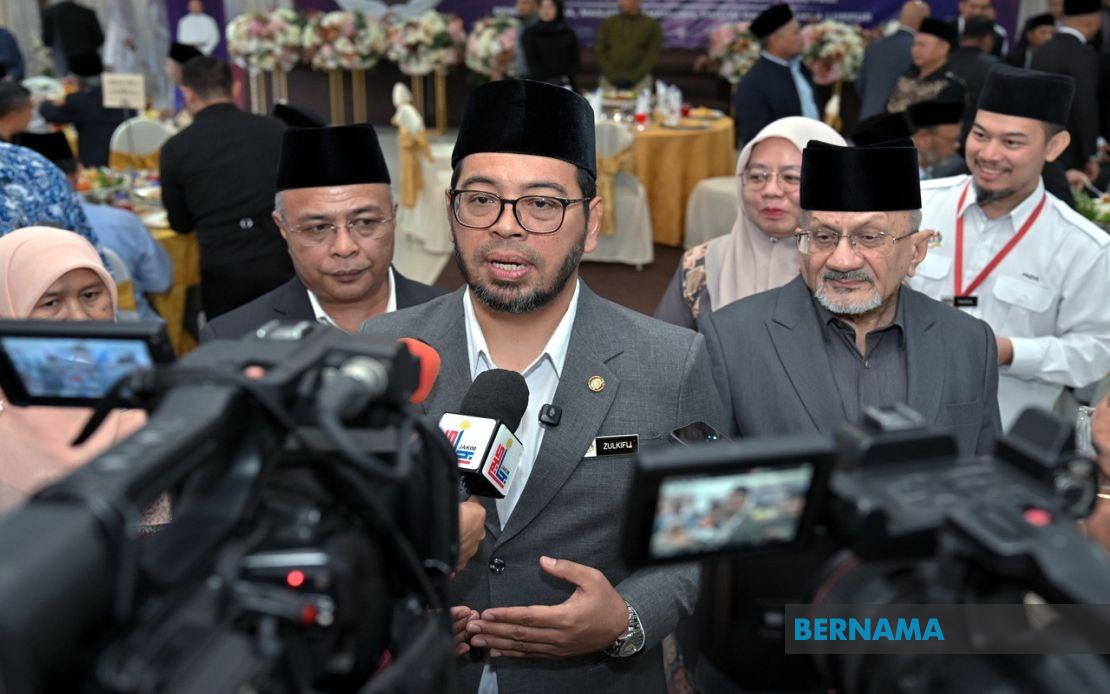
The long-anticipated Masjid Warisan development situated in front of the Tun Razak Exchange (TRX) tower in Kuala Lumpur will advance according to its original timeline, according to Minister in the Prime Minister's Department (Religious Affairs) Dr Zulkifli Hasan. The confirmation came during remarks to journalists in the federal capital on June 23, where the minister sought to dispel growing uncertainty surrounding the project's future. The initiative has been in development for an extended period and represents a deliberate effort to strengthen mosques as vital institutions fostering social cohesion across Malaysian communities.
The minister's announcement comes in response to recent media coverage highlighting objections from certain segments who have called for the project's abandonment. These critics have contended that the mosque's construction could potentially create friction between different groups and generate public dissatisfaction within the surrounding area. Nevertheless, Zulkifli dismissed these apprehensions, characterising the Masjid Warisan initiative as a firmly established component of the government's long-term urban development agenda that warrants implementation. The minister employed the phrase "Insya Allah" when expressing confidence that the project would be realised, reflecting both religious faith and official determination to see the plan materialise.
For residents and observers concerned about the mosque's proposed development, Zulkifli recommended engaging directly with the Federal Territories Islamic Religious Council (MAIWP) to obtain authoritative information and clarification regarding the construction's rationale and anticipated community benefits. This invitation to dialogue represents an attempt to transform opposition into understanding through transparent communication channels. The minister's approach underscores a broader strategy within Malaysia's religious affairs apparatus to address public anxieties through institutional engagement rather than dismissal.
Zulkifli contextualised the Masjid Warisan project within a global perspective, noting that major international cities routinely accommodate mosques as integral urban components. He highlighted that the Islamic call to prayer, or adhan, serves as a source of spiritual tranquillity in cosmopolitan centres worldwide. This framing positions the Kuala Lumpur mosque not as an anomalous or divisive insertion into the landscape, but as a natural fixture consistent with contemporary urban planning in developed metropolises. The observation carries particular significance for Malaysia, which aspires to position itself as a competitive global financial hub while maintaining its Islamic identity.
The minister's remarks were delivered during a separate ceremony at Masjid Al-Khadijah in Kampung Pantai Dalam, where he formally presented appointment letters to members of the Federal Territories Mosque and Friday prayer surau committee for the 2026-2029 term. This event provided a platform for the Religious Affairs Ministry to showcase governance structures within Malaysia's mosque administration system. The concurrent announcements linking committee appointments with the Masjid Warisan confirmation suggest a coordinated messaging strategy designed to emphasise institutional competence and continuity in mosque management.
The appointment process revealed substantial community engagement, with 3,010 nominations submitted for consideration across the forthcoming 2026-2029 session. These nominations encompassed 91 mosques and 124 Friday prayer surau facilities throughout the Federal Territories, reflecting widespread participation in mosque governance structures. The nomination process itself demonstrates the depth of voluntary commitment within Malaysia's Islamic institutional framework, where thousands of individuals express willingness to contribute to religious community leadership.
The selection mechanism employed rigorous vetting procedures designed to ensure administrative integrity and public confidence in mosque governance. Of the 3,010 nominees, 2,914 candidates successfully completed an integrity assessment process involving collaboration between the Royal Malaysia Police, the Malaysian Anti-Corruption Commission, and the Insolvency Department. This multi-agency verification approach represents a substantial investment in institutional credibility, suggesting that mosque governance in Malaysia operates within frameworks comparable to civil service standards.
The Masjid Warisan project's significance extends beyond its immediate architectural contributions to the Kuala Lumpur skyline. The mosque's proximity to TRX, one of Malaysia's most prominent financial developments, carries symbolic weight regarding the integration of Islamic institutions within modern commercial landscapes. For Southeast Asian observers monitoring Malaysia's approach to religious pluralism and secular development, the project demonstrates an attempt to reconcile contemporary urban growth with religious identity preservation. The willingness to proceed despite opposition suggests confidence in Malaysia's capacity to accommodate diverse community interests within evolving metropolitan environments.
The project also reflects broader discussions within Malaysia about urban identity and religious representation. As Kuala Lumpur continues expanding its international profile through developments like TRX, the Masjid Warisan represents a calculated assertion that Islamic architecture and institutional presence remain central to the capital's character. This positioning carries implications for how Malaysia articulates its identity as both a Muslim-majority nation and an aspiring international financial centre, demonstrating that these identities need not be mutually exclusive but can coexist within carefully planned urban spaces.
Looking forward, the Masjid Warisan project's implementation will likely serve as a case study in Malaysian urban development and community management. The government's determination to proceed despite vocal opposition suggests confidence in the project's benefits and reflects broader confidence in Malaysia's capacity to address religious and social concerns through institutional dialogue. The involvement of MAIWP in addressing public concerns establishes a mechanism for ongoing community engagement throughout the construction and operational phases. For Malaysian and regional observers, the project's trajectory will provide insights into how Southeast Asia's largest Muslim-majority economies navigate the complex intersection of religious identity, urban modernisation, and social cohesion in the twenty-first century.