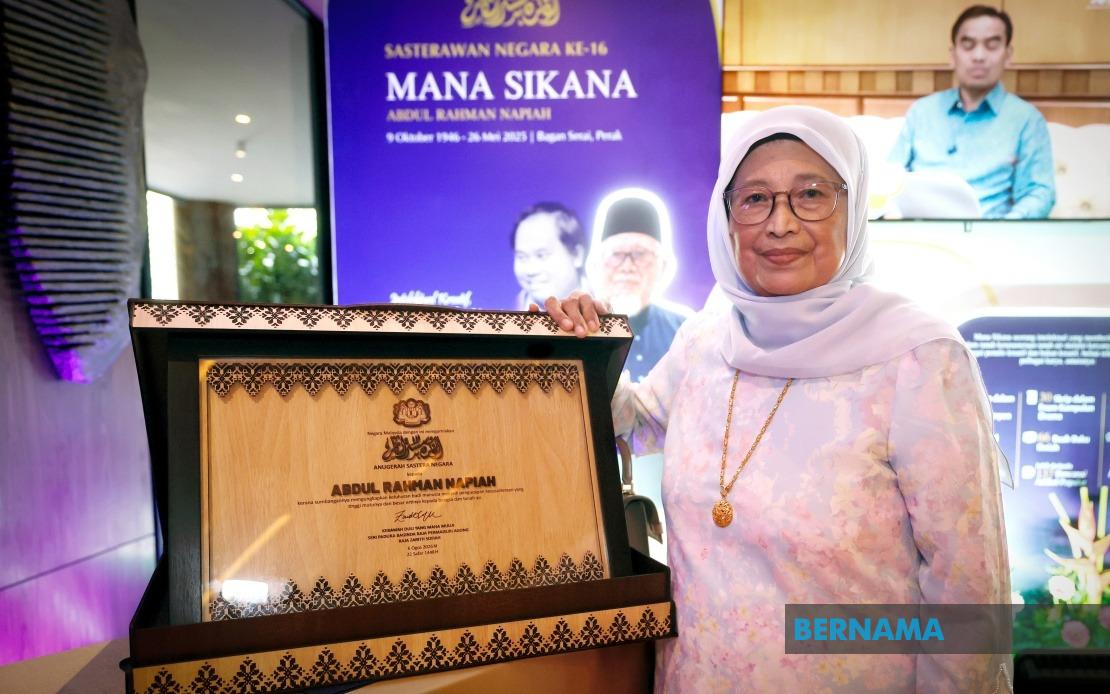
Malaysia's literary establishment has bestowed its highest honour on the late Dr Abdul Rahman Napiah, better known by his celebrated pen name Mana Sikana, conferring upon him the title of the nation's 16th National Laureate. The recognition came through a formal ceremony in Kuala Lumpur on August 6, where Her Majesty Raja Zarith Sofia, Queen of Malaysia, presented the award to his widow, Salmah Ali, 82, who accepted the honour with a mixture of pride and profound sorrow at her husband's absence.
For Salmah Ali, the moment encapsulated both vindication and loss. She disclosed that her husband had long anticipated this recognition, having consistently excelled in literary competitions and awards throughout his career spanning from his school years into retirement. In a poignant detail, Salmah revealed that Mana Sikana had been informed of the possibility of receiving the award before his death in May at age eighty from cardiac complications. On the very day he died, he had been engaged in his characteristic pursuit of intellectual contribution—presenting a research paper to Dewan Bahasa dan Pustaka—when he fell ill. The award he had hoped for thus arrives after his passing, a bittersweet fulfilment of aspirations.
Education Minister Fadhlina Sidek, also present at the ceremony, framed the selection as official recognition of Mana Sikana's foundational role in elevating Malaysian literature. His influence spanned creative writing, literary theory, critical analysis, and university-level discourse, disciplines through which he reshaped how Malay literature was studied and appreciated both domestically and internationally. This multidisciplinary contribution distinguishes him from literary figures focused solely on creative output; his scholarly rigor elevated the intellectual standing of Malay letters within academic institutions across multiple countries.
Born in Bagan Serai, Perak, on October 9, 1946, Mana Sikana's trajectory reflects the trajectory of Malaysia's intellectual class across several decades. He commenced his professional life as a classroom teacher, a foundation that anchored his understanding of language and expression. Subsequently, he transitioned into higher education, where he achieved the rank of professor—a distinction rarely paired with sustained creative output in Malay literature. His academic postings took him across Southeast Asia: he contributed significantly to Universiti Kebangsaan Malaysia's development as a centre for Malay studies, lectured at Nanyang Technological University in Singapore, and spent formative years at Universiti Pendidikan Sultan Idris (UPSI), demonstrating how Malaysian intellectual leadership extended beyond national borders.
Salmah's testimony illuminated dimensions of her husband's work beyond his published novels and academic papers. During their residence in Johor Bahru, he had crafted television and radio drama productions for Singapore's broadcasting landscape while simultaneously maintaining his teaching obligations—a workload that speaks to the intellectual productivity expected of his generation's scholars. Malaysian television networks regularly aired his dramatic works, positioning him as a bridge between popular and elite cultural consumption at a time when such crossover was uncommon. His parallel careers in creative writing, broadcasting production, and academia represented a model of intellectual engagement that increasingly disappeared as specialisation narrowed professional boundaries.
The couple's family life became an extension of his literary mission. Salmah disclosed that Mana Sikana transmitted his passion for language, writing, and literary appreciation to their four children and twelve grandchildren until his final days, suggesting that his influence operated at familial and institutional levels simultaneously. This intergenerational transmission of intellectual values, particularly through direct mentorship within families, constitutes an often-overlooked dimension of how literary cultures are sustained and evolved within societies. His grandchildren inherited not merely a famous surname but direct exposure to rigorous thinking about language and creative expression.
The National Laureate designation carries particular weight within Malaysia's cultural hierarchy, representing the state's official endorsement of a figure's contributions to national development through artistic and intellectual endeavour. By conferring this honour posthumously, Malaysia's leadership acknowledged that certain contributions transcend the lifetime of their creator and merit formal institutionalisation of their value. For Mana Sikana specifically, the award crystallises a career characterised by restless productivity across multiple domains—the novelist, the academic theorist, the drama producer, the university builder, and the mentor all unified in a single biographical narrative.
Yet the bittersweet nature of the recognition resonated through Salmah's emotional testimony. She described the peculiar pain of attending an awards ceremony honouring her husband's life without his physical presence, of accepting accolades he had longed for but would not himself experience. This dimension—the gap between ambition and realisation, between hope and posthumous validation—imbues the award with melancholic authenticity. Mana Sikana's awards trajectory, beginning in school and culminating in this final national honour, traces an arc of consistency rarely achieved in literary careers marked by fluctuating fashions and institutional whims.
For Malaysian and Southeast Asian readers, the recognition of Mana Sikana invites reflection on how literary cultures are sustained and valued within societies undergoing rapid modernisation. His career demonstrated that Malay literature required not merely creative practitioners but rigorous intellectuals willing to establish theoretical frameworks, build academic institutions, and produce works for mass audiences simultaneously. At a moment when digital platforms and commercial pressures reshape literary production, his model of multivalent engagement—scholarship, creative writing, drama, mentorship—suggests dimensions of literary practice increasingly difficult to maintain. The conferment of the National Laureate award to his memory thus honours not only individual achievement but a particular conception of the literary intellectual's role within society.

