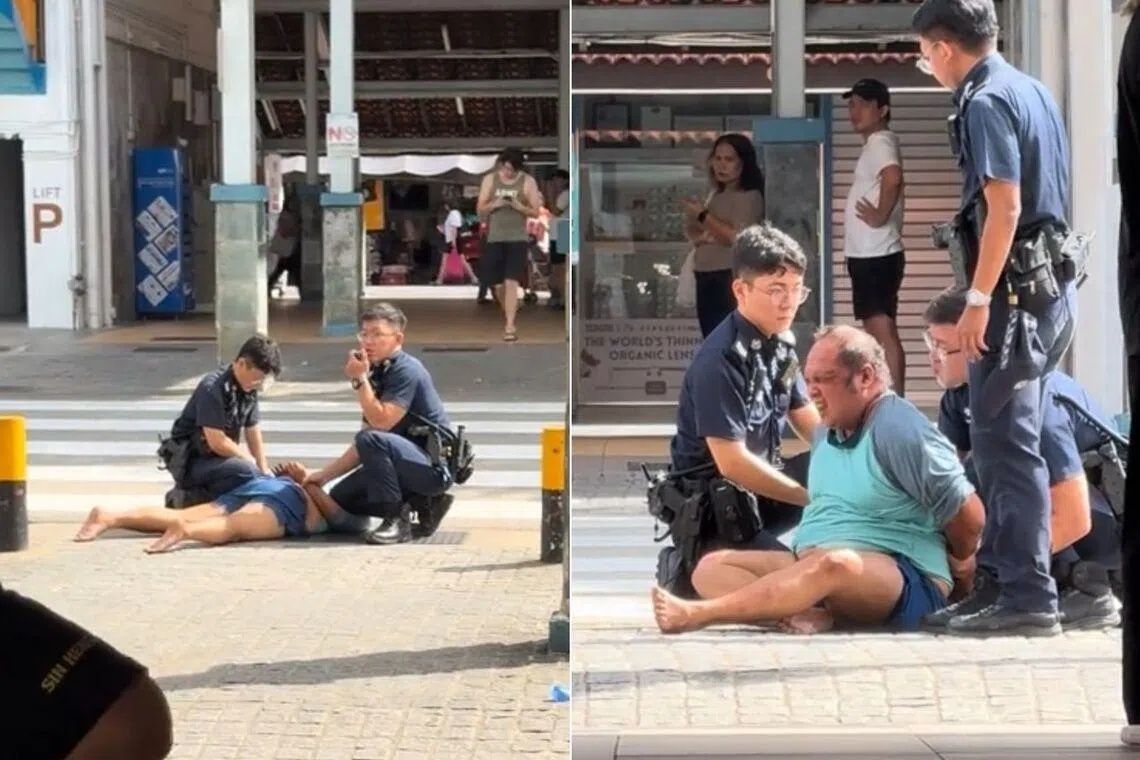
Law enforcement in Singapore moved to arrest a 36-year-old man on Sunday morning after he engaged in disruptive and criminal behaviour at a commercial establishment in one of the city-state's established residential neighbourhoods. The incident unfolded at Block 184 Toa Payoh Central, where officers responded to an emergency call shortly before 10am. The disturbance that prompted the police response centred on the suspect's conduct within a neighbourhood coffee shop, a common gathering spot for residents in the busy eastern district. What began as a public nuisance escalated into a direct confrontation between the man and responding officers.
The arrest itself proved contentious when the suspect resisted police intervention. As officers attempted to place him under custody, the 36-year-old man struck a police officer directly in the face—an act of violence that constituted a serious breach of law and a physical assault against a law enforcement agent carrying out his duties. The alleged punch came at the moment of arrest, adding an additional criminal dimension to the original disturbance. The physical altercation during apprehension highlighted the sometimes unpredictable nature of police work, even in routine public order incidents within a developed and regulated urban environment.
Footage documented by social media users captured key moments of the arrest. Video recordings posted on TikTok by user Kee Wee Shang showed at least two uniformed officers restraining the barefooted suspect on the ground during the initial phase of the arrest. The man's state—notably without footwear—suggested either that he had removed his shoes during the disturbance or that they had come off during the physical struggle. Additional footage from the same user depicted a third officer present at the scene, indicating a significant police presence had assembled to manage the situation. The videos subsequently showed the handcuffed suspect being escorted away by officers, documenting his removal from the immediate area.
The formal charges lodged against the suspect encompass two distinct offences that together paint a picture of escalating misconduct. He was arrested for committing an obscene act in a public space—a charge relating to the original disturbance that drew police attention to the coffee shop in the first place. The second charge concerned voluntarily causing hurt to a public servant with the intent to deter that officer from performing his lawful duties. This second charge carries particular weight within Singapore's legal framework, as assaults on law enforcement personnel are treated with considerable severity. The combination of these charges reflects both the initial public order breach and the subsequent physical confrontation.
The officer who sustained the blow from the suspect, identified as being 19 years old, suffered minor injuries from the assault. Despite being struck in the face during an active arrest, the young officer was conscious and responsive following the incident. He received medical attention at a hospital facility, where healthcare professionals evaluated and treated his injuries. The fact that the officer was young and relatively early in his law enforcement career underscores the reality that frontline policing roles carry inherent risks, even in a controlled urban setting with substantial police resources and training infrastructure.
The incident represents one of the periodic challenges that Singapore's police force confronts in maintaining public order across the island's diverse residential and commercial spaces. Toa Payoh, a major housing estate that has served as a residential hub since the 1970s, encompasses numerous commercial establishments including coffee shops that serve as social anchors within the community. The disturbance that prompted the police response indicates that behavioural issues can emerge even in well-established, regulated neighbourhoods with strong community infrastructure. Such incidents, though generally infrequent in Singapore's low-crime context, still require swift law enforcement response.
For Malaysian observers, the incident illustrates the operational approaches and rapid response mechanisms available to Singapore's law enforcement authorities. The immediate dispatch of multiple officers to a public disturbance call, coupled with the swift arrest and formal charges, reflects the capacity and efficiency of the city-state's police infrastructure. The social media documentation of the arrest also demonstrates how digital platforms have become routine tools for capturing public incidents, a phenomenon that has implications for police accountability and public awareness across the region. The filming and sharing of arrest footage on platforms such as TikTok raises ongoing questions about privacy, public interest, and the role of citizen documentation in modern policing.
Police investigations into the matter remained ongoing at the time of reporting, suggesting that officers continued to gather additional evidence and establish the full sequence of events. The investigation would likely include statements from witnesses present at the coffee shop, examination of any available CCTV footage from the establishment, and formal documentation from the officers involved in the arrest. Such thoroughness is typical of Singapore's investigative protocols, which aim to establish clear factual foundations for any prosecution that may follow.
The case underscores the importance of public compliance with law enforcement directives and the serious legal consequences that flow from assaulting police officers. Singapore's legal system treats such assaults with appropriate gravity, recognising both the breach of public order they represent and the danger they pose to officers executing their duties. For regional observers, the incident serves as a reminder that even developed, orderly societies periodically encounter behavioural breaches that require formal law enforcement intervention and subsequent judicial processes.

