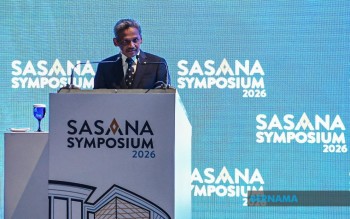
Malaysia's latest global sukuk offering, valued at US$1.5 billion, has generated exceptional market enthusiasm that underscores the international investment community's belief in the country's economic trajectory. At the opening of the two-day Sasana Symposium 2026 held in Kuala Lumpur, Bank Negara Malaysia Governor Datuk Seri Abdul Rasheed Ghaffour highlighted how the recent issuance witnessed demand soaring to nearly five times the amount being offered, a metric that speaks volumes about market sentiment towards Malaysian instruments.
What makes this capital-raising exercise particularly noteworthy is not merely the volume of investor interest, but the exceptional terms secured by the Malaysian authorities. The sukuk was issued at record-low spreads, indicating that international investors were prepared to accept tighter margins in exchange for exposure to Malaysian debt obligations. This pricing dynamic reveals a fundamental shift in how global financial markets perceive the country's creditworthiness and fiscal discipline, moving beyond routine participation into a genuine competition for allocation.
According to Abdul Rasheed, the strong reception extended beyond transactional mechanics. Investors demonstrated a tangible commitment to Malaysia's broader economic and governance architecture. Their willingness to deploy capital at favourable rates reflected confidence not only in immediate returns but also in the nation's overarching reform agenda and the sustainability of its macroeconomic management framework. For emerging market economies in Southeast Asia, such investor validation carries amplified significance, as it affects borrowing costs, currency stability, and the broader investment climate.
The timing of this sukuk success coincides with Malaysia's push to accelerate economic modernisation and labour market transformation. The governor reported that the country has channelled RM815 billion in approved investments over the preceding two years, equivalent to nearly half of Malaysia's annual gross domestic product. If these commitments materialise fully, they are projected to generate approximately 245,000 employment opportunities, with a substantial portion anticipated to be skilled positions requiring higher educational attainment and technical proficiency.
However, Abdul Rasheed candidly acknowledged that job creation represents only half the employment equation. The more complex challenge lies in equipping Malaysians with the requisite skills to fill these emerging roles. Current labour market statistics reveal a structural imbalance: more than two-thirds of employed Malaysians remain concentrated in low-skilled or mid-skilled occupations, a distribution that has proved remarkably sticky despite years of development initiatives. This skills gap has long posed a constraint on both individual earning potential and the economy's productive capacity.
Yet the governor pointed to tangible progress in labour force composition. Between 2019 and 2025, the proportion of Malaysians engaged in high-skilled employment expanded from 27.5 per cent to 30.1 per cent. While a 2.6 percentage point advancement might appear modest in isolation, Abdul Rasheed contextualised it within the broader reality that fundamental shifts in labour market structure unfold gradually. Wholesale transformation of employment categories across millions of workers requires years of sustained effort, not quarters.
The acceleration of high-skilled employment gains will become increasingly critical as technological disruption and artificial intelligence reshape traditional industries across Malaysia and the broader region. The governor stressed that the previous paradigm, where workers could acquire a skill and deploy it unchanged throughout their careers, has become obsolete. Instead, the contemporary employment landscape demands continuous reskilling and upskilling opportunities woven throughout working lives. This perpetual learning requirement presents both an enormous challenge and an opportunity for workers and policymakers alike.
The Sasana Symposium 2026, themed "Reforms for Resilience: Navigating Uncertainties," provided a forum for discussing these interconnected economic challenges. The two-day gathering encompassed substantive deliberations on economic resilience mechanisms, wage dynamics, cost-of-living pressures, foreign direct investment trajectories, energy security, Islamic finance development, and healthcare affordability. Such breadth reflects the complexity of contemporary policymaking in a middle-income economy navigating regional and global uncertainties.
Adding a practical dimension to the government's skills development agenda, the symposium witnessed the inauguration of iTEKAD Employment, a new initiative nested within Bank Negara Malaysia's broader iTEKAD social finance framework. This programme specifically targets individuals from economically vulnerable communities, facilitating their transition into stable, sustainable employment pathways and thereby addressing both immediate income needs and longer-term economic participation concerns.
For Malaysian observers and regional economic watchers, the convergence of strong external capital flows, ambitious domestic investment approvals, and targeted social employment initiatives suggests a coordinated policy approach. The government is simultaneously attracting external financing at attractive rates, channelling capital into productive economic ventures, and attempting to ensure that resulting employment gains reach populations traditionally left behind in development processes. Whether these complementary initiatives achieve their ambitious employment and skills targets will significantly influence Malaysia's economic trajectory over the coming years.

