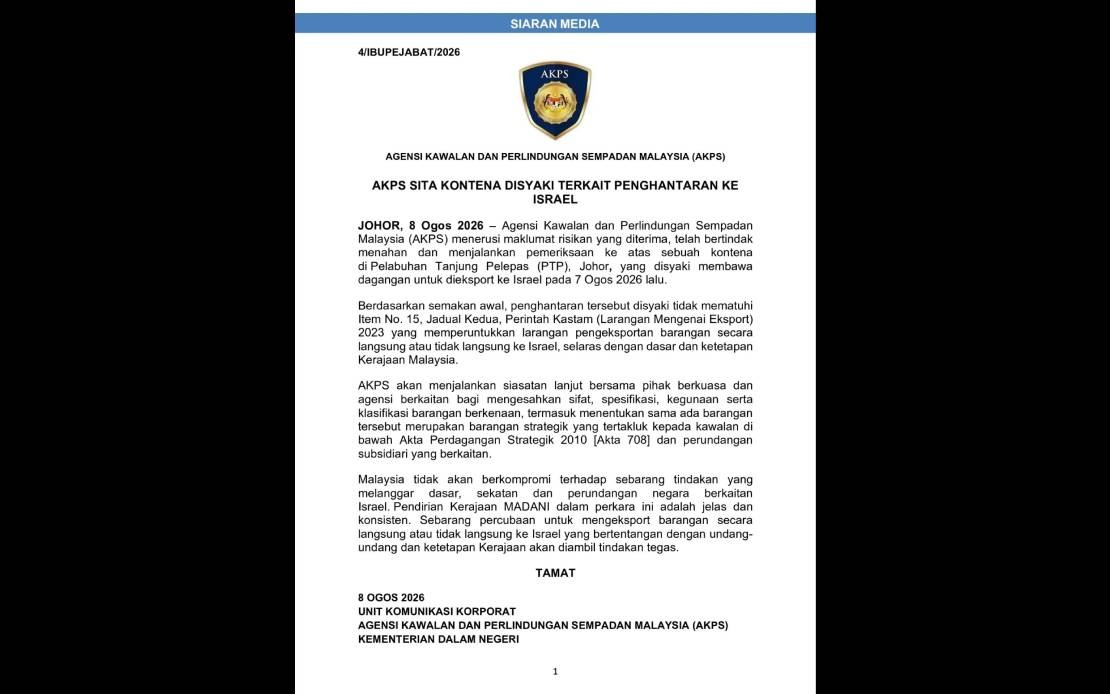
The Malaysian Border Control and Protection Agency (AKPS) has intercepted a shipment at the Port of Tanjung Pelepas in Johor that authorities suspected was bound for Israel, an action that Prime Minister Datuk Seri Anwar Ibrahim has publicly welcomed as evidence of Malaysia's unwavering commitment to its policy on Israeli trade restrictions. The seizure underscores the government's determination to prevent Malaysian territory and infrastructure from being exploited as conduits for commerce supporting Israel, particularly during the ongoing humanitarian crisis in Gaza.
In remarks posted on Facebook, Anwar highlighted that the interception represents more than routine customs enforcement. The Prime Minister characterized the AKPS action as a demonstration of Malaysia's principled position that the country will not serve as a transit hub or logistics platform for goods destined for the Israeli state. This framing positions border control operations within a broader geopolitical context, signalling that trade policy forms part of Malaysia's diplomatic and humanitarian engagement with global affairs.
The cargo in question was detained and inspected under provisions of the Customs (Prohibition of Exports) Order 2023, specifically Item No. 15 of the Second Schedule, which establishes a blanket prohibition on direct or indirect export of goods to Israel. This regulatory framework reflects official government policy, meaning the seizure was not an isolated enforcement action but rather the implementation of a comprehensive statutory ban that has been in place since December of the previous year.
Anwar's statement emphasized Malaysia's alignment with The Hague Group framework, a coalition of nations committed to upholding international humanitarian principles. By explicitly connecting the port seizure to this multilateral commitment, the Prime Minister situated Malaysia within a global movement advocating for accountability regarding the Israeli-Palestinian conflict. This positioning carries significance for Malaysia's international standing, particularly among Organisation of Islamic Cooperation members and developing nations that have championed Palestinian causes in United Nations forums.
The broader context of the ban reveals Malaysia's sustained policy direction on this matter. The December 2023 implementation date coincided with intensified international scrutiny of Israel's military operations in Gaza, and the government established an additional layer of enforcement by prohibiting Israeli-flagged vessels and ships transporting cargo to Israel from using Malaysian ports. This maritime prohibition complements the goods export ban, creating a comprehensive embargo that extends across multiple commercial dimensions.
For Malaysia's trading community and logistics sector, these measures carry practical implications. Companies engaged in international commerce must conduct due diligence regarding ultimate destinations of goods passing through Malaysian ports, particularly shipments involving electronics, components, or materials that could have dual-use applications. The Port of Tanjung Pelepas, as one of Southeast Asia's busiest transshipment hubs, has become a focal point for ensuring compliance with these restrictions, creating additional screening requirements for customs and port authorities.
Anwar's public endorsement of the seizure carries political weight domestically as well. The Prime Minister has consistently positioned Malaysia's pro-Palestinian stance as a matter of fundamental principle rather than temporary political positioning, linking it to the nation's commitment to justice, international law, and human dignity. By personally commending AKPS personnel for their vigilance, he reinforces this message internally while signalling to Malaysia's diverse electorate that the government takes these principles seriously in practical implementation.
The incident also highlights enforcement capacity challenges that maritime authorities throughout Southeast Asia face. Port operations involve complex supply chains, multi-party transactions, and shipping documentation that can obscure final destinations or create ambiguity about cargo contents. That Malaysian authorities successfully identified and interdicted this shipment suggests either strengthened intelligence capabilities, improved inter-agency coordination, or enhanced screening protocols—all of which contribute to making Malaysian ports less attractive for illicit or embargo-violating trade flows.
For Malaysia's relationship with regional partners, the seizure carries subtle implications. While many Southeast Asian nations maintain diplomatic and trade relations with Israel, Malaysia has chosen a more explicit policy position. This approach distinguishes Malaysia within ASEAN's typically consensus-driven, non-interfering framework, reflecting the country's particular historical commitment to Palestinian advocacy and its domestic political landscape, where support for Palestinian rights enjoys broad public backing across religious and ethnic communities.
The enforcement action also intersects with Malaysia's broader trade policy objectives. By demonstrating that port facilities are subject to rigorous compliance screening, the government can maintain its humanitarian and political commitments without necessarily deterring legitimate international commerce. Most trading partners can continue normal operations through Malaysian ports, provided their cargo complies with existing prohibitions. This balance allows Malaysia to uphold its principles while remaining an economically attractive transshipment location for the majority of global trade.
Moving forward, the successful interception may encourage further vigilance among AKPS personnel and port operators, potentially leading to additional seizures if enforcement intensity increases or if exporters attempt to reroute shipments through Malaysian ports. The public commendation from the Prime Minister also signals that personnel who implement these policies can expect government backing, potentially strengthening organizational commitment to enforcement compliance.
The broader significance of this incident extends beyond a single container. It demonstrates that Malaysia views its ports as extensions of its foreign policy and humanitarian commitments, not merely as neutral commercial infrastructure. In an era when trade embargoes face challenges from globalized logistics networks and complex supply chains, Malaysia's willingness to invest resources in screening and enforcement—and the government's willingness to publicly support these efforts—reflects a considered strategic choice about the country's international identity and values.

