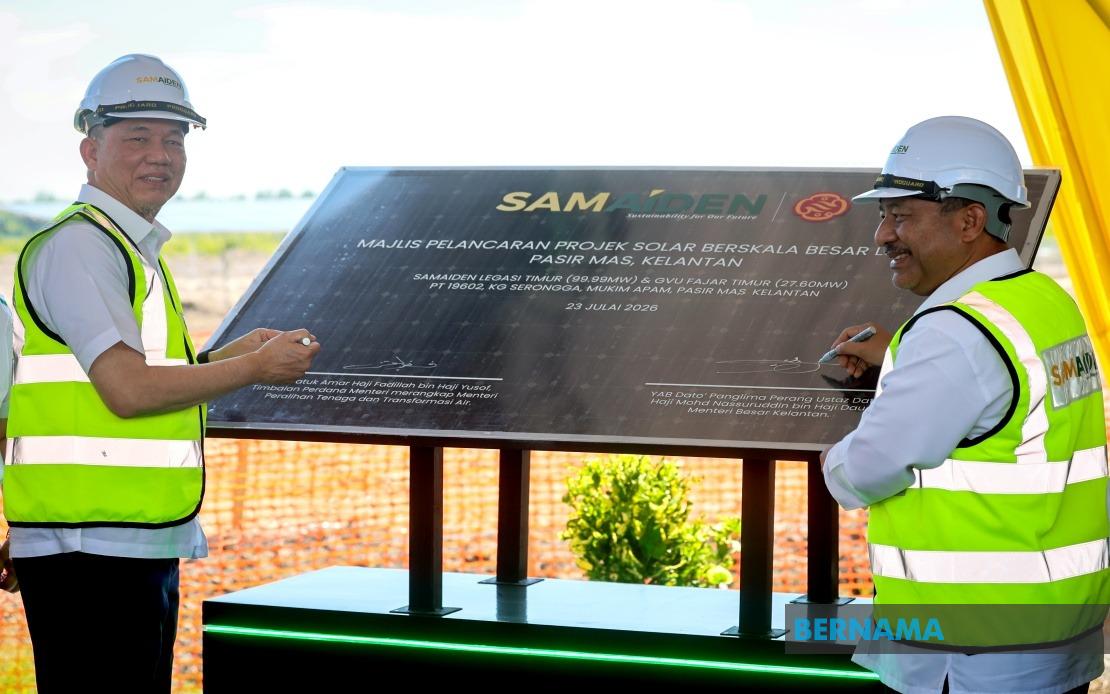
Malaysia's push toward a cleaner energy future is accelerating, with the country's renewable energy capacity now standing at nearly 32 per cent as of June. Deputy Prime Minister Datuk Seri Fadillah Yusof made the announcement while launching the Large-Scale Solar Project (LSS5) in Pasir Mas, Kelantan, underscoring that Malaysia remains firmly positioned to achieve its ambitious 35 per cent renewable energy target by 2030. The milestone represents tangible progress on a national agenda that extends far beyond environmental considerations, encompassing critical economic and strategic objectives that will shape Southeast Asia's energy landscape in the coming decades.
Fadillah, who also serves as Minister of Energy Transition and Water Transformation (PETRA), framed renewable energy transition not as an optional policy preference but as a strategic imperative. The government's National Energy Transition Roadmap (NETR) establishes a clear progression: Malaysia reached 31 per cent renewable capacity by December 2025, with the 2030 target set at 35 per cent and an ambitious 70 per cent target by 2050. This structured timeline demonstrates serious commitment, though reaching these figures will require sustained investment and technological advancement across the energy sector. The pathway is deliberately phased to allow the economy time to adapt while ensuring energy reliability remains uncompromised.
The rationale behind Malaysia's energy transition strategy extends across multiple dimensions of national interest. Fadillah articulated how the shift toward renewable sources strengthens energy security by reducing reliance on finite fossil fuel imports and price volatility on global markets. This is particularly significant for Malaysia, which despite its hydrocarbon resources must consider long-term sustainability. Furthermore, the transition serves to enhance economic resilience by positioning the nation as an attractive destination for multinational corporations increasingly committed to carbon-neutral operations and green supply chains. Such investments bring not only capital inflow but also technological transfer and skilled employment opportunities throughout the country.
The government's approach explicitly balances multiple competing demands. Energy security, affordability for consumers, and environmental sustainability form the three pillars of Malaysia's transition strategy. This triangular framework acknowledges that rushing energy transition without maintaining price competitiveness risks social backlash and industrial competitiveness, while moving too slowly jeopardizes long-term environmental commitments and international standing. Malaysia's strategy thus aims for evolutionary rather than revolutionary change, allowing existing infrastructure to gradually transition while new capacity comes online. The emphasis on competitive green electricity supply signals recognition that the transition must deliver economic benefits, not merely environmental ones.
Kelantan's emergence as a focal point for renewable energy development illustrates the geographical distribution of Malaysia's solar expansion strategy. The state possesses significant natural advantages for photovoltaic generation, including suitable landmass and supportive state-level governance under Menteri Besar Datuk Mohd Nassuruddin Daud. The LSS5 project, located in Kampung Serongga, represents more than infrastructure investment; it serves as a demonstration of investor confidence in Malaysia's policy framework and the collaborative capacity of federal and state governments working in concert with the private sector. Such signals matter enormously for capital allocation decisions, as international and regional investors assess political stability and institutional effectiveness alongside technical and financial metrics.
The implications for Kelantan extend well beyond energy generation capacity. The project promises job creation across multiple tiers—from construction and operation through to supporting industries and services. Local communities stand to benefit from employment opportunities and economic stimulus, provided implementation includes robust community engagement and skills development programs. Mohd Nassuruddin's emphasis on safety, environmental protection, and community relations suggests awareness that large infrastructure projects can generate local opposition if stakeholders feel excluded or adversely affected. This inclusive approach may become increasingly important as Malaysia expands renewable projects across different states and communities.
The renewable energy transition also carries implications for Malaysia's international positioning and climate commitments. As a signatory to global climate frameworks and a participant in regional sustainability initiatives, Malaysia's renewable capacity expansion demonstrates concrete action rather than mere rhetoric. This is particularly relevant as major trading partners, especially within the European Union and increasingly in the United States, increasingly factor carbon footprint into trade and investment decisions. Companies operating across Southeast Asia are coming under mounting pressure from parent organizations and investors to decarbonize operations, making Malaysia's renewable infrastructure attractive for multinational facilities seeking clean electricity supplies.
The Solar ATAP Programme, which Fadillah encouraged households, religious institutions, and commercial operators to utilize, represents a distributed generation approach complementing utility-scale projects like LSS5. Rooftop solar systems reduce transmission losses and democratize energy production, allowing individuals and organizations to generate their own power while contributing to national capacity targets. This dual-track approach—combining large centralized projects with widespread distributed generation—provides resilience and flexibility while engaging broader segments of society in the energy transition. The programme's success will depend on pricing, financing mechanisms, and technical support availability, factors that warrant close monitoring as adoption scales upward.
Investor confidence, emphasized by both Fadillah and Mohd Nassuruddin, remains crucial to achieving 2030 and 2050 targets. The renewable energy sector is capital intensive, requiring sustained funding flows across generation, storage, grid modernization, and transmission infrastructure. Malaysia's policy framework, demonstrated through NETR's comprehensive approach and the commitment of multiple government entities, provides confidence that regulatory environments will remain supportive and predictable. However, the sector also faces challenges including land acquisition complexities, grid integration technical requirements, and the need for skilled workforce development. Maintaining the policy momentum while addressing these practical obstacles will determine whether Malaysia's ambitious targets translate into achieved capacity.
Looking forward, Malaysia's renewable energy transition sits within a broader Southeast Asian context where nations compete for similar investment flows and technical expertise. Thailand, Vietnam, and Indonesia are simultaneously expanding solar and wind capacity, creating both competition and opportunities for regional collaboration. Malaysia's progress at 32 per cent renewable capacity positions it competitively, though several regional peers have announced equally aggressive targets. The coming years will reveal whether Malaysia can maintain momentum, attract necessary capital, and execute projects efficiently. Success would position the nation as a regional leader in energy transition, enhancing its appeal to international investors and demonstrating effective governance across federal and state levels—a model potentially applicable to other complex infrastructure challenges.

