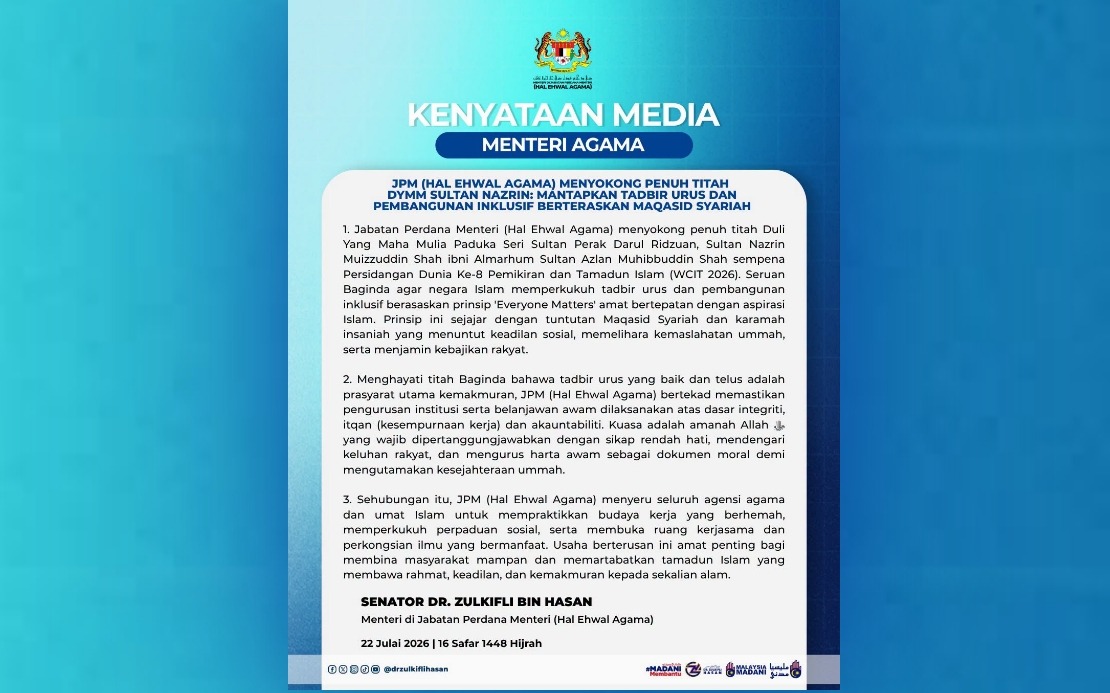
The Prime Minister's Department (Religious Affairs) is charting a new direction for how Malaysia's religious institutions operate, committing to a governance model rooted in Sultan Nazrin Shah's recently articulated vision of inclusive leadership. Minister Dr Zulkifli Hasan announced that the department would anchor its institutional management in three core pillars—integrity, accountability and public welfare—establishing a framework intended to serve all citizens equitably regardless of their background or beliefs.
Sultan Nazrin's call for better governance emerged from his address at the 8th World Conference on Islamic Thought and Civilisation, where the Perak ruler articulated a vision of public administration that transcends narrow sectarian interests. His Royal Highness emphasized that genuine national unity flows from civil services willing to hear grievances across all communities and to craft policies reflective of diverse constituencies. The monarch's position challenges a longstanding tension in Malaysian governance: how to balance religious administration with the pluralistic demands of a multi-confessional state.
Dr Zulkifli positioned the "Everyone Matters" principle not as a departure from Islamic teaching but as an expression of its highest ideals. He drew explicit connections to Maqasid Syariah—the overarching objectives of Islamic jurisprudence emphasizing the preservation of faith, life, intellect, property and progeny—arguing that these classical principles fundamentally demand equitable treatment and social protection. The minister further invoked karamah insaniah, the Islamic concept of human dignity, suggesting that administrative excellence and responsive governance are themselves forms of Islamic practice rather than secular impositions on religious bureaucracy.
This reframing holds significance for religious affairs management across Southeast Asia's Muslim-majority nations. Malaysia's Religious Affairs Ministry oversees complex portfolios including Islamic education, halal certification, zakat distribution and Islamic finance regulation. Embedding a governance philosophy centred on inclusive public service touches these domains directly. For instance, halal standards that serve not only Muslim consumers but also facilitate trade across religious communities would exemplify the principle in practice. Zakat distribution systems that enhance transparency and demonstrate responsiveness to beneficiary feedback would operationalize the commitment to accountability.
The minister's emphasis on "itqan"—excellence and perfection in execution—signals an intent to raise administrative standards beyond minimum compliance. In Malaysian bureaucratic practice, this distinction matters considerably. Religious institutions sometimes operate with less public scrutiny than secular counterparts, and Dr Zulkifli's stress on institutional excellence and public budgeting discipline suggests recognition that opacity in religious administration undermines both public confidence and religious credibility. The principle that authority constitutes a divine trust requiring humility represents a significant rhetorical repositioning of how religious leaders should understand their roles.
Sultan Nazrin's broader argument about development and international engagement carries implications beyond Malaysia's borders. His contention that isolation is economically untenable and that trade, investment and knowledge exchange drive national prosperity reflects a pragmatic vision often absent from more insular religious governance frameworks. For Malaysia, which aspires to remain an Islamic financial hub and moderate voice in Muslim-majority deliberations, this positioning strengthens arguments for religious institutions that can engage globally while maintaining doctrinal integrity. It implicitly rejects the false binary between religious devotion and worldly competence.
The commitment to strengthening social unity through courteous workplace culture and collaborative knowledge-sharing suggests attention to the machinery through which religious governance operates. Civil servants staffing religious agencies—from syariah courts to Islamic development banks—would become agents of this philosophy through their daily interactions. This people-centred approach to religious administration may particularly resonate in rural and underserved communities where residents interact directly with Islamic bureaucrats on marriage, inheritance and financial matters.
For Malaysian Muslims navigating rapid modernization and complex pluralistic environments, this governance framework addresses recurring concerns about whether religious institutions serve their interests effectively. By anchoring religious administration in accountability and responsiveness, the ministry signals willingness to treat Muslim constituents not as passive subjects of religious authority but as stakeholders entitled to transparent, efficient service. This distinction becomes increasingly important as younger Malaysians question institutional legitimacy across sectors.
The articulation also positions Malaysia within contemporary global debates about Islamic governance. Several Muslim-majority nations have grappled with balancing religious authenticity against administrative effectiveness, often defaulting to either secular models that alienate religious constituencies or theocratic structures that resist reform. Sultan Nazrin's "Everyone Matters" framework suggests a third path: governance grounded genuinely in Islamic principles yet committed to universal standards of equity and competence. Whether Malaysian religious institutions can successfully operationalize this philosophy remains an open question requiring sustained effort and measurable outcomes in service delivery and institutional transparency.

