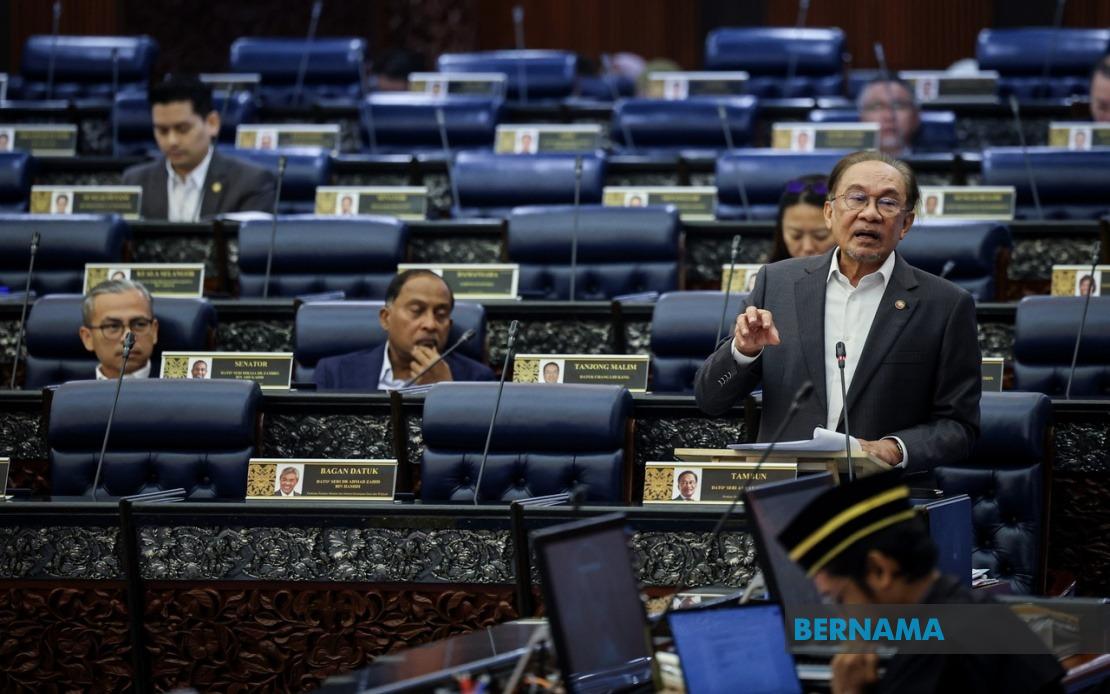
Prime Minister Datuk Seri Anwar Ibrahim has defended Malaysia's enforcement approach to media, arguing that the country's decline in this year's World Press Freedom Index stems primarily from international assessment criteria rather than deliberate censorship. Speaking during Minister's Question Time in Parliament on July 7, Anwar acknowledged that Malaysia's ranking fell to 95th place in the 2026 World Press Freedom Index from 88th the previous year, but framed the decline as a consequence of how international observers interpret specific enforcement actions.
The Prime Minister emphasised a critical distinction: that enforcement measures taken against several media organisations were not designed to stifle press freedom or extinguish legitimate political criticism, but were instead narrowly targeted at content involving religion, race, and the royal institution—collectively referred to as 3R issues—alongside matters affecting national security. This clarification reflects the government's attempt to reconcile Malaysia's international press freedom standing with its commitment to protecting constitutionally sensitive institutions and communal sensitivities.
Two high-profile cases have drawn particular international scrutiny and reportedly contributed to Malaysia's lower ranking. The first involved Sin Chew Daily, which faced action over the publication of an inaccurate illustration of the Jalur Gemilang national flag. The second concerned Sinar Harian, sanctioned for publishing the Inspector-General of Police's biography. Anwar acknowledged that the international media community viewed the action against Sin Chew Daily as a serious press freedom violation, yet he maintained that Malaysia's approach to flag-related matters reflects a principled stance on national symbols—even if other democracies do not share the same gravity toward such issues.
Anwar's defence reveals an underlying tension in Malaysia's media landscape: the gap between domestic legal and constitutional frameworks and international press freedom standards. While the Prime Minister stressed that enforcement actions are resolved appropriately and grounded in Malaysian law and the monarchy's constitutional position, he recognised that international indices operate on different assessment criteria. This friction highlights a persistent challenge for Southeast Asian democracies balancing indigenous values and institutions with global norms around media liberty.
The government's position is further anchored in constitutional arrangements. Anwar noted that the government remains bound by the position agreed upon by the Conference of Rulers, which closely monitors reports involving insults against the royal institution and content that could inflame racial or religious tensions. This governance framework exists partly to maintain interethnic and interfaith stability in Malaysia's diverse society, though it inevitably complicates the country's international press freedom metrics.
Crucially, Anwar clarified that no enforcement action is taken against content containing merely factual inaccuracies or political criticism standing alone. Instead, the government prioritises public clarification and transparency, including providing explanations directly in Parliament rather than resorting exclusively to legal remedies. This distinction suggests the administration seeks to calibrate its approach, reserving enforcement for content deemed genuinely harmful to protected constitutional categories rather than routine journalistic errors or political disagreement.
The government has also undertaken legislative reform aimed at strengthening press freedom protections. Amendments to Section 233 of the Communications and Multimedia Act 1998 ensure that satirical remarks directed at the Prime Minister or other political leaders are no longer treated as criminal offences. This reform reflects a deliberate effort to expand space for political satire and commentary, signalling the administration's willingness to distinguish between protected speech and genuinely harmful expression.
Anwar further contextualised Malaysia's ranking decline by noting that Reporters Without Borders' assessment methodology encompasses multiple indicators beyond enforcement actions alone: the political environment, legal framework, economic conditions, socio-cultural context, and security situation all influence the final score. This broader aperture suggests that Malaysia's ranking reflects systemic factors beyond any single government policy, offering a more nuanced picture than simple accusations of censorship might convey.
A significant and often overlooked dimension of Malaysia's ranking involves the role of private technology platforms. Anwar pointed out that considerable online content removal results from decisions by social media companies based on user complaints, rather than explicit government directives. He cited the removal of his own posts related to Hamas—contrary to the government's own position—as an example of how platform moderation operates independently of state action. This phenomenon underscores how international press freedom assessments must grapple with private corporate content policies that operate parallel to government regulation, a challenge transcending Malaysia and affecting global media ecosystems.
Moreover, requests by the Malaysian Communications and Multimedia Commission (MCMC) to social media platforms are not automatically accepted; final content moderation decisions rest with platform operators themselves. This reality complicates straightforward attribution of content removal to government censorship, as the mechanics of digital moderation involve multiple actors with divergent interests and priorities. For Malaysian policymakers and international observers alike, this distinction matters considerably when evaluating whether declining press freedom rankings reflect deliberate state suppression or the complex interplay of government requests, platform policies, and user-generated complaints.
The Prime Minister's parliamentary explanation reflects Malaysia's ongoing effort to position itself as a democracy respecting press freedom while maintaining constitutional protections for sensitive institutions. As regional competitors and international observers assess Malaysia's governance trajectory, the country's ability to sustain both media pluralism and protection of constitutionally privileged institutions will remain contested. The 2026 World Press Freedom Index decline serves as a reminder that Malaysia's approach to these competing values continues to generate scrutiny and debate among global observers evaluating democratic health.

