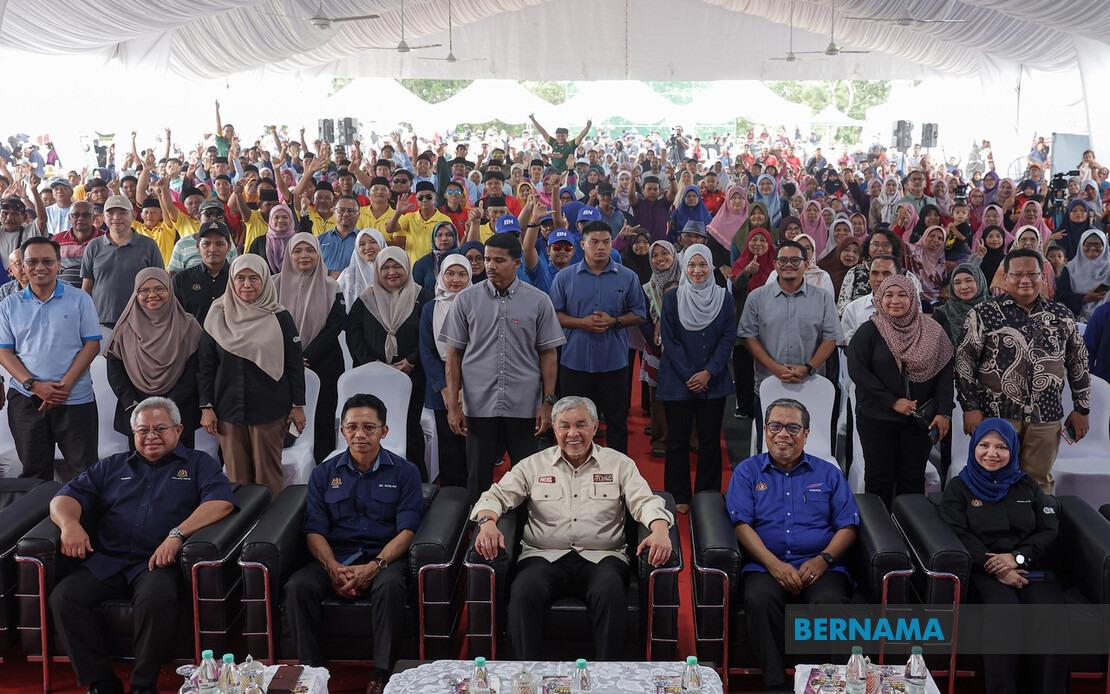
Malaysia's political landscape is shifting rapidly, and all coalitions must develop fresh strategies to maintain governmental stability, according to Barisan Nasional chairman Datuk Seri Dr Ahmad Zahid Hamidi. Speaking at the Gema@KKDW 2026 programme in Palong 8 near Jempol on July 18, Ahmad Zahid underscored the urgency of recalibrating inter-party relationships as the nation prepares for a period of significant electoral activity and potential realignment.
The BN leader outlined a pragmatic, phased approach to testing political cooperation with Perikatan Nasional, beginning with the 16th Negeri Sembilan state election scheduled for August 1. This electoral contest, he explained, would serve as a measurable indicator of whether broader collaboration between the two coalitions could work effectively in other jurisdictions and ultimately at the federal level. Such a methodical approach reflects growing recognition among Malaysia's major political players that the fractured nature of contemporary politics demands careful calibration rather than rushed decisions.
Ahmad Zahid characterised the BN-PN arrangement not as a formal, binding alliance but rather as a working understanding focused on preventing vote-splitting through overlapping nominations. This distinction carries significant weight, as it preserves the autonomy of both coalitions while establishing practical ground rules for competition. In Malaysia's multi-party system, where single-digit vote margins often determine electoral outcomes, the prevention of three-way contests between BN, PN, and Pakatan Harapan candidates can meaningfully shift seat distribution.
The Negeri Sembilan arrangement represents a test case that will inform decisions regarding the Melaka state election and, more critically, the 16th General Election. This sequential approach allows both coalitions to evaluate whether their members can work harmoniously at ground level, whether voters respond positively to the coordination, and whether the partnership produces tangible benefits in terms of seat numbers. Should the results prove encouraging, the template could be adapted and expanded to other state contests and eventually to the federal arena.
Malaysia's political dynamics have undergone substantial transformation since the 2022 general election, which produced a fractionalised Parliament dominated by neither BN nor PN but requiring complex coalition-building. The instability that followed, including the dissolution of Parliament and the subsequent 2023 election, highlighted the risks of fragmented political competition. Agreements such as the BN-PN understanding reflect a collective desire among senior political figures to prevent a repeat of the uncertainty that plagued the previous parliamentary term.
The rise of PN as a significant political force has fundamentally altered Malaysia's coalition architecture. Where two-coalition contests once dominated, three-way or multi-way races now characterise many elections. In this context, strategic understandings between BN and PN that prevent unnecessary splitting of centre-right votes could enhance the combined bloc's ability to withstand challenges from Pakatan Harapan or other opposition groupings. Ahmad Zahid's comments suggest that BN leadership views such arrangements not as permanent mergers but as situational responses to current political realities.
The lack of a formal binding agreement is particularly noteworthy. Ahmad Zahid explicitly stated that no contractual arrangement underpins the understanding, meaning either coalition retains the flexibility to adjust its approach based on performance and changing circumstances. This flexibility is especially important given the volatility of Malaysian politics, where unexpected developments frequently force rapid recalibration of strategies. Both coalitions can thus claim autonomy while benefiting from coordination where it reduces wasteful competition.
Early voting for Negeri Sembilan is scheduled for July 28, with the main polling day on August 1, providing a relatively near-term test of the coordination arrangement. The results will generate substantial data about voter receptivity to the BN-PN formula and whether ground-level party machinery can effectively implement the understanding without confusion or resentment. Should the coalition perform well relative to historical precedent or pre-election surveys, the political pressure to extend the arrangement will intensify.
For Malaysia's broader political ecosystem, the Ahmad Zahid statement signals that the country's major coalitions are moving toward recognising that winner-take-all competition may be less viable than negotiated, localist arrangements. This represents a degree of political maturation, as parties acknowledge the cost of fragmented contests. However, it also raises questions about the impact on democratic competition and whether such arrangements might eventually crystallise into a dominant two-coalition system that marginalises newer or smaller political forces.
The implications for Southeast Asia are worth noting. Malaysia's political culture has historically influenced neighbouring democracies. Should the BN-PN model prove durable and successful, it could offer a template for how coalition-based systems manage competition while maintaining stability. Conversely, if the arrangement fails or produces perverse outcomes such as weak governance or voter disengagement, it may serve as a cautionary tale.
Ahmad Zahid's comments also implicitly acknowledge that the era of presumptive BN dominance has ended. A generation ago, such statements about testing alignments would have been unnecessary—BN expected to win comfortably. Today, serious discussions about inter-coalition arrangements and vote management reflect a more competitive, uncertain political environment. This shift has profound implications for how Malaysia manages federal-state relations, especially in states controlled by PN or opposition coalitions.
Looking forward, the Negeri Sembilan election will be closely monitored by political analysts and international observers as an early indicator of whether new political alignments can deliver stability while maintaining democratic legitimacy. The success or failure of this test case will substantially influence Malaysian politics in the crucial lead-up to the 16th General Election, shaping which coalitions might govern and how power will be distributed.

