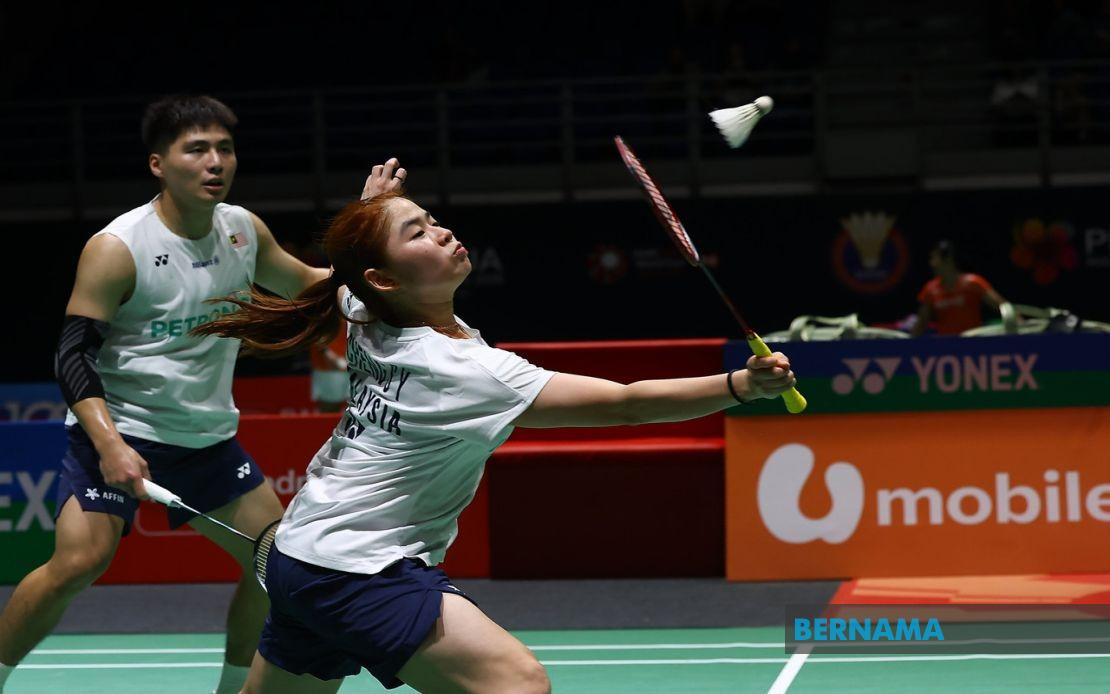
Malaysia's challenge at the Japan Open came to an end on July 18 after the nation's final two contenders were eliminated from semi-final play in Tokyo. The exits marked the conclusion of what had been a competitive outing for the Malaysian badminton delegation at one of the sport's premier tournaments on the international calendar.
The mixed doubles pairing of Jimmy Wong and Cheng Su Yin delivered a spirited performance before succumbing to Hong Kong's Tang Chun Man and Tse Ying Suet. Despite entering the match as an unseeded combination, the Malaysian pair pushed their experienced opponents hard across a tight encounter that stretched beyond an hour. The final scoreline of 17-21, 21-18, 21-15 reflected a competitive battle across all three games, with neither side able to establish clear dominance early on.
What made the mixed doubles exit particularly notable was the trajectory of Wong and Cheng's tournament run. Having progressed through earlier rounds against higher-ranked opposition, they had demonstrated the capacity to compete effectively against some of the world's elite pairings. The semi-final loss, while disappointing, underscored that Malaysian mixed doubles remains capable of mounting challenges at the highest level of international competition. The 69-minute duration of their match testified to the intensity of their resistance against their more seeded opponents.
Simultaneously, the men's doubles team of Goh Sze Fei and Nur Izzuddin Rumsani were defeated by South Korea's world number one ranked pair, Kim Won Ho and Seo Seung Jae. The Malaysian duo faced a formidable challenge from the top-ranked combination, yet they demonstrated resilience by fighting throughout their semi-final matchup. The 58-minute affair saw contrasting performances across the three games, with the opening frame seeing the Malaysians struggle to establish rhythm.
The first game proved particularly challenging for Goh and Nur Izzuddin, who fell significantly behind and ultimately lost 12-21. However, rather than accepting defeat, the Malaysian pair regrouped and produced a dominant performance in the second game, securing a commanding 21-11 victory to level the match. This turnaround suggested momentum had shifted in their favour heading into the deciding game, but the South Korean champions proved too strong when it mattered most. Kim and Seo closed out the encounter 21-13, claiming their place in the final.
The head-to-head record between the two men's doubles combinations provides context for the semi-final outcome. Malaysia has now lost three times across their five meetings against the South Korean pairing. While this suggests a pattern of Korean dominance in their recent encounters, the competitive nature of individual matches—particularly the comeback victory in the second game—demonstrates that the Malaysian pair remain capable of extending and challenging the world's top-ranked doubles team on any given occasion.
For Malaysian badminton, the Japan Open represented an opportunity to test themselves against the sport's elite on an important international stage. The performances delivered by both pairs, despite not reaching the finals, offer valuable insights into the current competitive standing of Malaysian doubles at the world level. Mixed doubles in particular showed glimpses of potential that could be developed further with continued tournament experience and refinement of tactical approaches against top-seeded opponents.
The tournament exits also highlight the intensifying competition in badminton across the Asia-Pacific region. Hong Kong's mixed doubles strength and South Korea's dominance in men's doubles reflect the depth of talent throughout East and Southeast Asia. For Malaysian teams looking ahead, the performances offer both lessons in areas requiring improvement and confirmation that competitive victories against top-ranked pairs are within reach.
As the Malaysia delegation departs Tokyo, the results will feed into strategic planning for upcoming tournaments. The nature of the semi-final losses—where Malaysian players demonstrated capability but ultimately fell short against more experienced or higher-ranked combinations—suggests that continued development and tournament exposure will be crucial for bridging the gap to consistent medal finishes at this level of competition.

