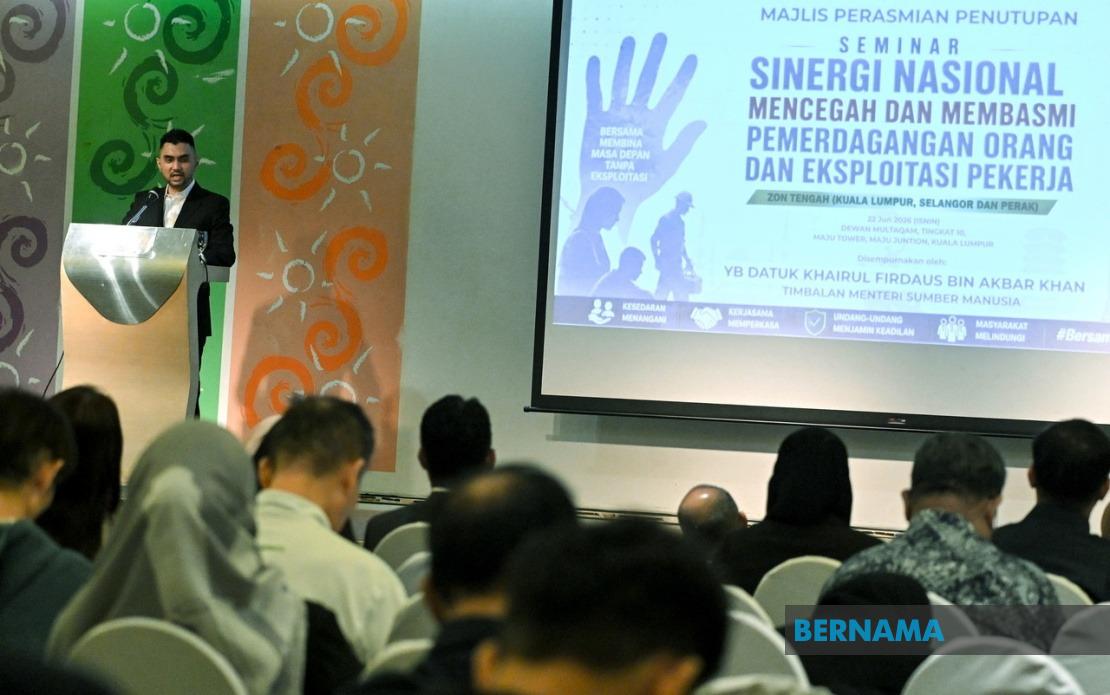
Malaysia has recorded a notable decline in rescued human trafficking and labour exploitation victims over the past two years, signalling what government officials characterise as the fruit of intensified enforcement campaigns. According to data presented by Deputy Human Resources Minister Datuk Khairul Firdaus Akbar Khan, the Peninsular Malaysia Manpower Department documented 70 victims in 2023, a figure that contracted to 10 the following year before rising to 17 in 2025 and dropping to just four through May of this year. The downward trajectory represents what authorities view as tangible progress in combating a persistent regional scourge, though the minister acknowledged substantial caveats regarding the reliability of these figures.
The optimism surrounding declining rescue numbers must be tempered by a recognition of the phenomenon's hidden dimensions. Datuk Khairul Firdaus articulated this tension during his address at the closing ceremony of the National Synergy Seminar on Preventing and Eradicating Human Trafficking and Labour Exploitation in the Central Zone, cautioning that officially reported cases represent only a fraction of actual trafficking activity. The informal economy, migrant worker networks operating outside formal channels, and victims' reluctance to come forward due to fear, cultural barriers, or distrust of authorities all contribute to a significant reporting gap. Malaysia's experience mirrors global patterns where law enforcement visibility captures merely the uppermost layer of what remains largely a clandestine criminal enterprise.
Government labour enforcement efforts have intensified notably, with authorities conducting 386 operations nationwide between January and May this year alone. These campaigns have resulted in the opening of 311 investigation papers, indicating that enforcement teams are identifying and documenting suspected violations at a consistent pace. This activity level reflects the seriousness with which the administration views labour exploitation, a category that encompasses not only trafficking for sexual purposes but also debt bondage, forced domestic work, and coercion within manufacturing, agriculture, and construction sectors. The breadth of these operations suggests a shift toward more comprehensive enforcement rather than narrowly targeted interventions.
Malaysia's commitment to addressing labour trafficking intersects with its international obligations under protocols ratified through the International Labour Organisation. The government has formally aligned its domestic agenda with ILO conventions on forced labour, creating a framework that positions Malaysia within the global architecture of labour rights enforcement. This alignment carries both symbolic and practical weight, as it subjects Malaysian policies to international scrutiny while providing technical expertise and benchmarking against other nations' approaches. For regional readers, Malaysia's positioning within this international system reflects broader moves across Southeast Asia to harmonise labour standards, though implementation remains uneven across ASEAN member states.
The National Synergy Seminar series represents a significant awareness and capacity-building initiative spanning Malaysia's regional zones. Following earlier programmes held in Sungai Petani, Kedah in May and Kluang, Johor in June, the Central Zone seminar drew nearly 1,000 participants from law enforcement, civil society, labour unions, employer organisations, and community groups. These multi-stakeholder forums facilitate knowledge exchange and build coalitions essential for sustained anti-trafficking work. The scale of participation indicates that awareness campaigns have achieved some institutional penetration, moving the issue beyond niche advocacy circles into mainstream government and civil society engagement. However, translating seminar attendance and awareness into systemic change at ground level—particularly regarding protection mechanisms for vulnerable migrant workers—remains an ongoing challenge.
Migrant workers constitute a particularly vulnerable population within Malaysia's labour market, where an estimated two million foreign nationals work across sectors characterised by wage theft, contract substitution, and mobility restrictions. The declining victim figures do not necessarily indicate improved protections for this group; rather, they may reflect resource constraints within enforcement agencies or shifts in trafficking patterns toward less detectable forms of exploitation. Women and girls trafficked for sexual exploitation, along with men trafficked for plantation and construction labour, often remain invisible until they encounter police or labour inspectors through chance rather than targeted rescue operations. This visibility problem shapes policy responses, as agencies tend to prioritise detected cases, creating a feedback loop where rescue numbers reflect enforcement capacity as much as actual trafficking prevalence.
The minister's cautious framing of declining numbers as progress tempered by acknowledged blind spots demonstrates an understanding that statistical reduction does not equate to crisis resolution. Unreported cases may number in the thousands, perpetuated through networks of brokers, employers, and complicit officials who profit from worker exploitation. Malaysia's geographic position as both a destination country for trafficked persons and a transit point for those en route to third countries complicates the enforcement picture. Regional criminal syndicates operate across porous borders, exploiting labour brokers and irregular migration channels that law enforcement struggles to monitor comprehensively. The concentration of officially recorded cases in Peninsular Malaysia, as opposed to Sabah and Sarawak, likely reflects enforcement disparities rather than lower trafficking prevalence in eastern Malaysian states.
Addressing the gap between recorded and actual trafficking requires multi-layered approaches that extend beyond law enforcement raids. Structural interventions targeting migrant recruitment practices, employer accountability, and labour standard enforcement within supply chains would address root causes rather than treating trafficking primarily as a crime to be detected and prosecuted. Malaysia's experience demonstrates the limits of enforcement-centric approaches, where impressive operation tallies and investigation openings mask systemic vulnerabilities within labour governance. The seminar participants gathered across three zones represent stakeholders positioned to influence these structural factors, yet their collective impact depends on institutional support and sustained political commitment to difficult reforms—such as regularising undocumented workers or imposing meaningful penalties on exploitative employers.
Looking ahead, Malaysia faces the challenge of translating awareness-raising initiatives and enforcement activity into measurable improvements in worker protection and trafficking prevention. The declining victim figures, while potentially positive, demand interrogation rather than celebration. Authorities must develop more sophisticated methodologies for estimating true trafficking prevalence, perhaps through victim population surveys or proxy indicators within sectors known for high risk. Regional cooperation within ASEAN remains underdeveloped, with trafficking networks operating across borders faster than law enforcement can adapt. For Malaysia specifically, the sustainability of anti-trafficking efforts hinges on institutionalising the commitment demonstrated through nationwide seminars and enforcement operations, ensuring that current initiatives do not dissipate when political attention shifts or ministerial priorities change.