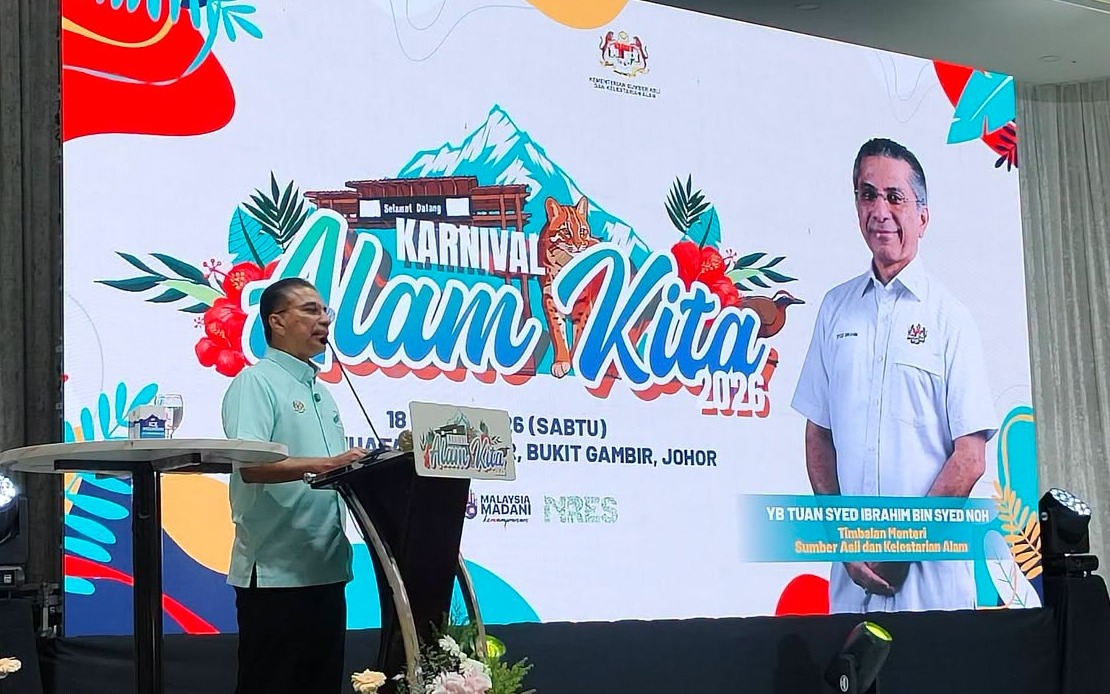
The Ministry of Natural Resources and Environment officially inaugurated Karnival Alam Kita 2026 in Johor Bahru on July 19, marking an expanded push to embed sustainable practices into everyday community life across the state. This year's festival represents a strategic shift in how federal authorities approach environmental messaging, moving away from abstract policy discussions towards tangible, ground-level demonstrations of how ordinary Malaysians can integrate green practices into their homes, workplaces, and neighbourhoods.
Deputy Minister Syed Ibrahim Syed Noh articulated the central philosophy driving this year's campaign: rather than presenting sustainability as a top-down mandate, the ministry aims to position environmental stewardship as a collective responsibility that begins at the household level and radiates outward through schools and community networks. This reframing acknowledges a persistent communication gap between policymakers and citizens, wherein environmental concerns—whether climate change, electronic waste management, or rare earth element extraction—can feel distant from immediate daily concerns. By localising the conversation, organisers hope to demonstrate tangible connections between individual choices and broader sustainability outcomes.
A cornerstone of the 2026 initiative is the newly unveiled Young Environmental Ambassador Programme, which targets secondary school students with structured environmental awareness training. This youth-focused approach recognises that embedding sustainability values in younger generations creates lasting behavioural change and cultivates future leaders capable of mobilising their families and communities toward greener practices. The programme reflects international best practices in environmental education, where peer-to-peer influence and youth leadership prove particularly effective in catalysing household-level sustainability shifts across diverse demographic groups.
Parallel to the ambassador initiative, the ministry organised the KUDAH waste collection drive, executed by the NRES Lestari Squad in partnership with Bateriku (M) Sdn Bhd, a strategic collaborator in circular economy transitions. During the initial event, volunteers gathered 37 kilogrammes of waste, including 17.3 kilogrammes of plastic bottles—materials typically destined for landfills or marine environments. The organisers quantified the environmental benefit in carbon dioxide equivalent terms: the collected materials represent an estimated 43.2 kilogrammes of CO₂e reduction, roughly equivalent to the emissions produced by driving a petrol-powered vehicle for approximately 100 kilometres. This metric-driven communication strategy helps bridge the conceptual distance between individual collection efforts and measurable climate outcomes.
The festival's broader programming encompasses interactive booths and awareness campaigns addressing multiple environmental streams simultaneously. Electronic waste recycling initiatives, used cooking oil collection programmes, and biodiversity exhibitions operate alongside vendor stalls promoting green consumer products. This diversified approach prevents the festival from becoming a monolithic messaging exercise, instead offering multiple entry points through which different community segments—from young families concerned with household waste management to small business owners exploring sustainable supply chains—can engage meaningfully with environmental topics relevant to their circumstances.
Deputy Secretary-General Datuk Khalid Mohamed and Tangkak district education officer Khairul Hizam Hassan's presence at the launch ceremony underscores the inter-agency coordination characterising this initiative. Effective environmental transformation requires seamless collaboration between natural resources management bodies, educational institutions, and local government structures. This structural alignment suggests the ministry recognises that sustainability challenges transcend ministerial boundaries and necessitate integrated governance approaches spanning multiple jurisdictional layers.
For Malaysian policymakers and environmental advocates, Karnival Alam Kita 2026 exemplifies a pragmatic communication strategy responsive to domestic audiences. Rather than relying on abstract sustainability frameworks or international commitments like the net zero carbon target by 2050—goals that can seem temporally distant and geographically abstract—the festival grounds climate action in immediate, observable community activities. Residents witness waste collection firsthand, interact with recycling technologies, and encounter peer ambassadors from their own schools, creating cognitive and emotional connections that abstract policy statements rarely achieve.
The positioning of sustainability as a shared responsibility rather than governmental mandate also carries subtle political messaging. By emphasising collective action across home, school, workplace, and community domains, the ministry implicitly acknowledges that environmental outcomes depend on voluntary civilian participation rather than regulatory enforcement alone. This framing may reflect lessons learned from previous top-down environmental campaigns that generated compliance without sustained behavioural change, suggesting a maturation in how Malaysian authorities approach sustainability governance.
The Johor deployment follows a pattern whereby environmental initiatives pilot in specific states before potential national scaling. Johor's selection likely reflects the state's economic significance, population density, and existing environmental pressures that make sustainability outcomes particularly visible and measurable. Success metrics from the Johor campaign—volunteer participation rates, waste collection volumes, programme enrolment figures—will inform whether the ministry expands Karnival Alam Kita to other states, potentially establishing it as a recurring national environmental calendar fixture.
For regional context, Malaysia's intensified domestic focus on green lifestyle practices aligns with broader Southeast Asian trends toward circular economy transitions and climate action. As ASEAN member states navigate the dual imperatives of economic development and environmental protection, domestic sustainability initiatives serve dual purposes: demonstrating genuine commitment to international climate frameworks while building voter support for necessary but sometimes economically disruptive environmental policies. KAK 2026 positions Malaysia within this regional conversation as a nation translating global sustainability aspirations into hyperlocal community engagement.
The Young Environmental Ambassador Programme particularly warrants regional attention. As other Southeast Asian nations grapple with scaling environmental education and youth engagement, Malaysia's ambassador model offers a replicable framework for cultivating peer-driven sustainability culture. The programme's emphasis on training young leaders to influence family and community behaviour represents a sophisticated understanding of how social influence cascades through kinship and peer networks—a dynamic particularly salient in cultures where family and community structures retain strong normative authority.
Looking forward, the festival's success depends substantially on whether the ministry sustains momentum beyond the inaugural Johor event. One-off campaigns generate temporary awareness spikes but rarely produce enduring behavioural shifts. Institutionalising the Young Environmental Ambassador Programme and establishing regular KUDAH collection schedules would signal serious commitment to embedding sustainability practices into community rhythms. If merely implemented as periodic festival entertainment divorced from ongoing policy infrastructure, the initiative risks reinforcing cynicism about governmental environmental commitments.

