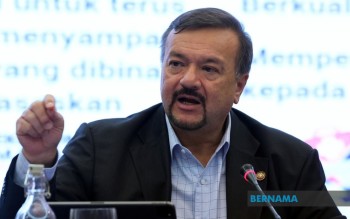
Malaysia is charting an economic course distinct from the turbulence afflicting much of the world, with growth accelerating to 5.6 per cent for the first half of 2025 despite persistent global uncertainties and regional tensions. Finance Minister II Datuk Seri Amir Hamzah Azizan unveiled these encouraging figures at a press conference in Putrajaya on Wednesday, underlining the country's consistent outperformance even as trade conflicts and Middle Eastern instability threaten other economies. The trajectory reveals a nation that has successfully insulated itself from major external shocks through deliberate policy choices and strategic domestic investment.
The pace of expansion has actually quickened as the year progresses, providing fresh validation for Malaysia's economic stewardship. After recording 5.2 per cent growth in both 2024 and maintaining that rate through 2025, the first quarter's advance showed a jump to 5.4 per cent. More impressively, preliminary estimates for the second quarter suggest an acceleration to 5.8 per cent, bringing the year-to-date average to 5.6 per cent. These numbers stand in marked contrast to the fragile growth trajectories of many developed economies and even some peers in the Southeast Asian region, signalling that Malaysia's policy framework is generating tangible results on the ground.
The durability of Malaysia's expansion becomes more remarkable when viewed against the headwinds the nation has weathered. Throughout 2024, trade tensions dominated global markets, with escalating tariff disputes disrupting supply chains and dampening business confidence worldwide. This year brings a different challenge: the unfolding geopolitical crisis in West Asia has introduced fresh volatility into energy markets and investor sentiment. Yet Malaysia has largely navigated around these obstacles, suggesting that the economy possesses structural strengths and policy buffers that insulate it from shocks that would severely constrain less-prepared neighbours.
Amir Hamzah credited much of this resilience to the MADANI Economy Framework, the government's overarching development blueprint introduced in recent years. Rather than relying on transient stimulus measures, the framework appears to be generating sustainable momentum through institutional and structural reforms that are gradually reshaping how the economy operates. The minister indicated that various initiatives nested within this broader agenda are only now beginning to demonstrate measurable impact, implying that Malaysia may still have considerable runway for further acceleration if implementation deepens and expands.
Central to the government's strategy is the GEAR-uP programme, a domestic investment drive led by the Finance Ministry since 2024. The initiative represents a deliberately expansionary approach to closing Malaysia's own productivity gaps and building competitive industries without excessive reliance on foreign capital flows. Over the 2024-2028 period, GEAR-uP aims to channel RM120 billion into direct domestic investment, a sum substantial enough to reshape entire sectors if deployed effectively. The programme represents a conscious pivot towards endogenous growth, where Malaysia cultivates its own capabilities rather than passively attracting external funds.
Government-linked investment companies and government-linked companies, acting as implementation vehicles for GEAR-uP, have emerged as catalysts for private industrial development. Their role extends beyond simple capital deployment; these institutions serve as vehicles for knowledge transfer, talent cultivation, and attraction of high-value foreign participation grounded in genuine technology and expertise rather than mere financial arbitrage. Amir Hamzah articulated this distinction pointedly: securing foreign funds is relatively straightforward, but channelling investment into channels that genuinely build Malaysian capacity and distribute benefits across society requires far more sophisticated institutional architecture.
The minister's emphasis on spreading benefits across the population rather than concentrating wealth reflects a maturing understanding of what sustained growth requires. An economy can achieve headline growth figures without improving living standards if investment flows to capital-intensive sectors that employ few workers or capital leaves the country in profit repatriation. Malaysia's stated objective of ensuring that invested funds translate into tangible improvements in people's circumstances distinguishes the MADANI approach from purely growth-maximising strategies that may exacerbate inequality. This orientation carries particular resonance in Malaysia's context, where income distribution remains a sensitive political issue.
The pathway to developed-nation status that Malaysia has set for itself depends critically on sustained productivity improvements and technological upgrading, not merely on accumulating capital or labour. The GEAR-uP framework appears designed to address this directly by concentrating resources on sectors and capabilities that can only be built through deliberate, patient investment in human capital and institutional capacity. This represents a departure from earlier development models that emphasised attracting multinational corporations to undertake assembly operations. The new approach demands that Malaysia's own companies and research institutions become sources of innovation and competitive advantage.
Realising these ambitions requires sustained policy coherence across multiple government agencies and continuity over electoral cycles, a challenge that has historically confounded Malaysian governments. Amir Hamzah's confidence in the trajectory, expressed through his invocation of the phrase "insya-Allah" alongside conventional policy language, suggests an awareness that success hinges on factors beyond technocratic control. Nevertheless, the economic data through the first half of 2025 does indicate that implemented policies are generating results measurable enough to warrant optimism about the medium-term outlook.
For regional observers, Malaysia's performance carries implications extending beyond domestic considerations. An economy the size of Malaysia's, with its role as a regional financial hub and manufacturing centre, influences the broader Southeast Asian growth picture. Should Malaysia sustain growth rates in the 5.5-5.8 per cent range while many developed economies struggle with slower expansion, it may attract capital seeking exposure to emerging market dynamism. Conversely, if the acceleration proves unsustainable or masks underlying structural weaknesses, the disappointment could ripple across the region, dampening confidence in other middle-income countries pursuing similar development strategies.
The credibility of Malaysia's current trajectory rests ultimately on whether the MADANI Economy Framework and its constituent programmes deliver not just growth headlines but sustained improvements in productivity, living standards, and competitive positioning. The initial returns appear encouraging, but these early-cycle gains are often the easiest to achieve. The real test will come in subsequent years, when the law of diminishing returns typically asserts itself unless new sources of dynamism are continuously cultivated. For now, Malaysia's economic managers have succeeded in steering a path that preserves growth momentum despite turbulent external conditions, a capability that sets Malaysia apart from many of its peers and validates the strategic choices made.

