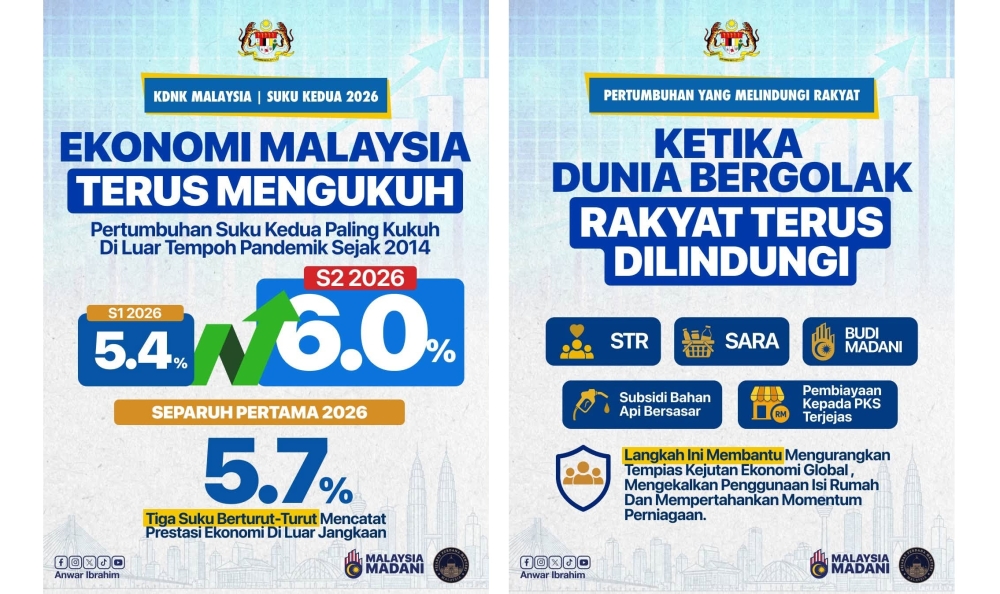
Prime Minister Datuk Seri Anwar Ibrahim expressed satisfaction on Wednesday with Malaysia's economic momentum in the second quarter, emphasizing that the stronger-than-anticipated expansion reflects the effectiveness of government interventions designed to protect ordinary Malaysians from surging global prices. Speaking in Kuala Lumpur, the Prime Minister framed the nation's growth trajectory as evidence that targeted policy measures have successfully cushioned households against the international cost-of-living crisis that has challenged economies worldwide.
The government's approach to economic management has centred on shielding domestic consumers from imported inflation while maintaining sufficient growth to support employment and business expansion. Anwar's comments underscore the administration's conviction that deliberate fiscal and monetary coordination, combined with strategic subsidies and price controls on essential goods, has enabled Malaysia to navigate inflationary headwinds more effectively than many peer nations in the region. This framing positions the second quarter results not merely as a statistical achievement but as validation of the broader economic strategy adopted over the past year.
The stronger expansion in the April-to-June period comes at a critical juncture for the government, which faces mounting pressure to demonstrate economic competence ahead of potential elections. Strong quarterly growth figures provide tangible evidence that the administration's priorities—balancing growth with affordability—are delivering measurable outcomes. For Malaysian voters concerned about household finances and job security, such numbers carry political significance beyond their technical economic meaning.
Southeast Asian economies have faced divergent trajectories during this period of global economic uncertainty. While some regional peers have struggled with stagflation concerns or slowing demand from advanced economies, Malaysia's outperformance suggests that its diversified economic base—spanning manufacturing, services, and emerging digital sectors—continues to provide resilience. The government's success in moderating inflation for ordinary consumers, while maintaining growth, represents a delicate balancing act that has eluded several neighbouring economies.
The Prime Minister's emphasis on household protection reflects a deliberate pivot from purely macroeconomic metrics to lived experience. International commentators often focus on headline growth figures, yet household purchasing power deterioration has sparked social discontent across the region. By highlighting government efforts to shield families from price shocks, Anwar is signalling that policymakers remain cognisant of the disconnect between headline growth and ground-level economic anxiety. This messaging matters particularly in Malaysia, where cost-of-living concerns consistently rank among voters' top electoral priorities.
Government interventions supporting the second quarter growth include targeted assistance programmes, subsidised utilities and fuel pricing, and measures supporting small and medium enterprises. These policies come at fiscal cost, raising questions about long-term sustainability. However, officials argue that temporary support during a volatile global environment represents prudent crisis management rather than reckless spending. The challenge ahead involves calibrating when and how to gradually unwind such measures without triggering renewed price shocks or demand destruction.
The broader regional context demonstrates that Malaysia's experience diverges from some peers. Thailand, the Philippines, and Vietnam have each confronted distinct inflationary and growth challenges, partly reflecting their different trade relationships, energy dependencies, and policy frameworks. Malaysia's success in moderating headline inflation while sustaining growth places it among the region's better performers, though structural challenges—including wage growth lagging price increases in some sectors—remain unresolved for portions of the population.
The second quarter results also carry implications for the central bank's future monetary policy stance. The Bank Negara Malaysia has undertaken a measured approach to interest rate adjustments, neither aggressive in tightening nor accommodative in loosening, aiming to support growth while guiding inflation expectations downward. Stronger-than-expected growth data may embolden policymakers to maintain this centrist position, avoiding both the growth-suppressing effects of rapid tightening and the inflation risks of prolonged accommodation. This calibration has become increasingly consequential as external financial conditions tighten globally.
Looking ahead, the government's economic narrative will increasingly emphasise sustainability alongside growth. Policymakers recognise that while temporary subsidies and price controls have shielded households, structural productivity improvements and wage growth remain essential for long-term living standards advancement. The administration's task involves communicating that short-term protective measures and long-term productivity-focused reforms operate as complementary strategies rather than contradictory approaches.
The political economy of inflation management will remain central to public discourse. Citizens across Malaysia daily encounter prices at markets, petrol stations, and shops, making inflation viscerally real in ways quarterly GDP figures cannot match. When government policies demonstrably moderate price increases compared to regional and global trends, this tangible benefit outweighs abstract growth statistics in public sentiment. Prime Minister Anwar's framing of the second quarter results as evidence of household protection thus connects macroeconomic data to microeconomic reality, bridging the gap between official statistics and voter experience that often determines electoral outcomes.

