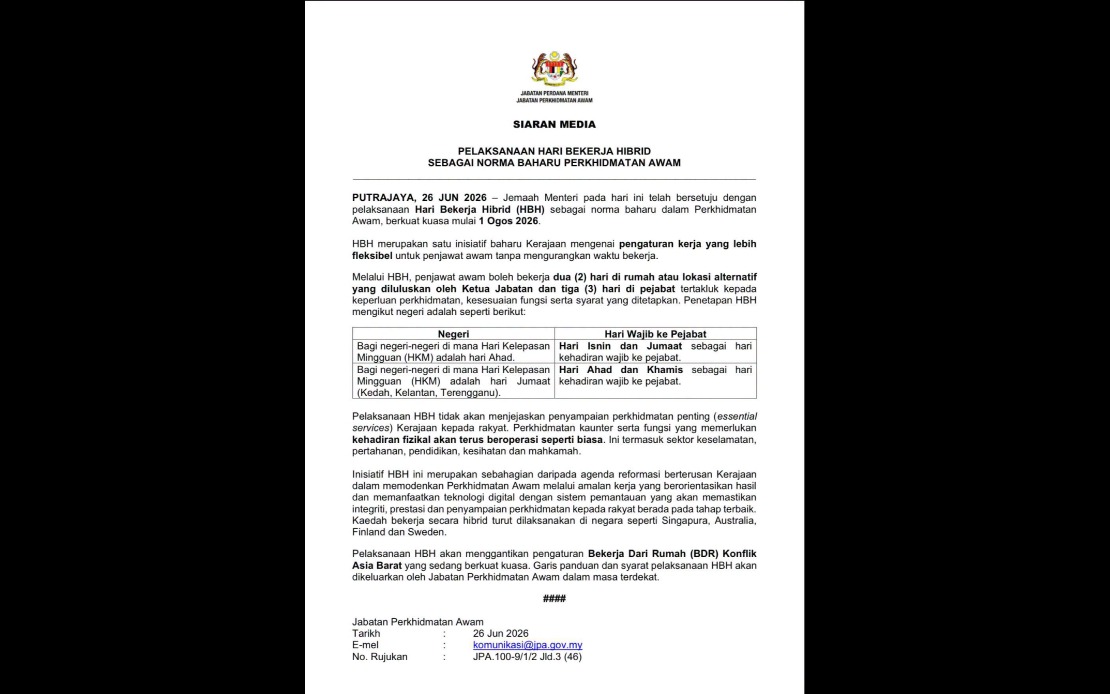
The Malaysian government has formally approved a significant restructuring of its civil service work arrangements, with the Cabinet agreeing on June 26 to introduce the Hybrid Work Day (HBH) model effective August 1. This decision, announced by the Public Service Department (PSD), represents a fundamental shift in how the nation's 1.6 million public servants will balance office attendance with remote working capabilities, moving away from the flexible arrangements that emerged during the pandemic era.
Under the new framework, civil servants across federal and state governments will be required to maintain a structured presence in their offices for three days per week while being permitted to work remotely from home or an approved alternative location for the remaining two working days. This arrangement applies across all government departments and agencies, though implementation will remain subject to the specific operational demands of each ministry, the suitability of individual roles, and established service requirements that may necessitate full-time office attendance in certain functions.
The policy introduces important geographical variations reflecting Malaysia's administrative diversity. For states that observe Sunday as their weekly rest day—the majority of the country—civil servants must be present at their offices on Monday and Friday without exception. Conversely, the three states with Friday as their designated weekly holiday—Kedah, Kelantan, and Terengganu—will have Sunday and Thursday designated as mandatory office days, ensuring consistency in administrative operations while respecting local observances.
Critically, the PSD has provided explicit assurances that the introduction of HBH will not compromise the delivery of essential public services to Malaysian citizens. Services requiring direct citizen interaction, such as counter services and administrative functions, will continue operating under normal schedules. Entire sectors including national security and defence, education provision, healthcare delivery, and the judicial system have been identified as areas where the new arrangement will not alter service hours or accessibility, effectively exempting roles that demand continuous or heavy public-facing presence.
The transition from the existing Work From Home (WFH) arrangement to HBH reflects broader modernization objectives within Malaysia's public sector reform agenda. The PSD characterizes this initiative not as a reduction in working time or a concession to employee preferences, but rather as an evolution toward results-based management practices that leverage digital technology infrastructure. This framing suggests the government views hybrid arrangements as compatible with—and potentially supportive of—enhanced productivity and accountability, provided that performance metrics and output standards remain clearly defined and monitored.
To maintain institutional integrity during this transition, the PSD plans to establish a dedicated monitoring mechanism designed to track performance indicators, service delivery standards, and overall compliance with HBH protocols. This surveillance framework indicates governmental concern that without structured oversight, the shift toward remote work could create gaps in accountability or reduce responsiveness to public needs. The announcement of these monitoring systems is intended to signal to both civil servants and the public that flexibility is being granted within a disciplined framework rather than representing a loosening of standards.
The policy also carries significant implications for Malaysian workplace culture and urban planning. Cities like Kuala Lumpur, Putrajaya, and state capitals will likely experience reduced weekday congestion and commercial activity as office occupancy declines by up to 40 percent on designated home-working days. This shift could affect transportation demand, reduce environmental emissions from commuting, and alter patterns of lunch-time retail spending—consequences that extend beyond the public sector into the broader economy.
Internationally, Malaysia joins a growing number of developed economies in embracing hybrid work structures as standard practice. The PSD's statement specifically references Singapore, Australia, Finland, and Sweden as comparable jurisdictions that have already implemented hybrid arrangements, suggesting the government views this policy as alignment with advanced governance practices rather than as an experimental or contentious measure. However, each of these reference countries operates in distinct economic and cultural contexts, meaning Malaysia's implementation will require careful calibration to ensure the model functions effectively within the local administrative environment.
The timing of the August 1 implementation allows a six-week preparation window for departments to establish operational guidelines, arrange necessary digital infrastructure, and brief staff on new expectations. The PSD has committed to releasing detailed implementation guidelines and specific conditions in the coming weeks, indicating that the June 26 Cabinet approval represents a policy framework rather than a finalized operational blueprint. Civil servants and department heads will need to await further clarification on how role-specific variations will be determined and approved.
For Malaysian private sector employers, this government initiative may serve as a template or validation for their own workplace flexibility arrangements. If the civil service successfully implements hybrid work at scale without compromising service quality or public satisfaction, it could accelerate acceptance of similar practices across Malaysia's corporate sector and potentially enhance the nation's competitiveness in attracting skilled workers who increasingly prioritize workplace flexibility.
The policy also reflects changing attitudes toward work-life balance within Malaysian governance, though implementation will ultimately determine whether the arrangement genuinely improves quality of life for public servants or simply creates scheduling complexity. Success will depend on clear departmental communication, technology reliability, and managers' willingness to assess performance on outcomes rather than physical presence—cultural shifts that remain works in progress in many Malaysian government offices.

