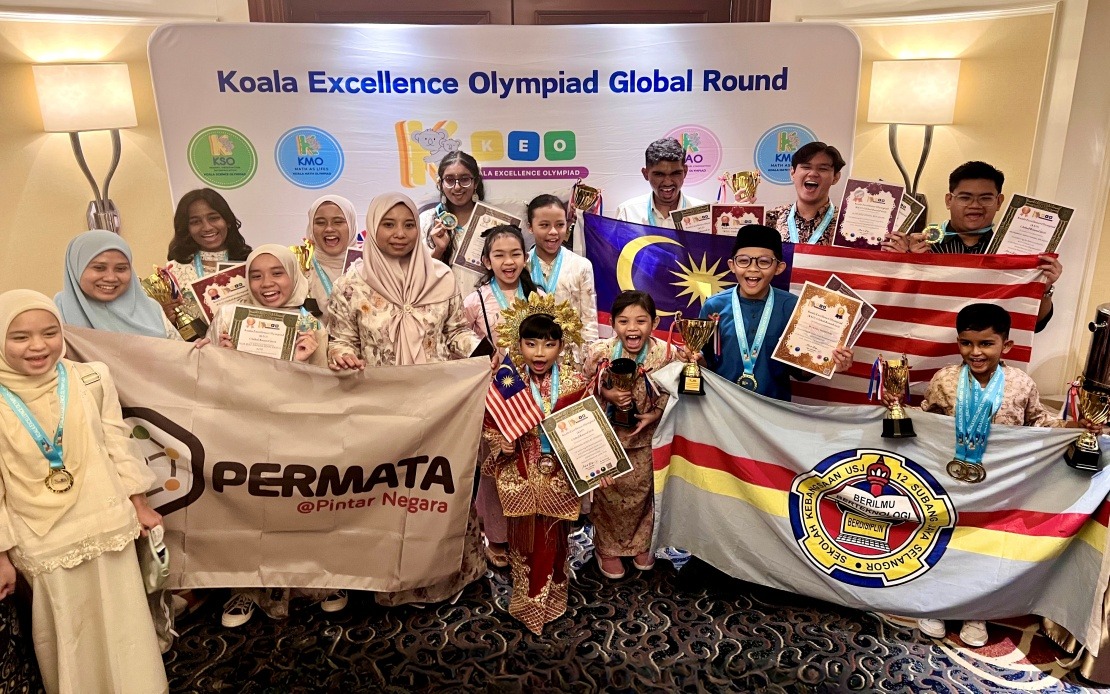
Malaysia has demonstrated considerable strength in international academic competition, with a contingent of seventeen students returning from the Koala Excellence Olympiad (KEO) 2026 in Macau bearing an impressive haul of nine overall awards and 22 medals. The delegation, which concluded its participation in the international event yesterday, secured five gold medals, six silver medals, and eleven bronze medals across multiple disciplines, marking a significant achievement for the country's young scholars at the global stage.
Aidah Misran, who coordinated the Malaysian Young Scientists Organisation (MYSO) and led the national team to Macau, highlighted the competitive calibre of the competition and the diverse composition of Malaysia's representative group. The contingent drew from eight different educational institutions across the country, reflecting the breadth of academic excellence present within Malaysia's school system. The representation included four students from Kolej PERMATA@Pintar Negara at Universiti Kebangsaan Malaysia, six from Sekolah Menengah Kebangsaan Ungku Aziz, two from Sekolah Sultan Alam Shah, and three from Sekolah Kebangsaan Convent (2) Bukit Nanas, with individual representatives from SMK Convent Teluk Intan, SK USJ 12, SK Seri Hartamas, and SK Convent Sentul 1.
The KEO platform, developed by Australian educational specialists, operates distinctively from traditional academic competitions by prioritizing critical thinking, creativity, and practical application of knowledge rather than rote memorisation. This pedagogical approach aligns with contemporary global standards in education, emphasizing skills that remain relevant in an increasingly complex and rapidly evolving world. The competition encompasses four distinct olympiad categories—English, Mathematics, Science, and Arts—providing comprehensive assessment across multiple intellectual domains and allowing participating nations to benchmark their educational systems against international benchmarks.
The most striking individual performance came from Year Six pupil Mukridz Mardzuki of SK Seri Hartamas, who captured the overall championship in the Science Olympiad within the primary school category. This achievement underscores the calibre of scientific thinking and problem-solving ability present among Malaysia's younger students. Mukridz's victory positions Malaysia prominently among participating nations and demonstrates that excellence in scientific inquiry begins early in the educational journey.
Beyond the championship position, Malaysian competitors secured multiple runner-up placements that further emphasize the competitive depth of the delegation. Sarah Isabel Maryam Ahmad Suhael from SK Convent (2) Bukit Nanas and Alfie Rizq Danial Azlan from Sekolah Sultan Alam Shah each obtained overall runner-up positions in the Science Olympiad across the primary and secondary school categories respectively. These placements indicate that Malaysia's strength extends across both educational levels, suggesting institutional consistency in nurturing advanced scientific capability among students.
Performance in the English Olympiad also yielded recognition, with Ayra 'Adani Muhammad 'Aizat from Kolej PERMATA@Pintar Negara at UKM securing an overall runner-up placement in that discipline. This result carries particular relevance for Malaysia, where English proficiency remains integral to academic achievement, professional competitiveness, and regional mobility. The strong showing in English Olympiad competitions reflects positive development in linguistic capability among Malaysia's academically advanced cohort.
The five third-place finishes distributed across multiple competitors further testify to the strength in depth of Malaysia's team composition. Marvyn Zef Mark Philip distinguished himself by capturing two category third-place awards in both Science and English Olympiads. Other third-place winners included P Prem in Science, Muhammad Khairul Mauidz Khairul Azman in Mathematics, and AK Shashini in English. This multi-disciplinary success pattern suggests that Malaysia's academic pipeline is producing well-rounded thinkers capable of excellence across varied intellectual pursuits rather than narrow specialists in single domains.
The Koala Excellence Olympiad represents an increasingly important platform for countries seeking to assess their educational systems against international standards and identify emerging talent at an early stage. The participation of students from diverse nations creates opportunities for cultural exchange and exposure to different pedagogical approaches, benefits that extend beyond medal tallies. For Malaysian participants, interaction with peers from other countries provides valuable perspective on their own learning methodologies and competitive positioning globally.
The composition of Malaysia's delegation across both primary and secondary institutions reflects strategic coordination by MYSO in identifying and developing talent. This representative structure ensures that achievement is distributed across age cohorts rather than concentrated in single educational levels, suggesting that Malaysia is building sustainable pipelines for academic excellence. The inclusion of students from both traditional government schools and specialized institutions such as Kolej PERMATA@Pintar Negara demonstrates that high-performing talent exists across Malaysia's diverse educational landscape.
The success achieved at the KEO 2026 carries implications for Malaysian education policy and resource allocation. International competition results often serve as catalysts for enhanced investment in science, technology, and advanced academic programming. The medal haul provides concrete evidence that Malaysia's students can compete effectively against their international peers when provided adequate preparation and institutional support. This achievement may inform discussions regarding curriculum development, teacher training initiatives, and the identification and nurturing of gifted students within the national education system.
For students and their families, participation in such international competitions offers broader developmental benefits beyond academic recognition. The experience of competing at an international level, interacting with students from other countries, and testing oneself against global standards contributes to the formation of confident, globally-aware citizens. These intangible outcomes often prove more valuable long-term than the medals themselves, fostering the kind of intellectual curiosity and resilience that characterizes successful professionals across fields.
Moving forward, Malaysia's continued participation in the KEO and similar international academic competitions will likely strengthen the nation's reputation as an education destination and its capacity to identify and develop talented youth. The organising partnership between KEO, Miss Man International Group, and the Malaysian Young Scientists Organisation demonstrates the value of coordinated effort between international bodies and local educational stakeholders. Sustained engagement with such platforms can further elevate Malaysia's standing in the international academic community while providing invaluable opportunities for the country's most promising students to showcase their abilities on a global stage.

