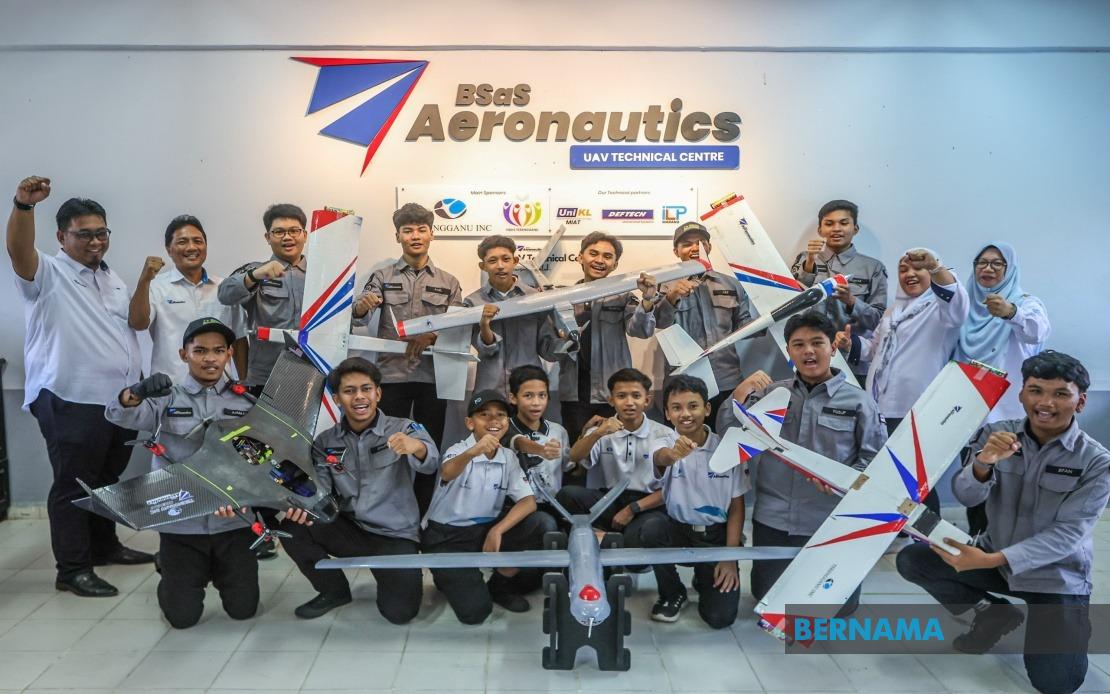
An initiative at SMK Bukit Sawa in Marang, Terengganu, demonstrates how secondary education can bridge the gap between classroom learning and cutting-edge technology development. Under the TI-BSAS UAV In School programme, 35 students have constructed their own unmanned aerial vehicles from scratch, each device meeting full aircraft specifications and representing an investment of between RM6,000 and RM10,000 per unit. The endeavour, which commenced in 2023 with backing from Terengganu Incorporated Sdn Bhd and partner organisations, signals a deliberate shift towards building aerospace competency at the grassroots level in Malaysia.
English teacher Badrul Hisyam Zakaria serves as the programme coordinator, guiding student teams alongside two colleagues through the intricate process of designing and assembling working UAVs. Rather than treating the project as theoretical exercise, the team employs industrial-standard techniques and materials scaled appropriately for educational contexts. This commitment to authenticity means students gain familiarity with professional methodologies they would encounter in actual aerospace roles, providing invaluable practical grounding that conventional curricula seldom offer. The hands-on nature of the work transforms abstract engineering principles into tangible understanding through direct experimentation and troubleshooting.
The current generation of student-built UAVs incorporates Global Positioning System technology for autonomous navigation and target detection, representing sophisticated integration of multiple systems. Yet the programme looks toward even greater capability, with teams actively developing next-generation platforms equipped with artificial intelligence functionality. These enhanced versions would employ computer vision to autonomously identify and track objectives, marking a significant leap beyond the GPS-reliant systems presently operational. This progression from established to emerging technologies mirrors how genuine innovation unfolds, allowing students to appreciate both foundational engineering and frontier developments simultaneously.
The programme's credibility received substantial validation when SMK Bukit Sawa claimed the championship title in the UAV Avionics Integration Challenge at the MyAERO Challenge 2026 competition held at MAEPS, Serdang, Selangor, in June. This competitive success demonstrates that the school's approach produces not merely functional prototypes but genuinely competitive designs. The achievement carries particular significance given that participants from other institutions had access to comparable resources and expertise, yet SMK Bukit Sawa's students and instructors emerged as the most accomplished in integrating avionics systems within the secondary school category.
Perhaps more telling than any single competition result is the documented career trajectory of programme alumni. Two former SMK Bukit Sawa students who participated in the initiative are now enrolled in aircraft engineering programmes at Universiti Kuala Lumpur, while three additional graduates have advanced to science-stream matriculation studies. These transitions from secondary education directly into specialised tertiary pathways in aviation represent precisely the outcome the programme architects envisioned. Badrul Hisyam emphasises that success metrics extend beyond immediate school-level achievements, with monitoring of student development continuing as they pursue aviation-related tertiary education and eventual professional careers.
The strategic vision underlying the TI-BSAS initiative explicitly targets medium-term capability building within the Malaysian aerospace sector. By cultivating a cohort of young Malaysians with hands-on UAV development experience during their secondary education, the programme positions them to become professionals capable of advancing domestic technological capacity. Badrul Hisyam articulated the broader ambition clearly: within three to four years, the first graduates who participated in the in-school UAV projects could enter the workforce as qualified aircraft engineers, potentially catalysing the emergence of more Malaysian-based companies capable of designing and manufacturing UAV systems independently. This represents a deliberate strategy to reduce reliance on imported aerospace technology and expertise.
Terengganu Incorporated has committed substantial financial resources to sustain and expand the initiative. Datuk Burhanuddin Hilmi Mohamed, serving as the company's president and group chief executive officer, disclosed that total corporate contributions have reached RM75,000 since the programme's 2023 inception. The funding pattern reveals strategic patience, with RM45,000 deployed during the establishment phase and an additional RM30,000 allocated in 2026 to maintain momentum and enable further development. This multi-year commitment signals confidence in the programme's direction and acknowledgement that genuine capability building cannot be accomplished through one-time grants.
The corporate social responsibility framework through which Terengganu Incorporated channels this investment specifically targets disadvantaged demographics, with particular emphasis on B40 households in Terengganu. This targeting reflects recognition that access to technology education remains unevenly distributed across socioeconomic strata in Malaysia. By providing opportunities for students from lower-income backgrounds to engage with advanced aerospace engineering, the programme helps address educational equity while simultaneously widening the talent pool from which the aerospace sector can recruit. Datuk Burhanuddin highlighted that witnessing students successfully operating UAVs they themselves constructed provided tangible confirmation that the investment yielded measurable impact.
For Malaysian policymakers and educators, the SMK Bukit Sawa model offers valuable lessons about integrating high-technology projects into secondary curricula. The programme demonstrates that with appropriate institutional support, teacher training, and corporate partnership, secondary students can engage meaningfully with engineering challenges far exceeding typical school laboratory work. The collaborative structure—involving school administration, state education authorities, corporate sponsors, and dedicated teaching staff—created an ecosystem enabling ambitious technical projects. Replicating similar initiatives elsewhere in Malaysia could accelerate development of aerospace-ready talent pools, particularly in states like Terengganu with strategic positioning relative to aviation industries.
Regionally, Malaysia's secondary school-based UAV development programme distinguishes the country as taking proactive steps toward building indigenous aerospace manufacturing capacity. Southeast Asian economies increasingly recognise that technology self-sufficiency requires investment in human capital development from secondary education onward. The TI-BSAS initiative exemplifies this principle in practice, ensuring that Malaysian young people possess not merely theoretical knowledge but demonstrable facility with cutting-edge systems. As the regional competition for aerospace sector jobs and investment intensifies, initiatives that produce graduates capable of designing and constructing sophisticated systems rather than merely assembling imported components provide competitive advantage.
Looking forward, the significance of programmes like TI-BSAS extends beyond immediate career outcomes for participating students. By normalising aerospace engineering as an accessible career pathway pursued by secondary-school cohorts, the initiative shifts perceptions about which young Malaysians might become engineers and technologists. Exposure to functioning UAVs designed and built by peer students at the same school creates aspirational models that abstract classroom instruction cannot replicate. Future students observing seniors' achievements will internalise the realistic possibility of aviation-related careers as authentic options rather than distant aspirations reserved for others.
The programme also reflects broader recognition that Malaysia's long-term economic resilience depends on developing high-value technological capabilities domestically. As global supply chains reconfigure and countries increasingly prioritise domestic technology security, the ability to design and manufacture sophisticated systems becomes strategically important. The students at SMK Bukit Sawa who are learning to build operational UAVs represent exactly the human capital foundation upon which sustainable technological independence rests. Their education investments, supported by corporate partnerships and state coordination, constitute investments in Malaysia's future industrial capacity and global competitiveness.

