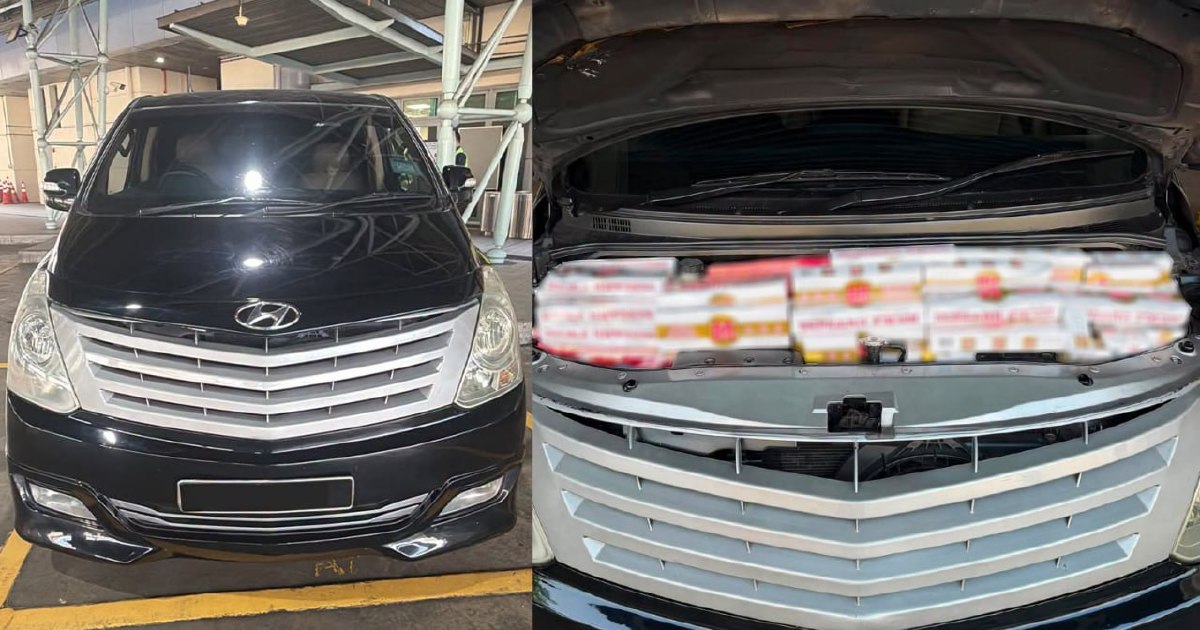
A 26-year-old Malaysian driver faces charges after Singapore's Immigration and Checkpoints Authority discovered one of the region's recurring smuggling problems at a routine border inspection—more than 600 cartons and 900 individual packets of cigarettes hidden beneath the floorboard of his multipurpose vehicle. The seizure underscores the ongoing challenge of contraband tobacco entering Singapore despite stringent enforcement measures, and signals the sophistication criminals employ to evade detection at one of the world's busiest checkpoints.
Officers conducting standard checks at the border identified the concealed compartment during what appears to have been a random inspection, revealing the extent of the smuggling attempt. The vehicle was immediately impounded pending further investigation. Such discoveries are far from isolated incidents; they reflect a robust black market driven by Singapore's consistently high excise duties on cigarettes—among the strictest tax regimes in the region—which creates substantial price differentials with neighbouring Malaysia and Indonesia.
For Malaysian readers, the arrest highlights an uncomfortable reality: cross-border cigarette smuggling remains a significant law-and-order issue with repercussions extending beyond simple customs violations. The contraband trade diverts tax revenue that governments depend upon for healthcare and infrastructure, while simultaneously funding organised crime networks that often diversify into human trafficking, drug smuggling, and money laundering. A single 600-carton shipment might generate profits in the tens of thousands of ringgit, making the risk worthwhile for desperate drivers or networks recruiting them.
Singapore's enforcement approach demonstrates the challenge authorities face. Despite the city-state's advanced scanning technology, intelligence networks, and rigorous inspections at Woodlands and Tuas checkpoints, contraband routinely slips through. This suggests either highly coordinated criminal operations adapting their methods constantly, or the sheer volume of cross-border traffic making detection impractical—probably both. The government's response has intensified in recent years, with heavier penalties for traffickers and stricter vehicle checks, yet the market persists.
The price gap between jurisdictions remains the fundamental driver. A carton of cigarettes in Singapore typically costs two to three times the Malaysian equivalent, owing to excise tax rates exceeding 40 per cent of retail price. This disparity ensures steady demand among Singapore's smokers seeking cheaper alternatives, and guarantees a pipeline of supply from smugglers willing to accept arrest risk. The economics are brutal but simple: detection rates remain low enough that expected profits exceed expected penalties for many operators.
For Malaysia, such incidents reflect a dual problem. While Malaysian smugglers profit from this arbitrage, the country's border areas also serve as transit zones for contraband destined for other regional markets, including Brunei. This strains limited customs and excise resources, particularly in states like Johor, where cross-border commerce is legitimate and voluminous. Distinguishing licit from illicit trade becomes exponentially harder when the same roads carry regular passenger vehicles and commercial goods.
The broader Southeast Asian context matters too. Tobacco smuggling networks operating in this region rarely confine themselves to single commodities or routes. The same criminal infrastructure moving cigarettes often handles counterfeit goods, labour trafficking, and regional drug distribution. Breaking these networks requires intelligence sharing and coordinated enforcement between Singapore, Malaysia, Indonesia, and Thailand—a challenge given jurisdictional differences and resource constraints in some neighbouring countries.
Singapore's strict penalty framework aims to deter participation through severity rather than certainty of detection. Convicted smugglers face substantial fines and potential imprisonment, yet the supply continues. This suggests that penalties, however stringent, fail to outweigh the financial incentive when unemployment or debt pressures young drivers in Malaysia toward accepting these jobs. Criminal syndicates deliberately recruit individuals with limited economic prospects, offering quick profits without requiring specialised skills or equipment.
The incident also illustrates technology's double-edged nature in customs enforcement. While advanced scanning equipment helps authorities detect increasingly sophisticated concealment methods—like floorboard compartments—organised criminal groups simultaneously invest in counter-technology and evolving hiding techniques. This arms race shows no signs of resolution, particularly when demand-side factors remain constant. Until Singapore or neighbouring countries significantly adjust their taxation strategies or pricing policies converge, the smuggling route will retain economic viability.
For Malaysian authorities, the challenge extends beyond enforcement at borders. Addressing the root supply requires disrupting the networks recruiting drivers, identifying the financiers and organisers behind major shipments, and prosecuting those roles under money laundering and organised crime legislation. Traditional customs prosecutions merely remove individual operators; dismantling the enterprise requires following financial flows and identifying hidden kingpins directing multiple importation attempts.
This arrest represents a single data point in a pattern that will almost certainly continue, barring dramatic policy shifts in tobacco taxation or regional cooperation that remains aspirational rather than achieved. The 26-year-old facing charges becomes another statistic in a largely intractable problem—one that Southeast Asian governments recognise as serious yet struggle to solve through enforcement alone.

