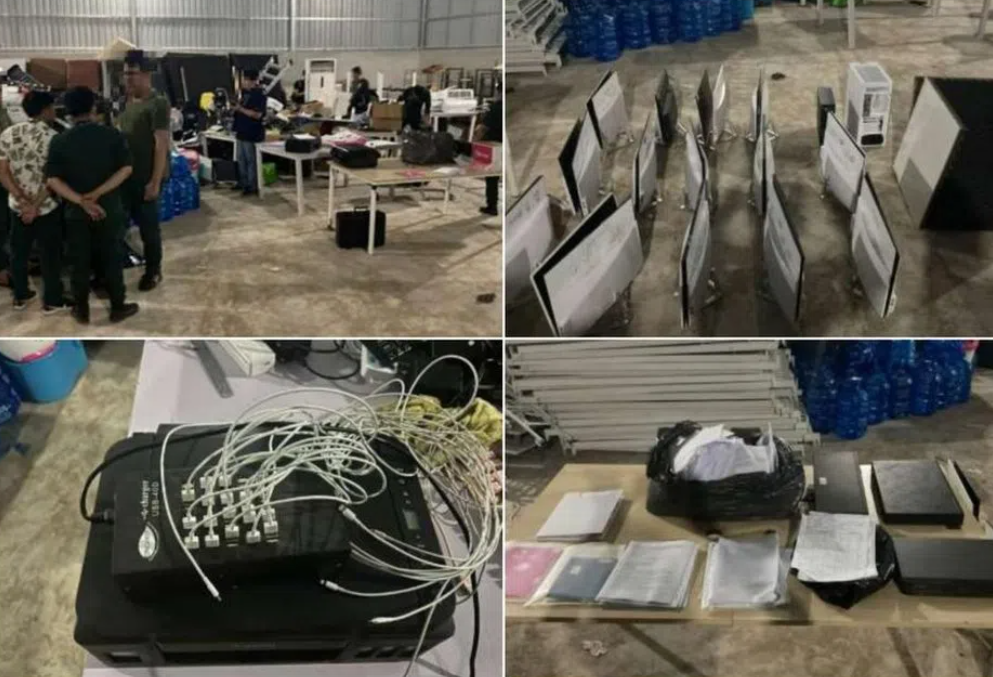
A Malaysian man has become an unlikely cautionary tale in the region's ongoing battle against organised scam networks, sentenced to 16 months and two weeks' jail for his brief and spectacularly unsuccessful tenure with a Cambodian-based fraud operation. Yip Chee Ming, 30, pleaded guilty to membership in an organised crime syndicate after an operation that netted multiple suspects across Singapore, Malaysia, and Cambodia—though his personal contribution to the conspiracy consisted of exactly three days of failed phone calls.
The Phnom Penh-based scam operation that recruited Yip was no small-time venture. Between September 2024 and September 2025, the syndicate orchestrated at least 528 documented scam cases targeting Singaporeans, accumulating losses of approximately S$52.5 million. The organisation operated with a hierarchical structure typical of modern cybercriminal enterprises, with senior leadership overseeing supervisors and trainers who managed individual callers like Yip. Beneath this operational tier existed specialised units dedicated to money laundering, converting stolen funds into cryptocurrency to obscure their origins and facilitate extraction across borders. The syndicate's personnel roster included at least 78 suspected members distributed across multiple countries, demonstrating the transnational nature of contemporary organised fraud.
Yip's pathway into the criminal network began innocuously through a personal connection. In October 2024, a friend identified in court documents as Jason approached him with an employment proposition—joining the scam centre as a phone operator. Yip accepted the invitation, and the pair were subsequently added to a Telegram group by Tang Soon Wah, identified by authorities as one of the syndicate's principal leaders. Tang extended an invitation to visit the operation's physical headquarters in Cambodia, a five-storey compound secured by stationed guards that served as the nerve centre for daily fraudulent activities. The two Malaysians returned home to deliberate the opportunity before committing to the enterprise, eventually boarding a flight to Cambodia on November 21, 2024.
Once stationed at the compound, Yip commenced his employment on November 22, 2024, assigned to impersonate banking officials during calls to Singaporean victims. His remuneration package—US$1,800 monthly in cryptocurrency plus one percent commission on successfully defrauded individuals—appeared lucrative by Malaysian standards, offering financial incentive aligned with the syndicate's profit-driven model. The operation equipped callers with carefully crafted scripts designed to maximise deception, whilst trainers provided ongoing coaching in psychological manipulation techniques, including instruction on adopting a Singaporean accent to enhance credibility during conversations with targets. This systematic approach to caller training revealed the syndicate's understanding of what made their fraud effective: authentic-sounding cultural performance that lowered victims' defences.
Yip's criminal career, however, proved remarkably short-lived. Despite diligent adherence to the provided scripts and exposure to trainer guidance, he failed to successfully deceive a single victim during his initial day of work. The following day brought renewed effort but identical results—no successful fraudulent transactions, no victims extracted of funds, no commission earned. By November 23, 2024, merely 24 hours into his second day, Tang had terminated Yip's employment, subsequently deleting their electronic communications to eliminate evidence of his involvement. Court documents remain silent regarding Yip's precise method of returning to Malaysia, whether through the same flight channels or clandestine arrangements.
Yip remained unapprehended for nearly a year following his dismissal. The arrest came during a coordinated enforcement operation launched in September 2025, when Singapore's police force and the Cambodian National Police executed simultaneous raids against the syndicate's network. Yip was detained on September 9, 2025, joining eleven other individuals charged in connection with the criminal enterprise. Nine of the accused—Deon Tan Ke Yuan, Lester Ng Jing Hai, Christy Neo Wei En, Heiqal Lee, Tay Jun Xiang, Ng Wei Kang, Zachary Lee Jia An, Melvin Tan Wenzheng, and Lau Haoxiang—are Singapore citizens aged between 25 and 39. The remaining defendants include Malaysian Muhamad Asyraf Anuar, 29, and Filipino national De Villar Rizalyn Panganiban, 34, underscoring the transnational composition of the criminal conspiracy.
The sentencing of Yip carries particular significance given the broader trajectory of scam-related crime across Singapore and the wider region. Although 2025 witnessed an overall decline in reported scam incidents compared to previous years, government impersonation fraud—the specific methodology deployed by the Phnom Penh syndicate—experienced a dramatic surge. Cases of this fraud category more than doubled from 1,504 reported incidents in 2024 to 3,363 in 2025, consolidating its position as Singapore's fifth most prevalent scam typology. This escalation suggests sophisticated criminal networks have identified official impersonation as a high-efficacy fraud vector, particularly effective against populations conditioned to defer to perceived authority figures.
The severity of Yip's punishment, despite his personal failure to defraud anyone, reflects Singapore's legislation regarding organised crime membership. Individuals convicted of participating in criminal syndicates face penalties extending up to five years' imprisonment and fines reaching S$100,000, provisions designed to deter recruitment into organised networks regardless of individual performance metrics. Prosecutors and courts have applied these statutes assertively in recent years, recognising that organised crime's danger lies in its structure and intent rather than solely in the aggregate financial harm individual members cause.
For Malaysian authorities and readers, the case illustrates several interconnected concerns specific to the region. Malaysia has become a significant sourcing point for scam syndicate recruitment, likely reflecting lower local earnings opportunities that make foreign remuneration packages appear attractive to vulnerable populations. The ease with which recruitment occurred—through personal networks and informal social channels—suggests insufficient awareness among young Malaysians regarding the criminal consequences of participating in international fraud schemes. Furthermore, the operational base in Cambodia indicates that jurisdictional fragmentation across Southeast Asia complicates law enforcement responses, requiring bilateral and multilateral coordination to dismantle transnational criminal infrastructure. Yip's case, though individually minor in its impact, exemplifies how regionalised scam operations endanger citizens across multiple countries whilst drawing perpetrators from across Southeast Asia's borders.
The prosecution's strategy in charging Yip despite his operational ineffectiveness sends a deliberate message: participation in organised crime carries consequences independent of personal success metrics. This approach aims to deter recruitment at the source, warning potential operators that joining such networks exposes them to significant penal consequences regardless of their individual aptitude or ultimate contribution to the syndicate's criminal objectives. As government impersonation scams continue proliferating throughout Southeast Asia, deterrence through enforcement—coupled with public awareness regarding the regional scale and coordinated nature of these operations—remains central to disrupting the recruitment pipelines that sustain these criminal enterprises.

