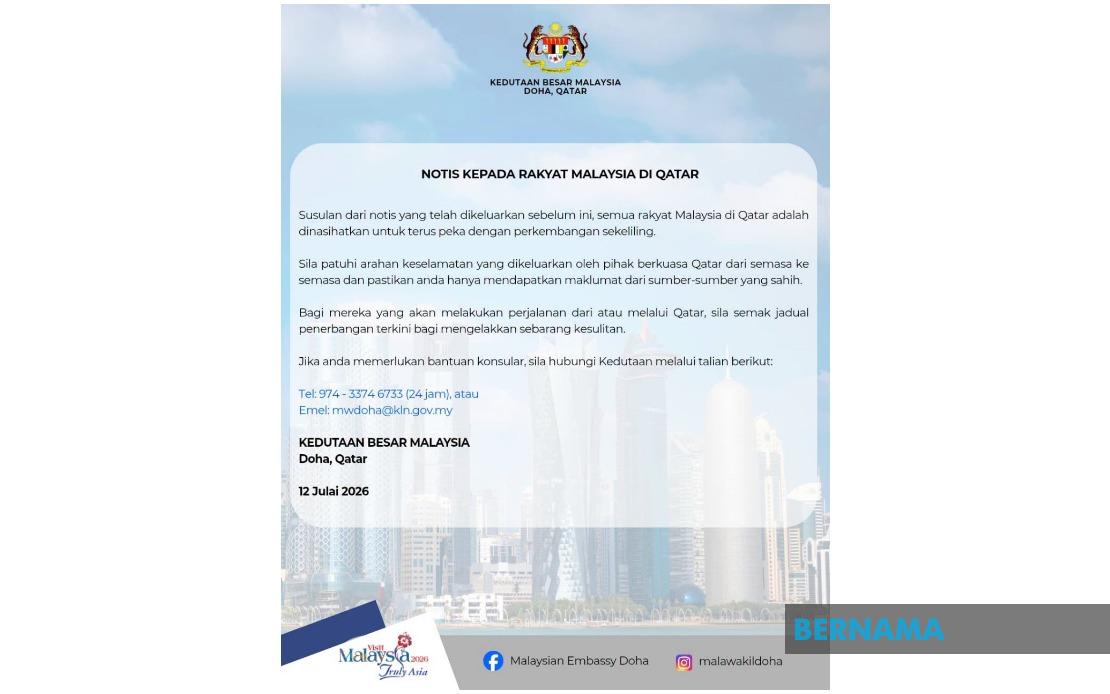
The Malaysian Embassy in Doha has directed all citizens residing in or transiting through Qatar to adhere strictly to security protocols issued by Qatari authorities in response to intensifying military confrontations between the United States and Iran. Through an official announcement on its Facebook page, the embassy underscored the importance of maintaining constant situational awareness and exercising heightened caution during this volatile period in the Gulf region.
The embassy's advisory represents a precautionary measure aimed at safeguarding the welfare of Malaysian nationals who may be exposed to the fallout from the broader geopolitical dispute unfolding across the strategically vital waterway. Residents have been encouraged to rely exclusively on credible information channels rather than unverified reports, particularly as misinformation can spread rapidly during times of regional instability. The embassy has established a 24-hour hotline at +974-3374 6733 for Malaysians seeking immediate consular assistance, while those with additional concerns may reach out via email to the diplomatic mission.
For Malaysians planning to depart from Qatar or pass through the country en route to other destinations, the embassy has advised immediate verification of flight schedules with airlines to mitigate the risk of travel disruptions. The escalating tensions have the potential to disrupt civilian air traffic and other transportation networks, making advance planning essential for those with imminent travel requirements. This guidance reflects the unpredictability that often accompanies military escalation in the region.
The latest round of hostilities was triggered on Sunday when the United States military conducted its third major aerial assault on Iranian targets within a single week. According to reports from Anadolu Ajansi, the strikes followed an incident in which the Iranian military fired upon a commercial vessel transiting the Strait of Hormuz. This sequence of tit-for-tat military actions illustrates the rapid deterioration of the security environment and the fragility of any existing ceasefires or diplomatic agreements.
Concurrently, Iran's Islamic Revolutionary Guard Corps navy announced an indefinite closure of the Strait of Hormuz, one of the world's most critical maritime chokepoints through which approximately one-third of global seaborne oil trade flows. The IRGC declaration stipulated that the waterway would remain sealed to all vessel traffic until the United States ceases its military interventions across the Middle East. This blockade announcement carries profound implications not only for international commerce but also for energy markets worldwide, including Malaysia's own energy security and economic interests.
The escalation stands in stark contrast to diplomatic progress achieved just weeks earlier when Tehran and Washington negotiated a Pakistan-brokered memorandum of understanding in June. That accord was designed to terminate hostilities that had erupted in late February and establish the groundwork for a comprehensive peace settlement between the two adversaries. The memorandum explicitly called for an immediate cessation of all military operations across multiple fronts, the lifting of the American naval blockade imposed on Iran, and the restoration of normal maritime traffic through the Strait of Hormuz.
However, despite the existence of this written agreement and the international mediation efforts that produced it, both nations have chosen to resume military action within days of signing the accord. The dispute centres specifically on commercial shipping rights through the Strait of Hormuz, suggesting that fundamental disagreements persist over how the memorandum's provisions should be implemented and enforced. This breakdown in compliance indicates that the underlying tensions between Washington and Tehran remain unresolved despite the nominal ceasefire.
For Malaysia and other Southeast Asian nations, the renewal of hostilities in the Persian Gulf presents multiple challenges. The closure of the Strait of Hormuz directly impacts regional economies dependent on Gulf oil imports and threatens the stability of international maritime commerce. Malaysian shipping companies and logistics operators face heightened insurance costs and route uncertainty, while Malaysian nationals employed in the Gulf region confront an environment of increased risk.
The situation also underscores the vulnerability of small and medium-sized nations caught in the crossfire of major power competition. Malaysia's diplomatic approach has traditionally emphasised non-alignment and peaceful dispute resolution, making the current escalation particularly concerning. The country's economic dependence on stable global trade routes and energy supplies means that prolonged regional instability carries direct consequences for domestic prosperity and development objectives.
As the situation remains fluid and subject to rapid change, Malaysian authorities and citizens are advised to monitor official embassy communications regularly and adjust travel and business plans accordingly. The embassy's advisory serves as both a protective measure for individual nationals and a signal of Malaysia's attentiveness to developments that may affect its broader national interests in one of Asia's most strategically important regions.

