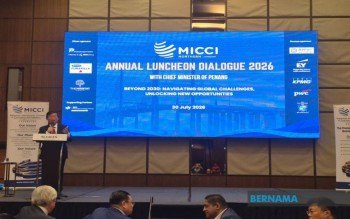
The Malaysian International Chamber of Commerce and Industry has sounded an urgent call for its members to prioritise spending on human capital and technological innovation if they are to maintain their competitive edge as artificial intelligence, automation and digital technologies fundamentally reshape the business landscape. Speaking at the MICCI Northern Branch Annual Luncheon Dialogue 2026 in George Town on July 30, branch chairman Datuk Brian Tan Guan Hooi painted a picture of a rapidly evolving industrial environment where traditional job roles are disappearing even as entirely new sectors and higher-paying employment categories emerge from technological advancement.
The challenge facing Malaysian businesses is acute: while the technological transformation underway promises significant opportunities, companies that fail to adapt their workforce strategy risk being left behind in an increasingly competitive global marketplace. Tan emphasised that merely ensuring workers hold the right academic qualifications is no longer sufficient in this new era. Instead, organisations must cultivate a more comprehensive set of capabilities within their teams, encompassing technical proficiency, creative problem-solving abilities, communication prowess and perhaps most importantly, a genuine commitment to lifelong learning and continuous self-improvement.
This message resonates particularly strongly across Southeast Asia, where Malaysia has positioned itself as a regional hub for technology and innovation. The country's manufacturing sector, its financial services industry and its emerging digital economy all face pressure to remain globally competitive while simultaneously addressing the reality that many traditional roles will be automated or displaced over the coming years. Penang Chief Minister Chow Kon Yeow, who attended the dialogue as guest of honour, likely recognised the implications for the state, which has built much of its economic success on attracting technology and manufacturing investment.
Tan's remarks highlighted a critical tension facing policymakers and business leaders throughout the region. Artificial intelligence and automation will undoubtedly eliminate certain categories of work, yet history suggests that major technological revolutions also create entirely new industries and job categories that do not yet exist. The key to capturing these emerging opportunities lies in having a workforce prepared not just for specific technical skills, but for adaptability itself. Workers who can think creatively, collaborate effectively and embrace continuous learning will be better positioned to thrive in roles that may not yet have been invented.
The MICCI leader made a compelling case that education and training systems cannot operate in isolation from industry realities. Too often, educational institutions develop curricula based on historical needs rather than anticipating future demand. The lag between what schools teach and what businesses actually need creates a mismatch that disadvantages both employers seeking skilled workers and graduates seeking meaningful employment. Tan argued that maintaining close alignment between education providers and industry practitioners was essential for ensuring that young Malaysians graduate with capabilities that directly address genuine market needs.
Beyond the workforce question, Tan underscored the necessity for Malaysian companies to embrace a longer-term strategic perspective. The pressure to deliver quarterly results or annual profits can tempt businesses to neglect the investments in innovation and talent development that might not yield immediate returns but could prove decisive over a five or ten-year horizon. The companies that thrive in the next decade will likely be those that resist this short-term thinking and instead allocate resources toward building organisational capabilities that position them to capture opportunities that currently exist only in potential form.
Crucially, Tan articulated a vision of public-private partnership that goes beyond the typical rhetoric about collaboration. He acknowledged that government has a legitimate role in setting strategic direction, providing infrastructure, and creating regulatory frameworks that enable business activity. However, he equally emphasised that private enterprise brings essential ingredients to this equation: capital investment, technological expertise, operational experience and the capacity to generate employment at scale. Neither sector, he argued, can successfully navigate the challenges ahead without the active engagement and genuine partnership of the other.
This perspective reflects an understanding that Malaysia's future competitiveness will depend not on either government policy or private sector innovation alone, but on the quality of dialogue and coordination between these two spheres. Practical challenges frequently arise at the intersection of policy and implementation, where well-intentioned regulations can inadvertently impede business activity or where businesses might pursue strategies that undermine broader public interest objectives. Honest, constructive conversation between stakeholders can help identify and resolve these tensions before they become entrenched problems.
The organisation invoking this message carries historical weight. MICCI, which traces its origins back to 1837 and is marking its 189th anniversary this year, has positioned itself as a custodian of Malaysian business interests for nearly two centuries. This longevity suggests that chambers of commerce can indeed serve a bridging function between private enterprise and government, sharing insights about industry conditions and contributing practical solutions grounded in real business experience. As Malaysia confronts the disruptive potential of artificial intelligence and digital transformation, such institutions may prove more valuable than ever in facilitating the kinds of difficult conversations necessary to ensure that economic transition benefits broad segments of the population rather than creating new divides.

