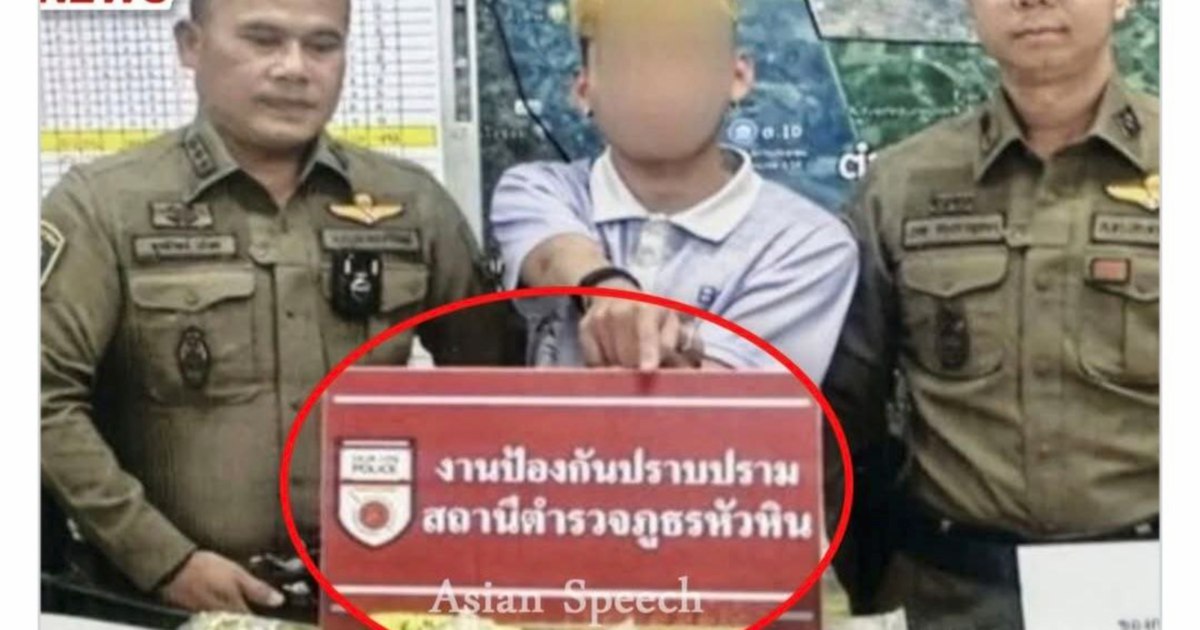
Thai police successfully apprehended a 20-year-old Malaysian national in Hua Hin, Prachuap Khiri Khan province, on Saturday in connection with a substantial drug trafficking operation that netted authorities one of the region's more significant recent crystal methamphetamine seizures. The arrest came after the suspect attempted to evade a police checkpoint operating in the coastal province, triggering a pursuit that ultimately led to his capture and the discovery of 166 kilograms of syabu, with an estimated street value exceeding RM8 million.
The incident underscores the persistent challenges facing both Malaysian and Thai law enforcement in combating transnational drug smuggling operations that exploit cross-border routes through the Strait of Malacca and land borders. Young Malaysian nationals have increasingly become targets for recruitment by trafficking syndicates, whether as couriers, operators, or minor facilitators in larger networks. The attempted checkpoint evasion suggests the suspect may have been aware of his illicit cargo or faced pressure from handlers operating the distribution network.
Crystal methamphetamine remains one of Southeast Asia's most problematic synthetic drugs, with manufacturing clusters predominantly located in the Golden Triangle region spanning Myanmar, Laos, and Thailand. The substance commands high prices across regional markets, particularly in urban centres where young adults and nightlife venues represent concentrated consumer bases. At current street valuations, a single seizure of this magnitude represents significant disruption to trafficking logistics and distributor networks.
The arrest reflects intensified cooperation between Thai and Malaysian law enforcement agencies, which have ramped up joint operations and intelligence sharing in recent years. Checkpoint operations along major transportation corridors in southern Thailand have become routine countermeasures against trafficking attempts. However, the sheer volume captured in this single interdiction indicates the scale of attempted smuggling operations crossing into Thailand, where demand for methamphetamine has grown substantially among both recreational users and individuals seeking performance enhancement in manual labour sectors.
For Malaysia, incidents involving young citizens detained abroad carry significant diplomatic and consular implications. The Kota Baru reference in the original report suggests the suspect may have originated from Kelantan or that Malaysian authorities first received notification there. Malaysian missions in Thailand routinely manage cases involving detained nationals, providing consular assistance while respecting host country legal proceedings. Such arrests also prompt discussions within Malaysia regarding drug awareness campaigns targeting youth and the recruitment tactics employed by trafficking networks.
The 166-kilogram seizure surpasses many individual drug busts reported across Southeast Asia in recent months, positioning this among the more substantial methamphetamine hauls in the region. The value proposition—exceeding RM8 million—illustrates why trafficking networks continue attempting to move products despite escalating enforcement risks. For traffickers, the potential profit margins justify deploying young, replaceable operatives willing to assume arrest risks, often in exchange for modest compensation or coercion through debt arrangements.
Thailand has strengthened its drug enforcement frameworks considerably, particularly following international pressure and domestic health concerns related to methamphetamine proliferation. The Royal Thai Police and Border Patrol Police maintain extensive checkpoint networks, especially in provinces bordering Malaysia and Laos. The Hua Hin location, while south of Bangkok, lies on a major transportation corridor where substances originating from manufacturing zones further north pass through en route to consumer markets in Malaysia, Singapore, or regional distribution hubs.
The timing and circumstances of checkpoint detection raise questions about the suspect's operational security and whether handler networks provided inadequate guidance regarding police positioning or activity patterns. Amateur operations often lack real-time intelligence about enforcement activities, whereas established syndicates maintain networks providing advance warning about heightened police presence. The fact that this shipment was intercepted suggests either inadequate precautions or that law enforcement intelligence successfully anticipated a trafficking attempt.
Detention of a Malaysian in Thai custody triggers notification requirements to Malaysia's Ministry of Foreign Affairs and engagement of appropriate legal representation. Thai jurisprudence regarding drug trafficking offences carries severe penalties, with sentences for trafficking quantities exceeding 100 kilograms typically involving decades of imprisonment. The suspect now faces navigation of Thailand's legal system while simultaneously requiring consular support from Malaysia.
For regional observers, the seizure reinforces that synthetic drug trafficking through Southeast Asia remains fundamentally undiminished by enforcement efforts to date. Precursor chemicals essential for methamphetamine production flow relatively freely through regional supply chains, manufacturing capacity in Myanmar and Laos continues expanding, and demand across consumer markets—including Malaysia—generates sufficient profit incentives to sustain supply networks despite interdiction risks. Law enforcement agencies acknowledge that substantial quantities successfully evade checkpoints, meaning actual trafficking volumes substantially exceed seizure figures.
The arrested individual joins hundreds of Malaysian drug detainees currently held in Thai prisons, part of a broader regional pattern in which youth from Malaysia, Indonesia, and Bangladesh feature prominently in trafficking-related arrests. Rehabilitation organisations and criminal justice advocates increasingly point to inadequate economic opportunities, social marginalisation, and targeted recruitment tactics as factors influencing why young people accept trafficking roles. Addressing these underlying dynamics requires interventions extending far beyond checkpoint enforcement.

