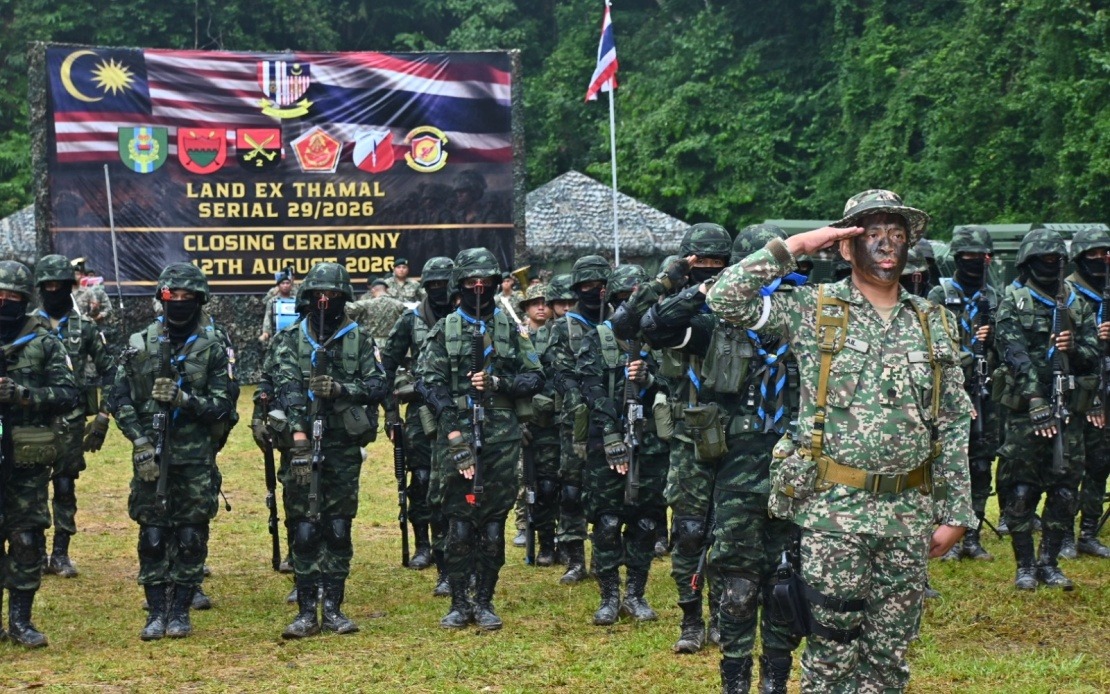
Over 250 soldiers from Malaysia and Thailand are undertaking an intensive joint military exercise in Gerik, marking another significant milestone in the two nations' deepening defence partnership. Exercise LAND THAMAL Series 29/2026, which commenced on August 5 and continues through this month, brings together 197 personnel from the Malaysian Army (TDM) and 55 from the Royal Thai Army (RTA) in a coordinated effort to sharpen combat capabilities and foster greater interoperability between the allied forces. The exercise represents a continuation of long-standing bilateral military cooperation that has become increasingly vital for regional stability.
The scope of the exercise encompasses three distinct operational phases designed to provide comprehensive training across multiple military disciplines. The Cross Training Exercise (CTX) phase allows personnel to exchange foundational knowledge and doctrine, while the Field Training Exercise (FTX) component exposes soldiers to realistic tactical scenarios including combat manoeuvres, obstacle crossing, defensive base establishment, reconnaissance patrols, and assault operations against simulated enemy positions. These practical elements form the core of hands-on skill development, enabling troops to test theoretical knowledge against challenging field conditions that mirror potential real-world operational environments.
The third component, Combined Military Civil Action (CMCA), underscores the exercise's broader purpose beyond conventional military training. Through the Jiwa Murni Programme, participating soldiers from both countries engaged in community service activities at Sekolah Menengah Kebangsaan Sultan Idris Shah II in Gerik, demonstrating the military's commitment to civil-military relations and grassroots community engagement. This dimension reflects modern military doctrine that recognises soldiers' roles extending beyond combat to encompass humanitarian assistance, disaster relief, and community development—capacities that both armies increasingly emphasise.
Official oversight of the exercise fell to senior commanders from both nations. Brigadier General Datuk Mohd Zaini Hashim, Commander of the 30th Malaysian Infantry Brigade, jointly presided over the August 5 opening ceremony at Gerik Airstrip alongside Senior Colonel Taweeporn Kanatong, who commands the 5th Infantry Brigade of the Thai Army. Their ceremonial collaboration symbolised the formal commitment of both defence establishments to the exercise and underscored the political support underpinning military-to-military cooperation.
Senior Colonel Taweeporn's remarks during the opening highlighted the exercise's strategic significance beyond bilateral interests. He articulated how LAND THAMAL strengthens Malaysia-Thailand defence capabilities in confronting multifaceted security challenges encompassing natural disasters, transnational security threats, and conventional conflicts. This framing reflects the reality that both nations face overlapping security concerns—from transnational crime and terrorism to maritime boundary issues and humanitarian emergencies—where coordinated military responses yield superior outcomes compared to unilateral approaches.
The emphasis on knowledge exchange and tactical procedure harmonisation represents a sophisticated understanding of modern military cooperation. Rather than simply conducting parallel training, the exercise deliberately integrates personnel to facilitate direct exposure to each nation's operational methods, command structures, and tactical preferences. This cross-pollination creates networks of professional relationships and mutual understanding among mid-level officers and non-commissioned officers who may cooperate in future joint operations. Such interpersonal connections often prove as valuable as formal agreements in enabling effective coordination during crises.
For Malaysia and Thailand, border security constitutes a paramount concern. Both nations share an extensive land frontier that historically required vigilant management, and sustained military cooperation helps prevent misunderstandings while coordinating responses to transnational challenges including smuggling, human trafficking, and insurgent activity. Exercise LAND THAMAL contributes to this strategic objective by ensuring that front-line units from both armies operate from a foundation of shared understanding and established working relationships.
The exercise also carries implications for Southeast Asian regional security architecture. Malaysia and Thailand's demonstrated commitment to professional military cooperation sets a positive example amid broader regional tensions and occasionally fraught diplomatic relationships. Their exercise demonstrates that substantive defence collaboration—grounded in clear institutional frameworks, regular engagement, and professional military principles—can flourish even when broader political relationships experience fluctuations. This stability in military-to-military ties provides ballast during periods when diplomatic channels face strain.
The operational readiness dimension cannot be understated. Both the TDM and RTA benefit from exposure to different training methodologies, equipment systems, and tactical doctrines. Such comparative exposure often reveals gaps in individual unit capabilities or identifies innovative approaches that can be adapted to local contexts. The exercise thus functions as a professional development opportunity for participating military education establishments, with lessons learned circulating through both armies' training infrastructure long after the exercise concludes.
The format of LAND THAMAL—occurring as a numbered series with this edition designated Series 29/2026—indicates institutionalisation of the cooperation. Regular, scheduled exercises signal permanence and commitment rather than ad-hoc military interaction. This regularity enables systematic development of joint capabilities and doctrine, with each iteration building upon previous sessions and establishing progressive skill development objectives. For Malaysian defence planners, these exercises demonstrate how sustained engagement with key regional partners yields tangible operational improvements.
Looking forward, the Malaysian military establishment has signalled that Exercise LAND THAMAL will continue serving as an important platform for deepening Malaysia-Thailand defence relations. Military leaders have explicitly stated the exercise's contribution to joint border security preservation and regional peace and stability maintenance. This forward-looking perspective suggests both nations view the exercise as foundational infrastructure supporting longer-term strategic cooperation rather than isolated annual events.
The participation of 252 military personnel, while modest in absolute numerical terms, carries significance beyond headcount. These individuals return to their parent units as ambassadors for cross-border military cooperation, potentially influencing organisational cultures toward greater professional engagement with Thai counterparts. Their networks and relationships established during the exercise create informal channels facilitating future coordination, whether during peacetime exercises or responding to actual contingencies.
For Malaysian readers, Exercise LAND THAMAL exemplifies how the armed forces advance national security interests through patient, systematic development of bilateral partnerships. While such military cooperation rarely features prominently in public discourse, these exercises constitute critical foundations for regional stability. The exercise demonstrates Malaysia's consistent commitment to strengthening ties with neighbouring Thailand, a strategic imperative for a nation whose security environment increasingly emphasises cross-border cooperation and regional harmony.

