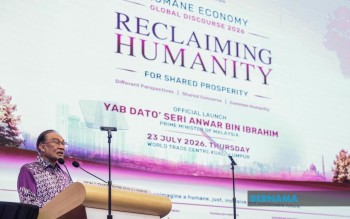
Prime Minister Datuk Seri Anwar Ibrahim has set the stage for Malaysia's fiscal planning cycle, announcing that the government will commence work on Budget 2027 next month with the intention to present it to Parliament in early October. Speaking in his capacity as both Prime Minister and Finance Minister, Anwar outlined a timeline that gives policymakers and administrators roughly two months to craft Malaysia's spending and revenue plans before formal parliamentary proceedings. This schedule aligns with Malaysia's traditional budget calendar, allowing the administration adequate preparation time whilst maintaining momentum on fiscal governance that has characterised the current government's approach to economic planning.
The philosophical underpinning of Budget 2027 represents a notable departure from purely growth-centric economics, according to Anwar's statement. He articulated a vision wherein economic expansion serves as a vehicle for human flourishing rather than an end goal in itself, emphasising that numerical improvements in GDP or consumption figures hold limited value if they fail to enhance the material circumstances of ordinary Malaysians. This framing reflects broader international discourse on inclusive growth, a concept gaining traction among policymakers who recognise that rapid economic expansion can coexist with stagnant wages, widening inequality, and deteriorating living standards for significant population segments. For Malaysian readers, this signals a potentially consequential shift in how government allocates resources and designs policies across ministries and government-linked companies.
According to Anwar's address at the Humane Economy Global Discourse event, the upcoming budget will embed a systematic evaluation mechanism into decision-making processes. Officials tasked with formulating spending priorities must interrogate whether proposed investments and policies expand economic opportunity or constrain it, strengthen household and community resilience or undermine it, and treat citizens as active participants in national development or merely as factors of production to be optimised. This methodology suggests a more granular, impact-focused approach to budgeting that demands evidence of human benefit alongside financial metrics. Implementation of such criteria across government departments would represent a significant institutional shift requiring coordination between the Finance Ministry and sectoral agencies.
The economic growth principle articulated by Anwar directly challenges conventional development metrics that have long dominated policy discussions in Malaysia and throughout Southeast Asia. Rather than celebrating increases in gross domestic product, government expenditure, or foreign investment flows, the administration's stated intention is to evaluate progress through improvements in tangible living conditions. These improvements encompass higher real wages adjusted for cost of living, employment that provides dignity and career progression, housing affordability that enables home ownership across income brackets, healthcare accessibility without catastrophic financial burden, educational quality that prepares citizens for economic participation, and the presence of vibrant local communities where social bonds remain intact. Malaysia's middle-income status makes this transition particularly important, as the country faces the challenge of sustaining growth whilst addressing quality-of-life concerns that could otherwise breed political instability.
The inclusion of sustainability principles within Budget 2027's framework indicates an attempt to reconcile development objectives with environmental and fiscal constraints. Anwar's statement emphasises that prosperity must not come at the cost of bequeathing environmental degradation, fiscal imbalances, or social dysfunction to subsequent generations. This perspective addresses Malaysia's vulnerability to climate impacts, including flooding, heat stress on agriculture, and potential sea-level rise in coastal regions, whilst acknowledging that unsustainable fiscal policies create medium-term vulnerabilities in public debt servicing. For Southeast Asian economies dependent on regional supply chains and trade flows, environmental and fiscal stability directly influence investment decisions by multinational corporations and capital allocators.
Innovation and digital transformation feature prominently in the Budget 2027 framework, though Anwar contextualises technological advancement within explicit distributional parameters. Rather than permitting innovation to concentrate wealth and economic opportunity among technological elites or foreign firms, the government's intention appears to be directing digital transformation toward expanding human capabilities broadly across society. This stance matters considerably for Malaysia's semiconductor and technology sectors, as it suggests government policy may privilege local content development, workforce upskilling programmes, and technology transfer mechanisms over the pursuit of foreign direct investment alone. Such an approach could influence how Malaysia positions itself within regional technology value chains dominated by countries including Taiwan, South Korea, and Vietnam.
The semiconductor strategy referenced alongside Budget 2027 carries particular significance for Malaysia's economic trajectory, as the nation hosts substantial semiconductor manufacturing and assembly operations for global technology companies. How government resources are allocated toward supporting this sector—whether through research and development funding, workforce development, or infrastructure investment—will shape Malaysia's competitive positioning. The emphasis on ensuring that semiconductor industry growth translates into quality employment and skill development for Malaysian workers suggests potential reorientation of sectoral support mechanisms away from purely subsidy-based approaches toward human capital investment and technology capability building.
Energy transition represents another consequential budgetary domain highlighted by Anwar, reflecting global and regional imperatives toward decarbonisation. Malaysia's substantial petroleum and natural gas revenues have historically funded government operations, creating fiscal challenges as global energy demand patterns shift toward renewable sources. Budget 2027 must navigate the tension between sustaining revenue from hydrocarbons whilst simultaneously investing in renewable energy infrastructure, grid modernisation, and the workforce retraining that energy transition demands. For regional observers, Malaysia's energy transition pathway influences broader Southeast Asian energy security and climate commitments, as the region collectively pursues net-zero objectives by mid-century.
The timing of budget formulation commencing in August positions Malaysia within the standard fiscal planning cycle observed by most Commonwealth nations and ASEAN neighbours. Beginning the process two months before parliamentary tabling allows department heads to consult with relevant stakeholders, model fiscal scenarios incorporating recent economic data, and reconcile competing spending priorities within overall expenditure envelopes. This timeline also permits adjustment based on international economic developments, commodity price movements, and domestic economic conditions during the preparation period. For Malaysian business and civil society sectors, the August commencement signals an appropriate moment to engage with government officials on policy priorities and spending allocations relevant to their constituents.
The presentation at the Humane Economy Global Discourse conference suggests Malaysia is positioning itself within an emerging intellectual movement questioning whether conventional economic growth frameworks adequately capture human welfare. This positioning carries soft power implications, as Malaysia potentially differentiates itself from regional peers by articulating a distinctive development philosophy. Whether Budget 2027 substantively operationalises these principles or remains aspirational will determine the credibility of this positioning. For Malaysian taxpayers and citizens, the gap between stated philosophy and actual budget allocation across defence, health, education, social welfare, and infrastructure categories will reveal the government's genuine priorities and the sincerity of its commitment to inclusive, sustainable, human-centred development.

