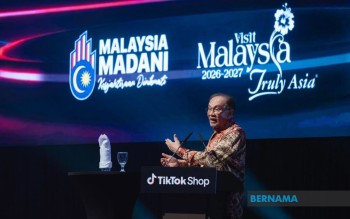
Malaysia is moving to strengthen its investment vetting process to prevent foreign entities from exploiting domestic market access without contributing meaningfully to the local economy. Prime Minister Datuk Seri Anwar Ibrahim made the announcement while addressing participants at the TikTok Shop Summit 2026 in Kuala Lumpur, signalling growing concern about business models that drain rather than develop Malaysia's economic capacity.
The government has identified a troubling pattern where international companies establish minimal local operations—typically warehouse facilities or transit hubs—that generate neither employment opportunities nor tangible economic stimulus for Malaysian citizens and businesses. The Ministry of Investment, Trade and Industry (MITI) has flagged this issue directly to leadership, prompting the administration to take defensive measures against what amounts to economic arbitrage without responsibility. Anwar explained that enforcement action has already commenced against such activities, but a comprehensive review of pending applications is now underway to prevent additional problematic entrants from establishing a foothold.
The concern extends beyond traditional import-export operations to encompass a newer category of digital commerce operators. Cross-border e-commerce platforms like Temu and Pinduoduo have flooded Malaysian markets with extraordinarily cheap products sourced almost entirely from overseas suppliers, creating what Anwar characterised as market-dumping behaviour designed to capture consumer share while leaving local sellers unable to compete. This phenomenon reflects the broader challenge facing developing economies in the digital age: how to remain open to legitimate foreign investment and international commerce while protecting domestic industries from predatory pricing and hollow subsidiaries.
Particularly galling to policymakers is the practice of registering shell companies under Malaysian business names—often mimicking established local brands like coffee shops or traditional retailers—while selling exclusively imported goods. Anwar drew specific attention to this deceptive strategy, noting that such operations masquerade as domestic enterprises while offering zero benefit to local communities or business owners. The tactic exploits consumer assumptions about product origin while circumventing the spirit of local business support, representing a form of regulatory arbitrage that undermines genuine entrepreneurship.
Port Klang's warehousing sector has become emblematic of the broader problem. Large foreign investors rent industrial space at Malaysia's premier container port without any requirement to employ local workers or source Malaysian products, essentially using national infrastructure as a transshipment hub with no corresponding obligation to the host nation. This arrangement extracts logistics value while remaining detached from domestic employment creation or supply chain integration—the very mechanisms through which foreign investment traditionally stimulates broader economic participation and skill development.
The government's response must navigate the delicate balance between openness and protection that defines Malaysia's economic philosophy. As Anwar acknowledged, Malaysia functions as a free-trade country with deliberately permissive policies toward foreign commercial activity. Digitalisation has accelerated this openness, lowering barriers for overseas sellers to reach Malaysian consumers directly. Yet this liberalisation, while generating consumer choice and competition, has created vulnerabilities that less scrupulous operators exploit through deliberately extractive business models.
The scrutiny will likely focus on measurable contributions: employment of Malaysian citizens at competitive wages, purchasing of local inputs and services, technology transfer, and genuine integration into domestic supply chains. Enforcement officers have already begun investigating existing operations, suggesting the government will pursue both preventive and corrective approaches. New applicants will face questioning about employment plans, local procurement strategies, and the overall economic multiplier their activities will generate.
This initiative carries particular significance for Southeast Asia's broader development trajectory. As wealthier nations and multinational corporations seek lower-cost bases for operations, smaller economies risk becoming dumping grounds for low-value transactional activities rather than sites for genuine value creation. Malaysia's willingness to enforce stricter standards sends a message that even open economies retain the right to discriminate based on economic contribution and social benefit.
The timing reflects mounting frustration among Malaysian business owners and workers who face competition from imported cheap goods and foreign operators unbound by local employment norms or community obligations. Small enterprises that operate under full regulatory compliance and hire local staff resent competing against digital platforms that capture market share through pricing strategies subsidised by overseas capital structures. Anwar's commitment to address this disparity should resonate with constituencies that feel economically threatened by unfiltered globalisation.
Implementing such a policy requires sophisticated assessment mechanisms. Officials must distinguish between legitimate foreign investors with genuine commitment to Malaysian development and opportunistic operators pursuing short-term extraction. The criteria will likely include employment ratios, local procurement percentages, capital invested relative to assets employed, and technology or skill contribution. Companies demonstrating clear commitment to genuine market operation rather than mere transshipment should face favourable treatment.
The broader implications extend to how Malaysia positions itself within global investment hierarchies. By insisting that foreign capital serve Malaysian development rather than merely exploit market access, the government reasserts sovereignty over its economic agenda. This approach aligns with other middle-income nations reassessing foreign investment frameworks to ensure alignment with domestic priorities rather than accepting whatever capital arrives.
Regional competitors will watch Malaysia's implementation carefully. If successful, the model could demonstrate how developing economies protect vulnerable domestic sectors without abandoning openness or provoking retaliation. If enforcement proves inconsistent or criteria too vague, the initiative risks becoming symbolic gesture without substantive protection for local business.

