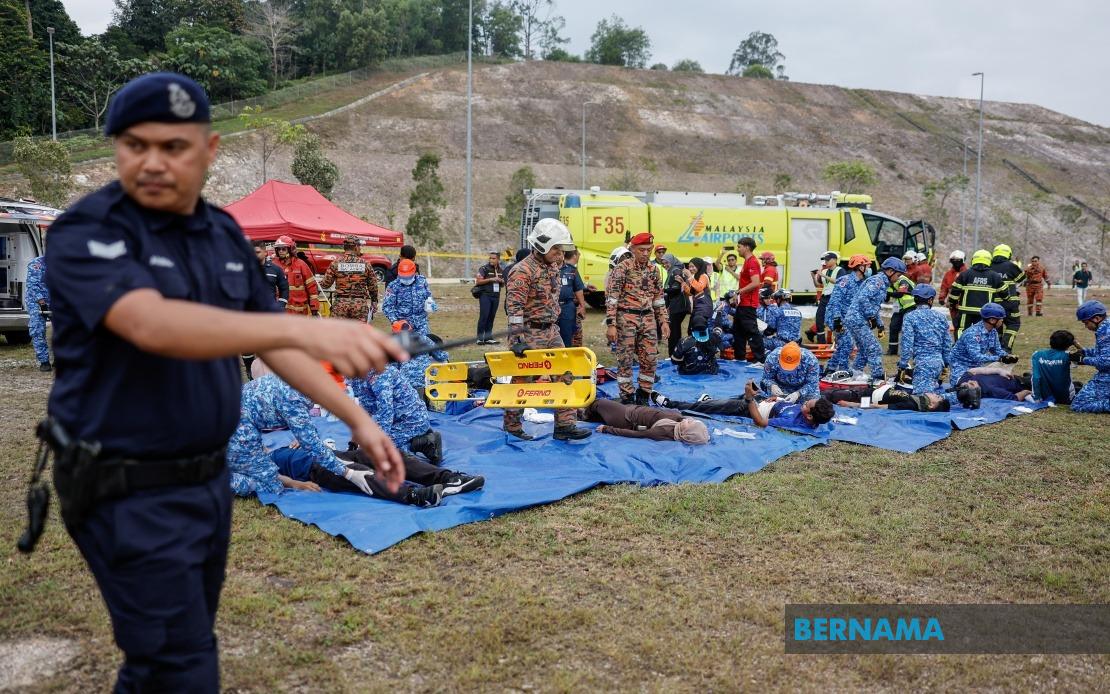
Malaysia conducted a landmark full-scale emergency simulation at the Denai Alam Rest and Service Area near the Damansara-Shah Alam Elevated Expressway on July 16, testing how the nation's aviation authorities and emergency services would respond to an aircraft disaster occurring well beyond airport boundaries. Dubbed Ex Urban Falcon 2026, the exercise represented the first comprehensive attempt to rehearse procedures for an air incident in an off-airport setting, departing from decades of drills focused primarily on emergencies within or immediately adjacent to airport perimeters. The simulation centred on an ATR72 aircraft "crashing" approximately six kilometres from Sultan Abdul Aziz Shah Airport in Subang, engaging more than 20 enforcement and emergency response agencies alongside 450 total participants from critical public and private-sector organisations.
Airport Fire and Rescue Services general manager Muhammad Hidayat Ismail stressed that the exercise aimed to validate Malaysia Airports Holdings Berhad's coordination mechanisms with responding agencies and to ensure operational readiness under Malaysia's aeronautical search and rescue framework. According to the National Aeronautical Search and Rescue Manual, AFRS maintains responsibility across a radius extending eight kilometres from an airport's central point—a geographic threshold that had rarely been tested in practical scenarios until this drill. By positioning the simulated incident substantially beyond typical response zones, planners sought to identify operational gaps that might emerge during real-world disasters occurring in populated residential or commercial areas where commercial aircraft might conceivably descend in emergency situations.
One of the most significant challenges the responding teams encountered involved the logistics of reaching the scene swiftly despite navigating residential streets, intersecting multiple toll plazas on expressway systems, and managing traffic congestion that would inevitably accompany an actual disaster. Muhammad Hidayat observed that while agencies executed their established procedures competently and firefighting and rescue operations proceeded according to protocol, the practical difficulties of accessing remote or partially urbanised crash sites highlighted critical vulnerabilities in Malaysia's disaster response infrastructure. These logistical impediments—fundamentally different from the controlled airport environment where emergency vehicles maintain ready access to runways and established routes—underscored why off-airport simulations represent such valuable training opportunities for a nation increasingly crisscrossed by major transportation corridors where aircraft emergencies, though statistically rare, carry potentially catastrophic consequences.
The terrain characteristics of off-airport crash locations create markedly different rescue and survival dynamics compared with incidents occurring within airport boundaries. Off-airport terrain tends to be uneven, fragmented by buildings, roads, and vegetation, significantly reducing victim survival rates and complicating both initial rescue operations and subsequent victim identification efforts. Muhammad Hidayat noted that the exercise deliberately incorporated realistic casualty numbers that would overwhelm survivors, forcing rescue teams to confront the tragic mathematics of mass disasters where Disaster Victim Identification operations, coordinated through the Royal Malaysia Police, become paramount. This emphasis on DVI coordination reflects international best practices in aviation emergency management, where systematic victim identification prevents compounding families' suffering and ensures accurate casualty reporting that underpins subsequent investigations and policy adjustments.
Malaysia's technological capabilities in aviation firefighting stand among its greatest assets for managing such emergencies. The nation operates aircraft firefighting vehicles constructed to specifications and standards mandated by the International Civil Aviation Organisation and the Civil Aviation Authority of Malaysia, ensuring compatibility with international search and rescue protocols and interoperability with regional partners' equipment. However, technology alone cannot address the fundamentally different operational environment that off-airport scenarios present, where access constraints, terrain irregularities, and the necessity of coordinating across multiple municipal and state authorities introduce coordination challenges that pure equipment excellence cannot surmount. The exercise therefore served as an important reminder that aviation safety excellence requires not merely technological investment but sustained investment in inter-agency relationships, standardised procedures, and realistic training that exposes institutional vulnerabilities before actual disasters reveal them lethally.
The workshop scheduled for July 26 and 27 will analyse findings from Ex Urban Falcon 2026 and develop concrete improvement measures based on the day's observations. This follow-up analytical phase transforms the exercise from a mere procedural rehearsal into a foundation for genuine institutional learning and capability enhancement. Malaysian officials recognise that air disaster scenarios extending beyond airport perimeters represent a substantial gap in the nation's tested preparedness, one that becomes more significant as aviation traffic densifies and urban sprawl brings developed areas closer to traditional flight paths. The structured review process ensures that agencies will not simply forget lessons learned but will institutionalise improvements through updated protocols, revised coordination mechanisms, and potentially reallocation of resources to address identified shortcomings.
The partnership orchestrating this exercise—comprising MAHB, NADMA, the Selangor state government, and PROLINTAS-DASH—reflects the recognition that effective aviation disaster response transcends any single organisation and requires coordination across airport authorities, national disaster management frameworks, state administrations, and private infrastructure operators. Selangor state's involvement proves particularly significant given that Sultan Abdul Aziz Shah Airport operates near densely populated areas where residential communities and commercial developments create complex emergency response environments. PROLINTAS-DASH's participation acknowledges that expressway operators, sometimes overlooked in traditional aviation emergency planning, play crucial roles in enabling rapid transport of emergency personnel and equipment to off-airport incident sites.
The commitment demonstrated by all participating agencies signals Malaysia's determination to maintain robust aviation safety standards at a moment when global air travel continues recovering from pandemic disruptions and when technological advances enable safer aircraft operations than ever before. Yet statistical safety improvements should not breed complacency; even extraordinarily safe transportation modes experience occasional catastrophic failures, and nations must remain prepared to respond effectively when they do. Malaysia's willingness to challenge its existing procedures through realistic simulation and to acknowledge gaps in off-airport disaster response preparedness positions the country ahead of many regional peers in aviation safety maturity.
Enhanced preparedness for off-airport aircraft emergencies carries implications extending beyond Malaysia's borders. Regional aviation hubs increasingly handle routes connecting developing nations with higher-density traffic and more complex airspace management challenges, creating scenarios where incidents occurring beyond traditional airport zones become statistically more plausible. Malaysia's systematic approach to testing and improving off-airport response capabilities establishes standards and methodologies that other Southeast Asian nations might adopt, potentially elevating aviation safety across the region. The exercise thus contributes not merely to Malaysia's domestic security but to regional resilience and the ongoing international project of making air travel safer for all users.

