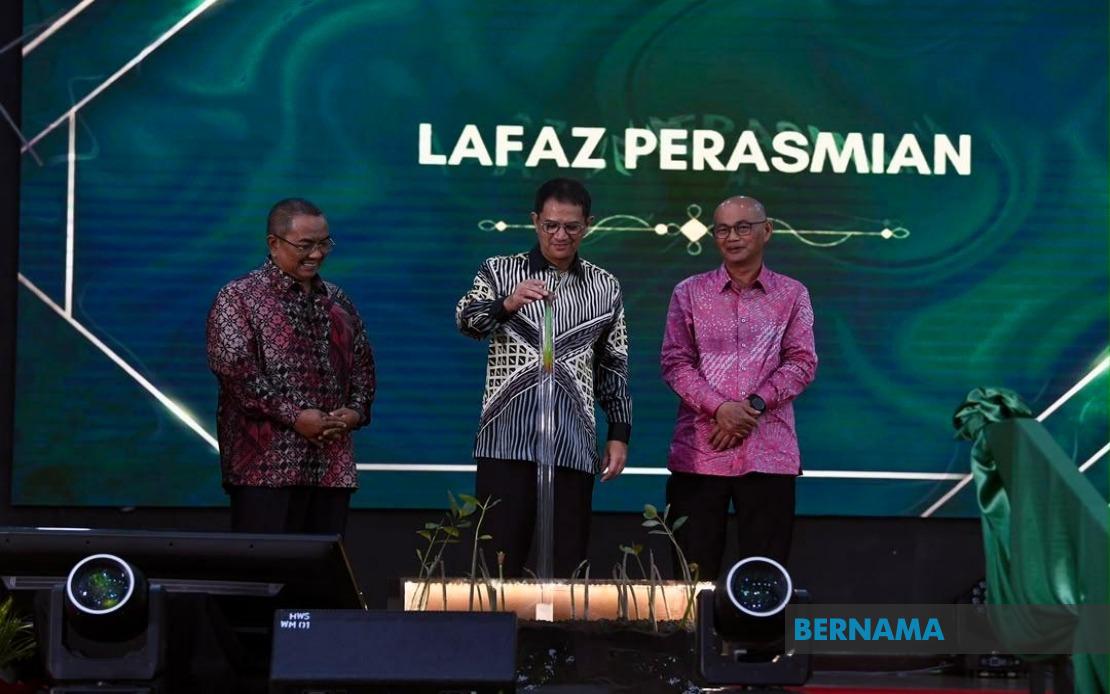
Malaysia has made substantial progress in rehabilitating its coastal mangrove ecosystems, with nearly 4,000 hectares of forest restored through an intensive tree-planting programme that has deployed over 9.3 million saplings across the country. The achievement underscores the government's determination to reverse decades of mangrove degradation whilst creating sustainable environmental benefits for Southeast Asia's coastal regions. The restoration work, acknowledged at a national-level celebration in Alor Setar, reflects a strategic pivot towards blue economy sustainability and climate resilience in an era when mangrove forests face mounting pressures from development and urbanisation.
Natural Resources and Environmental Sustainability Minister Datuk Seri Arthur Joseph Kurup disclosed that the government has invested RM71.3 million in the National Coastal Mangrove and Suitable Species Tree Planting Programme through 2025, channelling resources into planting operations, ongoing maintenance of restored sites, scientific research on mangrove ecology, environmental monitoring systems, and community education initiatives. This financial commitment positions Malaysia amongst countries taking mangrove conservation seriously, particularly as international attention focuses on the critical role these ecosystems play in carbon sequestration and climate change mitigation. The allocation demonstrates recognition that restoration requires not merely initial planting but sustained investment in monitoring and maintenance to ensure trees reach maturity and establish viable ecosystems.
Looking ahead, the government has further committed RM2 million under the 13th Malaysia Plan for 2026, extending conservation activities across Peninsular Malaysia, Sabah, and Sarawak. This three-pronged geographical approach acknowledges that mangrove challenges and solutions differ significantly across regions, from the densely populated coastal zones of the peninsula to the more biodiverse mangrove forests of East Malaysia. The allocation signals that mangrove conservation remains a cabinet-level priority rather than a peripheral environmental issue, with resources flowing across multiple years rather than through one-off funding cycles.
The restoration initiative represents a complex institutional collaboration, coordinating efforts between Forestry Peninsular Malaysia (JPSM), the Sabah Forestry Department, the Sarawak Forest Department, and the Forest Research Institute Malaysia (FRIM). This multi-agency framework reflects the reality that coastal ecosystem management cannot succeed through any single government body operating in isolation. By pooling technical expertise, field resources, and research capacity, participating agencies can address mangrove degradation more comprehensively than would be possible through fragmented efforts. The institutional architecture also facilitates knowledge transfer between peninsular and East Malaysian forestry specialists, building domestic capacity in mangrove science and management.
Non-governmental organisations and grassroots community groups constitute essential partners in the restoration framework, contributing through environmental education, public awareness campaigns, and direct ecosystem protection activities. The ceremony presented certificates of appreciation to four NGOs and community organisations for their conservation contributions, recognising that government agencies alone cannot achieve landscape-scale restoration without local stakeholder engagement. Community involvement generates ownership of restoration outcomes, increases volunteer capacity for planting and maintenance activities, and embeds environmental values within coastal populations who depend economically on mangrove ecosystem services.
The thematic framing of conservation efforts around blue economy sustainability signals a crucial reorientation in how Malaysia conceptualises mangrove value. Rather than viewing mangrove forests purely as environmental amenities, policy makers increasingly understand them as economic assets generating fishery productivity, coastal protection, carbon credits, and ecotourism potential. This economic framing can mobilise additional funding and political support, particularly in resource-constrained environments where environmental conservation alone may struggle for budgetary prioritisation. For Malaysian policymakers and Southeast Asian observers, the explicit connection between mangrove restoration and blue economy development offers a template for integrating conservation into broader development frameworks.
The National Mangrove and Coastal Ecosystem Seminar 2026, held alongside the celebration, featured twelve research papers, fifteen technical posters, and nine exhibition booths presenting mangrove management approaches and conservation innovations. This knowledge-exchange platform created space for researchers, technical officers, government specialists, and stakeholder representatives to discuss emerging challenges, share experimental results, and refine best practices across multiple mangrove management domains. Such professional forums strengthen the technical foundation underlying restoration work, ensuring that planting programmes incorporate the latest scientific understanding of mangrove ecology, species selection, and habitat restoration techniques.
Mangrove forests occupy a distinctive ecological niche within Malaysia's coastal geography, occupying the interface between terrestrial and marine environments whilst providing critical ecosystem services extending far beyond their geographic boundaries. These forests stabilise shorelines against erosion and storm surge, filter sediments and pollutants from runoff, provide nursery habitat for commercially important fish and crustacean species, and sequester atmospheric carbon in ways that rival tropical rainforests. The 3,965 hectares restored represents meaningful recovery, though context matters—this figure should be understood against the broader trajectory of mangrove loss across Southeast Asia over recent decades, during which conversion to aquaculture, urban development, and industrial infrastructure has eliminated vast areas of original mangrove cover.
Malaysia's mangrove restoration programme carries implications extending beyond national borders. The country's experience rehabilitating nearly 4,000 hectares offers lessons for neighbouring Southeast Asian nations confronting similar mangrove degradation challenges. As countries across the region grapple with balancing coastal development pressures against ecosystem conservation imperatives, Malaysian institutional approaches and restoration techniques merit regional attention and potential adaptation. The government's explicit allocation of research resources through FRIM and partner institutions positions Malaysia to generate and share mangrove science relevant to diverse tropical coastal contexts across the region.
The Kedah Raja Muda Tengku Sarafudin Badlishah Ibni Sultan Sallehuddin's official presence at the celebration signalled royal endorsement of mangrove conservation, elevating the initiative within state-level governance hierarchies and potentially catalysing additional Kedah-specific restoration commitments. Royal patronage of environmental initiatives carries particular significance in Malaysian governance contexts, translating conservation priorities into cultural imperatives that resonate beyond bureaucratic frameworks. This symbolic dimension reinforces mangrove protection as a matter transcending partisan politics, instead framing it as reflecting shared values of environmental stewardship and sustainable development.
For Malaysian readers and Southeast Asian observers, the restoration programme illustrates how sustained government investment, inter-agency coordination, community participation, and explicit linkage to economic development goals can achieve landscape-scale environmental rehabilitation. The achievement of nearly 4,000 hectares restored through 9.3 million trees planted represents tangible progress against degradation trends that dominated preceding decades. Sustaining this momentum beyond 2026 will require maintaining budgetary allocations, strengthening institutional coordination, deepening community engagement, and integrating mangrove conservation into broader coastal development planning. The seminar's knowledge-sharing approach suggests Malaysia is building the technical and intellectual infrastructure necessary for long-term mangrove ecosystem sustainability.

