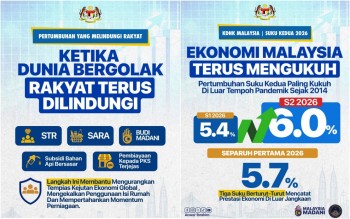
Malaysia's economy has demonstrated remarkable resilience with second-quarter gross domestic product expansion of six per cent, a result that has defied widespread economic pessimism gripping global markets. Prime Minister Datuk Seri Anwar Ibrahim announced the figure, which surpassed analyst predictions and represents the nation's most robust second-quarter showing in over a decade when measured outside the extraordinary pandemic period. The achievement arrives at a moment when most major economies worldwide are grappling with persistent challenges stemming from fractured international supply networks and geopolitical instability centred on West Asia, circumstances that typically constrain growth across the region.
The strength of Malaysia's economic performance becomes all the more significant when contextualised within the broader regional and international environment. While numerous trading partners have seen their growth trajectories flatten or contract in response to inflationary pressures and trade uncertainty, Malaysia has managed to expand output at a pace that suggests underlying structural health in key sectors of the economy. This accomplishment indicates that policymakers in Kuala Lumpur have successfully navigated the competing demands of maintaining economic momentum whilst shielding households from the worst excesses of global price escalation, a balancing act that has eluded many comparable nations.
Prime Minister Anwar attributed this encouraging outcome to deliberate government interventions aimed at protecting ordinary Malaysians from the economic fallout of international instability. The administration has deployed a range of targeted assistance programmes designed to cushion household finances against the inflationary tide that has swept across global markets. Among these initiatives are the BUDI MADANI scheme, which provides direct support to vulnerable populations, alongside the Sumbangan Tunai Rahmah and Sumbangan Asas Rahmah cash transfer programmes. Together, these mechanisms have functioned as economic shock absorbers, enabling consumers to maintain purchasing power and sustaining aggregate demand even as commodity costs and import prices have climbed.
Beyond the headline assistance programmes, the government has undertaken substantial behind-the-scenes efforts to stabilise the cost of essential goods and maintain adequate domestic supply chains. Price controls on critical commodities, strategic procurement arrangements, and coordination with producers have all played roles in preventing the kind of runaway inflation that might otherwise have dampened consumer confidence and constrained spending. By keeping a lid on expenses for food, fuel, and utilities, policymakers have effectively preserved real incomes for millions of households, allowing them to sustain their consumption patterns and thereby maintain the domestic demand that underpins economic expansion.
The achievement of six per cent quarterly growth carries particular significance for Malaysia's positioning within Southeast Asia's economic hierarchy. The region has become an increasingly important locus of global manufacturing and services activity, and nations capable of maintaining healthy expansion whilst others falter tend to attract augmented foreign investment and strengthen their competitive standing. Malaysia's ability to grow faster than many developed economies and hold ground against peer nations in the region underscores the underlying productivity improvements and sectoral diversification that have accumulated over recent years. This performance may well influence investor perceptions of the country's stability and growth prospects going forward.
However, Prime Minister Anwar was careful to temper expectations by emphasising that current expansion rates cannot be taken as guaranteed. He stressed that sustaining the growth momentum into subsequent quarters and beyond will require continued policy vigilance and structural reform. The government recognises that temporary support measures, whilst valuable for smoothing adjustment during crisis periods, cannot substitute for deeper economic transformations that enhance productive capacity and raise underlying competitiveness. The emphasis on reforms reflects a sophisticated understanding that Malaysia must build foundations capable of supporting improved living standards not merely through government expenditure, but through the creation of genuinely remunerative employment and expanded opportunities across the economy.
Particular attention must be given to the government's commitment to ensuring that economic gains are equitably distributed rather than concentrated among narrower segments of society. The MADANI Government has explicitly committed to mechanisms that enable broader participation in Malaysia's prosperity, recognising that sustained political stability and social cohesion depend upon tangible improvements in the circumstances of ordinary citizens. This includes targeted assistance for vulnerable households facing the greatest exposure to price pressures, alongside measures designed to expand job creation in sectors offering meaningful career progression and income growth rather than merely casual or low-wage employment.
The implications of Malaysia's strong second-quarter performance extend beyond domestic borders. A resilient Malaysian economy contributes to regional stability and creates opportunities for neighbouring economies through trade and investment linkages. Within ASEAN, Malaysia's growth trajectory influences regional growth dynamics, and stronger-than-expected performance in Southeast Asia's fourth-largest economy can provide psychological confidence to investors and policymakers across the bloc who have faced considerable uncertainty.
Looking ahead, the government faces the challenge of translating current momentum into sustainable long-term expansion. Policymakers must balance the maintenance of near-term growth with investments in human capital, technological advancement, and economic restructuring that will be essential for competing effectively in global markets increasingly shaped by digitalisation and energy transition imperatives. The strong second-quarter result provides a window of opportunity to pursue more ambitious reform agendas that might have faced resistance during periods of economic weakness.
The six per cent growth figure also reflects the resilience of Malaysia's export sectors, which continue to generate substantial foreign exchange earnings despite global trade slowdowns. Electronics, petroleum products, palm oil, and manufactured goods remain important sources of external demand, and their sustained performance suggests that Malaysian producers retain competitive advantages even in challenging international conditions. Supporting these sectors through infrastructure investment and innovation incentives represents a logical extension of the policies that have already delivered encouraging results.
Moving forward, the government's declared intention to remain committed to reform initiatives whilst maintaining support for vulnerable populations suggests a development philosophy that attempts to combine immediate welfare protections with longer-term productivity improvements. This dual-track approach, if executed effectively, could position Malaysia favourably for the economic transitions anticipated across the coming decade. The solid fundamentals evidenced by second-quarter growth provide the fiscal space and economic confidence necessary to pursue such ambitious goals.

